All You Need to Know About the New HSK 6
HSK 6 is the move from HSK 5 short-text competence to article-level Chinese: long listening, public topics, full Chinese articles, practical writing, and 300-character argument writing.
What Is the New HSK 6?
New HSK 6 is the highest single-level Chinese proficiency exam before HSK 7-9. Under the new HSK 3.0 syllabus, it requires 5,400 cumulative words, includes 1,800 new HSK 6 words, and tests whether you can handle advanced Chinese articles, long listening passages, public topics, and structured writing.
See and Hear the Real New HSK 6
The official sample paper shows what makes HSK 6 different: the listening passages are longer, the topics are public and abstract, and the writing section asks for both practical writing and a 300-character opinion essay. Use the clips below to hear the actual density before you plan your preparation.
Short news-style passage
This sample uses a current-affairs sports topic. The task is not casual conversation; it is compressed information with a main point and distractors.
Official-style HSK 6 sample listening clip, Part 1.
Long explanatory passage
This sample explains an education-related topic. You must hold several paragraphs in memory and answer multiple questions from one passage.
Official-style HSK 6 sample listening clip, Part 2.
Interview and discussion
This sample is an interview-style passage about literature, screen adaptation, local culture, and tourism. It tests detail, viewpoint, inference, and topic structure.
Official-style HSK 6 sample listening clip, Part 3.
For HSK 6, vocabulary alone is not enough. You need to follow long passages, remember key details, recognize the speaker's point, and answer under time pressure.
Who Actually Needs HSK 6?
HSK 6 is useful when you need proof of advanced Chinese ability, especially for Chinese-taught graduate programs, language-related degrees, advanced professional work, or personal fluency goals. But not every learner needs to rush from HSK 5 to HSK 6.
Take HSK 6 if...
- Your target university or program explicitly asks for HSK 6.
- You are applying for advanced Chinese-taught humanities, language, education, or social-science programs.
- You need a high-level Chinese certificate for professional credibility.
- You already read Chinese articles and want official proof of advanced ability.
- You can write at least 250-300 characters under time pressure.
HSK 5 may be enough if...
- Your target program accepts HSK 5.
- You need a certificate this application cycle.
- Long listening passages still feel overwhelming.
- You cannot yet write a structured 300-character opinion essay.
- You are still slow with general Chinese articles.
Before committing to HSK 6, check the exact requirement for your university, scholarship, employer, or visa purpose. Requirements vary by institution and program; start with our HSK requirements for Chinese universities guide if your goal is admission.
Work backwards from your deadline. We can compare your current level with your target program and help you choose the safer exam path.
HSK 5 vs HSK 6: The Real Gap
The main jump from HSK 5 to HSK 6 is not the number of topics. It is the depth of Chinese inside each topic. HSK 5 proves you can handle complex situations; HSK 6 asks whether you can process and produce article-level Chinese.
| Dimension | HSK 5 | HSK 6 |
|---|---|---|
| Cumulative vocabulary | 3,600 words | 5,400 words |
| New words at the level | 1,600 | 1,800 |
| Official topic map | 72 specific topics | 68 specific topics |
| Writing level | Short texts and structured compositions | Practical writing plus full opinion essay |
| Listening | Complex daily, study, work, and social topics | News, interviews, reports, public affairs, culture, and abstract topics |
| Reading | Short and medium texts | Full articles, explanations, and longer passages |
| Main challenge | Moving beyond sentence-level Chinese | Handling dense, long, abstract Chinese |
New HSK 6 Test Format
The new HSK 6 written exam has 82 questions and lasts about 125 minutes, including personal information and answer-sheet time. The exam has listening, reading, and writing sections. For scheduling, see our 2026 HSK test dates page and confirm registration details at chinesetest.cn.
| Section | Parts | Questions | Time | What it tests |
|---|---|---|---|---|
| Listening | 3 | 40 | about 30 min | Main idea, detail, inference, viewpoint, long-passage memory |
| Reading | 3 | 40 | 40 min | Vocabulary in context, sentence logic, long article comprehension |
| Writing | 2 | 2 | 45 min | Practical writing and opinion writing |
| Total | 8 | 82 | about 125 min | Advanced integrated Chinese ability |
Listening
Part 1 has 8 questions, Part 2 has 20 questions, and Part 3 has 12 questions. The sample paper shows news-style passages, explanatory texts, and interviews.
Reading
Reading has 40 questions in 40 minutes. The later passages are long enough that slow word-by-word reading becomes risky.
Writing
Writing has two tasks in 45 minutes: a practical writing task of at least 150 characters and an opinion essay of at least 300 characters.
HSK 6 Vocabulary: 1,800 New Words, 5,400 Total
The official HSK 6 vocabulary list covers words 3601-5400 in the new syllabus. That means HSK 6 adds 1,800 new words after HSK 5 and brings the cumulative total to 5,400 words.
For self-study and review, use the HSK 6 vocabulary Excel with 3 free quiz sheets to sort, filter, and test the new words instead of memorizing them in one long list.
Do not study alphabetically
At HSK 6, alphabetical or pinyin-order memorization is inefficient. Group vocabulary by topic, usage, collocation, and register.
Build article vocabulary
HSK 6 words often appear in news, education, culture, economy, society, science, environment, and public-affairs passages.
Track production
Separate words you can recognize from words you can actually use in writing. HSK 6 writing rewards controlled, accurate usage.
Useful vocabulary clusters include public affairs, academic study, economic phenomena, enterprise management, technology products, environmental issues, literature and art, sports events, Chinese tradition, and historical culture.
HSK 6 Characters: 413 to Recognize, 150 to Handwrite
The new HSK 6 syllabus lists 413 recognition characters and 150 handwriting characters. You do not need to handwrite every recognition character, but you must be able to recognize them quickly in reading and use key characters accurately in writing.
Recognition characters
Learn these for reading speed. Use component awareness, repeated article exposure, and flashcard review to turn character recognition into fast visual processing.
Handwriting characters
Drill the 150 handwriting characters separately. Paper-based test candidates need more handwriting stamina; computer-based candidates still need accurate written production.
HSK 6 Topics and Tasks
The new HSK 6 syllabus defines 24 communicative tasks and a topic map of 7 main topics, 25 subtopics, and 68 specific topics. This is one of the best tools for planning your preparation.
Daily life
Services, help-seeking, food, travel, health, community life.
Education
Courses, teaching, learners, campus life, education events and ideas.
Work life
Work content, career positioning, management, enterprise development.
Nature and environment
Geography, climate, natural resources, disasters, energy, infrastructure.
Science and technology
Technology products, information technology, scientific knowledge, research results.
Contemporary society
Economic phenomena, social issues, trends, public welfare, news events.
Culture and tradition
Language, idioms, poetry, festivals, traditions, history, ancient science.
Communication output
Discuss, explain, report, introduce, evaluate, and write about complex topics.
HSK 6 Topic Readiness Check
Tick a topic only if you can understand a listening passage, discuss it, read an article, and write a short opinion or explanation about it in Chinese.
HSK 6 Grammar and Written Style
HSK 6 grammar is less about one isolated sentence pattern and more about article-level logic. You need to connect ideas, qualify opinions, explain causes, contrast viewpoints, and organize discourse clearly.
Formal word-building and register
超-反-无-准--化-式-型-性
These patterns help you understand formal vocabulary in news, explanations, and opinion writing.
Argument logic
除非...才除非...否则就算...也...以便...
At HSK 6, grammar is a tool for building coherent arguments, not just producing correct sentences.
HSK 6 Writing: Practical Writing and 300-Character Arguments
The HSK 6 writing section has two tasks in 45 minutes: one practical writing task of at least 150 characters and one opinion essay of at least 300 characters.
Task 1: practical writing
The official sample asks candidates to write an online roommate-search post for a shared apartment, including requirements and room information. This tests task completion, clarity, audience awareness, and practical written Chinese.
Useful structure: purpose -> key information -> requirements/details -> contact/action -> polite closing.
Task 2: opinion essay
The official sample asks for an opinion on technology and human development. This tests whether you can state a position, give reasons, use examples, and conclude in formal Chinese.
Useful structure: position -> reason -> example -> second reason -> qualification -> conclusion.
Free writing framework: start with the two safest structures
Use our HSK 6 Writing Framework to plan both writing tasks: the 150-character practical writing task and the 300-character opinion essay. It includes reusable Chinese sentence frames, a model essay on the official-style technology prompt, and teacher comments.
PDF resource: HSK 6 practical writing and opinion essay framework.
A 300-character essay can look fluent but still lose points for weak structure, register problems, vague examples, or unnatural word choice.
How Long Does It Take to Prepare for HSK 6?
Most learners moving from HSK 5 to HSK 6 should plan for 8-12 months of focused preparation. Very strong HSK 5 learners may be ready in 4-6 months. Learners who passed HSK 5 narrowly or have weak writing and listening may need 12-18 months.
| Starting point | Realistic timeline | Main work |
|---|---|---|
| Strong HSK 5, already reads Chinese articles | 4-6 months | Timed practice, writing feedback, mock tests |
| Solid HSK 5, weak long listening or writing | 8-12 months | Vocabulary, topic input, essays, listening stamina |
| Borderline HSK 5 pass | 12-18 months | Rebuild HSK 5 base, then move into HSK 6 topics and writing |
| No HSK 5 certificate yet | Take HSK 5 first unless HSK 6 is required | Build HSK 5 foundation before HSK 6 |
HSK 6 Preparation Roadmap
The most reliable HSK 6 preparation plan starts with diagnosis, then builds topic vocabulary, long-input stamina, writing production, and mock-test strategy.
Diagnostic and gap mapping: 2-4 weeks
Take a listening and reading diagnostic, write one 300-character essay, check vocabulary coverage, and identify weak topic domains.
Vocabulary and topic input: 2-3 months
Study the 1,800 new words by topic. Read Chinese articles weekly and listen to news, interviews, and explainers connected to the official topic map.
Reading and listening stamina: 2-3 months
Practice timed long reading, listen without transcripts first, summarize passages in Chinese, and train main-idea and inference extraction.
Writing production: 2-3 months
Write one 150-character practical text and one 300-character opinion essay every week. Get corrections and rewrite after feedback.
Mock tests and score strategy: final 4-6 weeks
Do full mock exams, review timing, maintain an error log, refine writing templates, and practice speaking if your registration requires it.
Mandarin Zone's HSK 6 preparation can combine topic vocabulary, long listening, article reading, weekly writing correction, and mock-test review.
Does HSK 6 Include a Speaking Test?
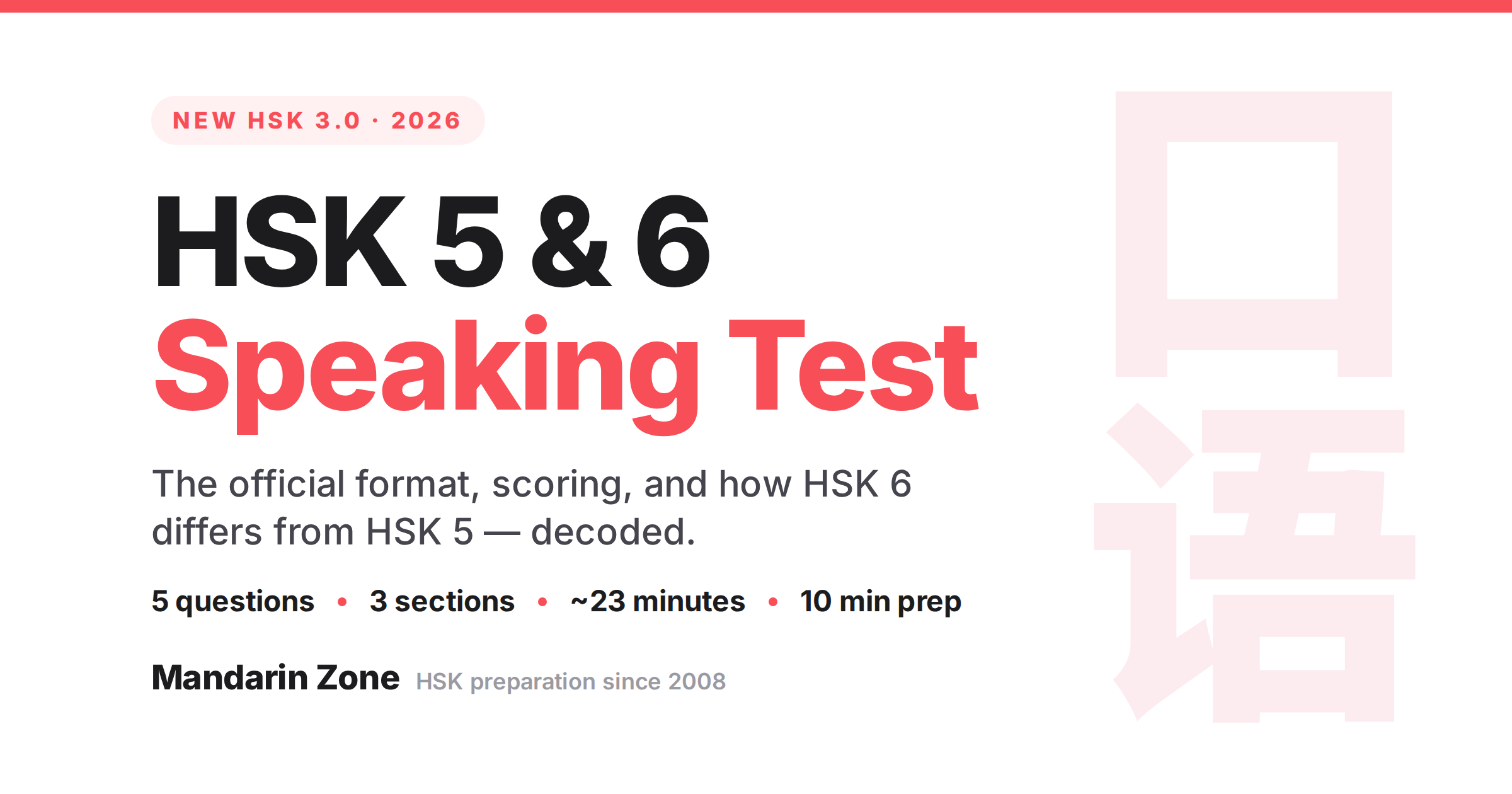
The official HSK 6 speaking sample has 5 questions in about 23 minutes, including 10 minutes of preparation time. Confirm the registration requirement at your test center, because policies can depend on the exam rollout and local registration system.
Part 1
Listen and retell. Two questions, about 1.5 minutes each.
Part 2
Speak from a picture. One question, about 2 minutes.
Part 3
Answer opinion questions. Two questions, about 2.5 minutes each.
The sample questions are abstract and personal, such as comparing your generation with your parents' generation or explaining whether investing in yourself is the best investment.
For level-specific format and preparation advice, see our HSK 5-6 speaking test guide. For a broader overview of the spoken exam system, see the HSK Speaking / HSKK guide.
Should You Take HSK 5 First or Go Straight to HSK 6?
For most learners, HSK 5 first is the safer path unless a target university, scholarship, employer, or program specifically requires HSK 6.
Go straight to HSK 6 if...
- Your target program requires HSK 6.
- You already read Chinese news or essays comfortably.
- You can write 250-300 characters under time pressure.
- You can understand long spoken Chinese without replay.
- Your HSK 5 level is clearly above passing.
Take HSK 5 first if...
- You need a certificate soon.
- Long reading passages are still slow.
- You struggle to write organized essays.
- Listening passages feel dense.
- Your vocabulary beyond HSK 5 is limited.
Compare your current Chinese against real HSK 5 and HSK 6 writing/listening tasks, then choose the exam that matches your deadline.
New HSK 6 FAQ
How many words are in the new HSK 6?
The new HSK 6 requires 5,400 cumulative words, including 1,800 new HSK 6 words after HSK 5. In the official syllabus, the HSK 6 vocabulary range is 3601-5400.
How many questions are on the new HSK 6?
The new HSK 6 written exam has 82 questions: 40 listening questions, 40 reading questions, and 2 writing tasks.
How long is the new HSK 6 test?
The written exam lasts about 125 minutes, including time for personal information and the answer sheet. Listening is about 30 minutes, reading is 40 minutes, and writing is 45 minutes.
How hard is HSK 6 compared with HSK 5?
HSK 6 is harder because it moves into article-level Chinese. The biggest challenges are long listening passages, full articles, abstract public topics, and a 300-character opinion essay.
How long does it take to prepare for HSK 6 from HSK 5?
Most learners should plan for 8-12 months. Very strong HSK 5 learners who already read Chinese articles may need 4-6 months, while borderline HSK 5 learners may need 12-18 months.
Does HSK 6 require handwriting?
The syllabus lists 150 HSK 6 handwriting characters and 413 recognition characters. Handwriting demands depend partly on paper-based versus computer-based testing, but writing practice remains important for HSK 6 preparation.
Is HSK 6 required for Chinese universities?
Some Chinese-taught programs require HSK 6, especially advanced humanities, language, literature, education, and graduate-level programs. Many programs accept HSK 5, so always check the target university's current admission page.
Is there a speaking test for HSK 6?
The official HSK 6 speaking sample has 5 questions and lasts about 23 minutes including preparation time. Confirm whether your written HSK 6 registration must be paired with speaking at your test center.
Can I prepare with old HSK 6 materials?
Old HSK 6 materials can still help with advanced Chinese practice, but they do not fully reflect the new HSK 3.0 vocabulary list, topic map, task descriptions, or sample-paper format.
What is the hardest part of HSK 6?
For most learners, the hardest parts are long listening passages and 300-character opinion writing. Both require stamina, structure, and topic knowledge, not just vocabulary memorization.
HSK 6 Resources and Next Steps
Mandarin Zone can help you build a realistic preparation plan around your current level, your writing ability, and your deadline.