HSK 2 (汉语水平考试二级) is the second level of the HSK — the official Chinese Proficiency Test. It is the level where Chinese stops being a pile of separate words and starts becoming a language you can actually use for everyday situations. It is also the first HSK level that asks you to write Chinese characters by hand. This guide is fully updated for the new HSK 3.0 syllabus taking effect on July 1, 2026.
|
📘 Source
Official 2025 HSK syllabus
Published Nov 2025 by CLEC
|
🎓 Author
Mandarin Zone School
Beijing · Since 2008 · 5,000+ HSK students
|
✅ Pass rate
90% across all HSK levels
Learners from 40+ countries
|
HSK 2 in 30 seconds — the three things every learner asks
|
📗 What is it?
The second of 9 HSK levels — proof you've reached upper-beginner (CEFR A2) Mandarin. You can take it without HSK 1 first.
|
🆕 What changed for 2026?
Vocabulary doubled (300 → 600), and HSK 2 now has a writing section — your first handwriting on an HSK exam.
|
✍️ Is the writing hard?
Manageable. It tests only 100 common characters (shared with HSK 1), the pinyin is given, and Part 1 hands you hints.
|
The bottom line: HSK 2 is still a beginner-band exam — but it's the one where Chinese gets real, and where handwriting begins. Full breakdown below.
📑 In this guide
1. What Is HSK 2?
HSK 2 is the second level of the nine-level HSK 3.0 system, the official Chinese Proficiency Test administered by the Center for Language Education and Cooperation (中外语言交流合作中心) under China's Ministry of Education. Passing HSK 2 means you can handle simple, routine exchanges in Chinese — and that you've taken your first steps in handwriting Chinese characters.
| Advanced (高等) · HSK 7–9 · CEFR C1–C2 · Single combined exam |
| Intermediate (中等) · HSK 6 · CEFR C1+ |
| Intermediate (中等) · HSK 5 · CEFR C1 |
| Intermediate (中等) · HSK 4 · CEFR B2 |
| Beginner (初等) · HSK 3 · CEFR B1 |
| ⭐ HSK 2 — Beginner (初等) · CEFR A2 · You are here |
| Beginner (初等) · HSK 1 · CEFR A1 |
What HSK 2 means in practical terms
HSK 2 sits at the "Waystage" level (CEFR A2). You're no longer producing single words and set phrases — you're stringing simple sentences together to deal with familiar, everyday situations. Here is what that looks like in the four skills:
|
🗣️
You can speak about
Everyday situations — shopping and prices, ordering food, directions, simple plans; describing and comparing people and things
|
👂
You can understand
Short, slow, clear conversations on familiar topics — family, study, work, travel, health, leisure
|
|
📖
You can read
Short notes, messages and simple texts. Pinyin is still printed above the characters on the HSK 2 test
|
✍️
You can write NEW
Handwrite about 100 of the most common Chinese characters — the brand-new HSK 2 writing section
|
Who takes HSK 2 — and do you need HSK 1 first?
|
📗 HSK 1 graduates
The natural next milestone after passing HSK 1 — about another semester of study
|
🧒 School & young learners
A widely used benchmark in school Mandarin programs and for course completion
|
📚 ~1-year learners
Anyone with roughly a year of study (or a year of college Chinese) testing in directly at their level
|
📌 What "HSK 3.0" means. "HSK 3.0" is the informal name for the new HSK system, finalized and published in November 2025 with mandatory rollout from July 1, 2026. It expands the HSK from 6 levels to 9 levels and rebuilds the test around real-life communication. For HSK 2, the two headline changes are simple: the vocabulary doubled, and a writing section was added.
2. What's New in HSK 2 (2026)?
If you're studying with an older HSK 2 textbook (the 150-word version standard since 2010), here is exactly what has changed under the new HSK 3.0 syllabus. The biggest one is structural — HSK 2 is no longer a listening-and-reading-only exam.
| Feature | Old HSK 2 (HSK 2.0) | New HSK 2 (HSK 3.0) | Change |
|---|---|---|---|
| Test sections | Listening + Reading | Listening + Reading + Writing | ✍️ Writing added |
| Vocabulary (new at level) | 150 words | 300 words | ↑ +100% |
| Cumulative vocabulary | 300 | 600 | ↑ +100% |
| Recognition characters (认读字) | not defined | 125 new · 371 cumulative | Now listed |
| Handwriting characters (书写字) | not defined | 100 (HSK 1–2 shared) | Now listed & tested |
| Communicative tasks | broad descriptions | 17 specific tasks | Now standardized |
| Topics | unstructured | 5 / 18 / 34 hierarchy | Now structured |
| Questions / time | 60 / ~55 min | 60 / ~60 min | Similar |
| Question formats | included True/False | True/False replaced | Refreshed |
So the new HSK 2 keeps the same 60-question / ~60-minute footprint — but it now spans three sections, not two, and tests roughly twice the vocabulary. The two changes that matter most:
|
✍️ BIGGEST CHANGE
A writing section was added
The old HSK 2 had no writing at all. The new HSK 2 has a 10-question handwriting section — making HSK 2 the level where writing Chinese begins. Full details in Section 5.
|
📈 DOUBLED
600 cumulative words
From 300 to 600 cumulative — the same proportional jump every HSK level sees under HSK 3.0. HSK 2 now tests HSK 1's words plus 300 new ones.
|
Why the New HSK 2 Is a Better Test (Not Just a Bigger One)
More words and an extra section make the new HSK 2 sound harder. But look at what changed: the redesign makes HSK 2 a more honest measure of whether you can actually use Chinese.
|
🎯
It tests real communication, not trivia
The syllabus is built around 17 everyday tasks — comparing prices, talking about your family, describing how you got somewhere. Every word is tied to something you'd really say.
→ Passing HSK 2 means you can handle daily life, not just pass a quiz. |
✍️
Handwriting starts — but gently
HSK 2 introduces handwriting with just 100 high-frequency characters, shared with HSK 1. It's a deliberate, manageable on-ramp before the heavier writing at HSK 3+.
→ You build a real skill early, in small steps. |
|
📱
The vocabulary matches modern life
The 600-word list reflects how people actually live today — transport, sports, leisure, feelings, comparing and describing things.
→ You learn Chinese you can use the week you learn it. |
🧭
Nothing on the test is a secret
The syllabus spells out the exact 600 words, 371 characters, 100 writing characters, 17 tasks, 34 topics and grammar points.
→ Your study list is finite, public and checkable. |
The new HSK 2 asks for about twice the vocabulary and adds a writing section — so yes, it's a step up. But it's still a beginner-band exam: recordings are played twice, pinyin is printed above every reading passage, and the writing section covers only 100 common characters with the pronunciation supplied. A learner who's solid at HSK 1 can reach HSK 2 in a few months of steady study.
3. HSK 2 Vocabulary: 600 Words
The new HSK 2 syllabus adds 300 new words at this level. Because HSK 2 builds on HSK 1, your cumulative total is 600 words — HSK 1's 300 plus the 300 new ones. This is the first thing that changes from HSK 1: the test is cumulative, so HSK 1 vocabulary is fair game too.
| Cumulative vocabulary by level (HSK 3.0) | ||
| HSK 1 | 300 | |
| ⭐ HSK 2 | 600 | |
| HSK 3 | 1,000 | |
| HSK 4 | 2,000 | |
| HSK 5–6 | 5,400 | |
| HSK 7–9 | 11,000 | |
What kind of words are new at HSK 2?
HSK 1 gave you the survival core. HSK 2's 300 new words let you describe, compare and explain — colours, sports, feelings, travel, and the small words that join ideas together. Here is a sample by topic area:
|
👤 People & description
爱好 àihào · 身体 shēntǐ · 眼睛 yǎnjing · 长 cháng · 高 gāo · 白色 báisè · 红 hóng · 黑 hēi · 一样 yíyàng · 漂亮 piàoliang
|
🛒 Daily life & travel
车站 chēzhàn · 公共汽车 gōnggòng qìchē · 票 piào · 路 lù · 旅游 lǚyóu · 房间 fángjiān · 件 jiàn · 条 tiáo · 张 zhāng
|
|
⚽ Activities & feelings
踢足球 tī zúqiú · 打篮球 dǎ lánqiú · 跑步 pǎobù · 游泳 yóuyǒng · 跳舞 tiàowǔ · 累 lèi · 快乐 kuàilè · 希望 xīwàng
|
💬 Verbs you'll use daily
介绍 jièshào · 帮助 bāngzhù · 觉得 juéde · 知道 zhīdào · 告诉 gàosu · 让 ràng · 开始 kāishǐ · 准备 zhǔnbèi
|
|
🔗 Connectors & "level-up" words — the real multiplier
因为 yīnwèi · 所以 suǒyǐ · 但是 dànshì · 虽然 suīrán · 还是 háishi · 比 bǐ · 一起 yìqǐ · 已经 yǐjīng · 别 bié · 真 zhēn · 最 zuì
These are only a handful of words, but each one unlocks a whole sentence pattern — comparing, giving reasons, contrasting. Learn them first.
|
|
|
🎁 Free download · Complete HSK 2 word list (2026)
All HSK 2 words · pinyin, English, part of speech & example sentences
|
Get the word list → |
4. HSK 2 Characters: Recognize 371, Write 100
The HSK 3.0 syllabus splits Chinese characters into two jobs — characters you must recognize (认读字, read on sight) and characters you must handwrite (书写字, write from memory). HSK 2 is the level where the second job begins.
|
认读字 · Recognition
371 characters (125 new)
Read and understand on sight. HSK 2 adds 125 new recognition characters to HSK 1's 246, for a cumulative 371.
|
书写字 · Handwriting
100 characters — and now tested
HSK 1 and HSK 2 share one combined 100-character handwriting list. At HSK 2, the writing section tests them for real.
|
The official syllabus (p.374) gives one shared list titled "HSK 1–2 handwriting characters" — 100 characters total, not 100 per level. So there is no separate "HSK 2 handwriting list." If you already practised these 100 characters during HSK 1 prep (we recommended it, even though HSK 1 didn't test them), your entire HSK 2 handwriting requirement is already covered — you just need to keep it sharp.
What kind of characters are these?
The 100 handwriting characters are the highest-frequency characters in the language — the building blocks of thousands of words. Many are just a few strokes:
|
🔢 Numbers & basics
一 二 三 大 小 人 口
|
👪 People & pronouns
我 你 他 她 爸 家
|
✅ Everyday words
是 好 不 有 工 中 国
|
5. ⭐ The New HSK 2 Writing Section
This is the single biggest change at HSK 2 — and the part new test-takers worry about most. So let's be precise about what it actually is. The writing section (书写) is 10 questions, in 2 parts, worth about 10 minutes of the test. It tests handwriting of the 100 shared HSK 1–2 characters — nothing beyond that list.
| Part | Items | What you do |
|---|---|---|
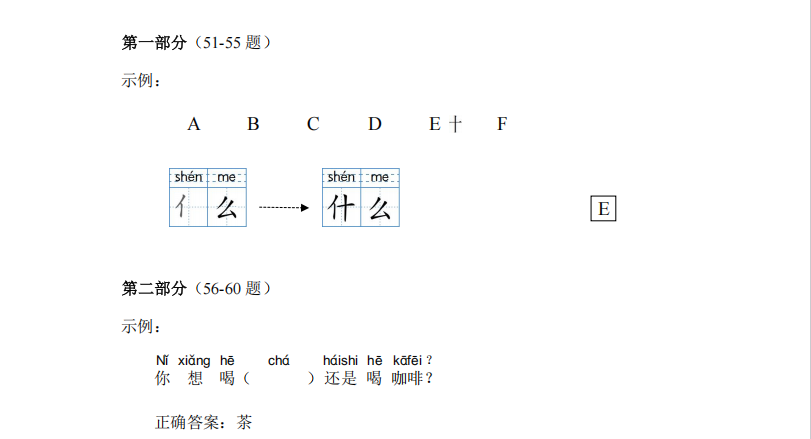
| Part 1 (items 51–55) | 5 | Complete the character. You're shown a word with one character missing a component, plus the pinyin. You write in the missing part to form the correct character. Example: 亻 + 么, add 十 → 什么 (shénme). |
| Part 2 (items 56–60) | 5 | Write the missing character. A sentence has a blank with the pinyin written above it. You handwrite the correct character. Example: 你想喝(chá)还是喝咖啡?→ write 茶. |
Why it's more manageable than it sounds
|
💯
Only 100 characters
The whole section draws on one fixed, public list of 100 high-frequency characters — and they're shared with HSK 1.
|
🔤
The pinyin is given
You're always told the pronunciation. You're never asked to recall a character from meaning alone.
|
🧩
Part 1 gives you hints
In Part 1 most of the character is already printed — you only add the missing piece, not the whole thing.
|
6. HSK 2 Grammar: The Step Up From HSK 1
HSK 1 grammar was about building single, simple sentences. HSK 2 grammar is about joining ideas and adding detail — comparing, giving reasons, describing how and how well. Here are the six groups of grammar that are new at HSK 2, each with an example.
|
GROUP 1 · ★ most important
Comparing things (比较句)
• A 比 B + adjective: 他比我高。— "He's taller than me."
• A 跟 B 一样: 这个跟那个一样。 • A 有/没有 B (那么): 我没有他那么忙。 |
GROUP 2
Joining ideas (复句)
• 因为…,所以… — reason: 因为下雨,所以我没去。
• 虽然…,但是… — contrast: 虽然很累,但是很高兴。 • (是)…还是… — choice · 一…就… — "as soon as" |
|
GROUP 3
Verb & adjective reduplication
• Verb: 看看 / 听一听 — "have a (quick) look/listen"
• Adjective: 高高兴兴 — adds vividness • Softens a request, makes speech sound natural. |
GROUP 4
Two new "tenses": 着 & 过
• 着 — ongoing state: 门开着。— "The door is open."
• 过 — experience: 我去过中国。— "I've been to China." • Joins HSK 1's 了 to describe time properly. |
|
GROUP 5
Complements — saying how & how well
• Result: 我听懂了 / 写完了 / 做错了
• Direction: 他出来了 / 回去了 • State: 他说得很好。— "He speaks very well." |
GROUP 6
More connectors & particles
• 给 / 跟: 我给你打电话 / 跟朋友一起去
• 别 — "don't": 别走。 • 已经…了 · 一起 · 最 — time, togetherness, "the most" |
7. What HSK 2 Covers: 17 Tasks & 34 Topics
The new HSK 3.0 syllabus describes HSK 2 as 17 communicative tasks — concrete things you can do in Chinese — mapped onto a 5 / 18 / 34 topic hierarchy. Note one quiet but important detail: unlike HSK 1, every HSK 2 task now includes a writing sub-skill ("can fill in / can write…"). That's the syllabus itself confirming that handwriting begins at HSK 2.
The 17 HSK 2 communicative tasks
| # | Task (中文) | What you can do |
|---|---|---|
| 1 | 问答个人基本情况 | Personal details — appearance, clothing, birthday, habits, hobbies, origin |
| 2 | 问答事件情况 | Events — people, time, manner, place, reason, change |
| 3 | 问答物品情况 | Objects — name, colour, quantity, position, differences |
| 4 | 介绍天气基本情况 | Weather — good/bad, sunny/cloudy, how comfortable it feels |
| 5 | 介绍某个地方 | Places — a school, a new home, a station; distance and location |
| 6 | 日常言语交往 | Social interaction — greetings, blessings, thanks, apology, requests, suggestions |
| 7 | 问答日常饮食 | Food — eating habits, dining, restaurants, reviews, cooking |
| 8 | 问答出行情况 | Travel — asking & giving directions, plans, tickets, transport, how it felt |
| 9 | 问答商品情况 | Shopping — product info, price, comparing items, reviews, buying |
| 10 | 问答生病、探病 | Illness — symptoms, seeing a doctor, medicine, comfort & advice |
| 11 | 交流休闲活动 | Leisure — travel, internet, dancing, running, ball sports |
| 12 | 介绍家庭日常生活 | Family life — members, birthdays, habits, household chores |
| 13 | 介绍学习情况、学习经历 | Study — schedule, progress, methods, exams, school, your study history |
| 14 | 交流学校情况、课后活动 | School & after-class activities — environment, classmates, activities |
| 15 | 交流工作情况 | Work — where you work, environment, hours, how you feel about it |
| 16 | 介绍过年及传统饮食 | Spring Festival — when it is, festive food, "过年好", dumplings |
| 17 | 使用中文称谓语 | Chinese forms of address — 王先生, 张老师, 张爷爷 and similar |
The HSK 2 topic map (5 / 18 / 34)
Everything you talk about at HSK 2 fits into 5 broad areas, split into 18 sub-areas and 34 specific topics — an expanded version of HSK 1's 5 / 15 / 30 map.
| ||
| ||
| ||
| ||
|
8. HSK 2 Test Format & Sample Questions (2026)
The new HSK 2 has three sections — Listening, Reading and Writing — and 60 questions total in about 60 minutes.
|
Section I
📻 Listening 听力
25 questions · 3 parts
~17 minutes Recordings played twice |
Section II
📖 Reading 阅读
25 questions · 4 parts
25 minutes Pinyin above every sentence |
Section III
✍️ Writing 书写
10 questions · 2 parts
10 minutes Handwriting — pinyin supplied |
Total: 60 questions · ~60 minutes (including time to fill in personal details and the answer sheet)
What each of the 9 parts looks like
| Section | Part | What you do (from the official samples) |
|---|---|---|
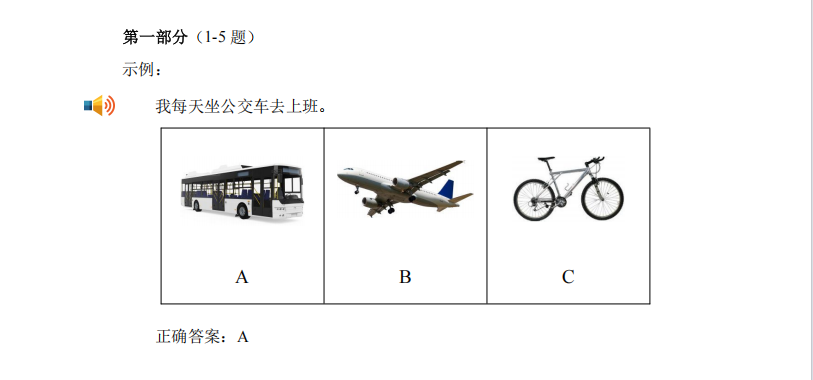
| 📻 Listening 3 parts · 25 Q · ~17 min | Part 1 (1–5) | Hear a sentence → choose the matching picture from 3 (A/B/C). |
| Part 2 (6–15) | Hear a short dialogue → choose the matching picture from 6 (A–F). | |
| Part 3 (16–25) | Hear a dialogue + a question → choose the answer from 3 written options. | |
| 📖 Reading 4 parts · 25 Q · 25 min | Part 1 (26–30) | Read a sentence → choose the matching picture from 6 (A–F). |
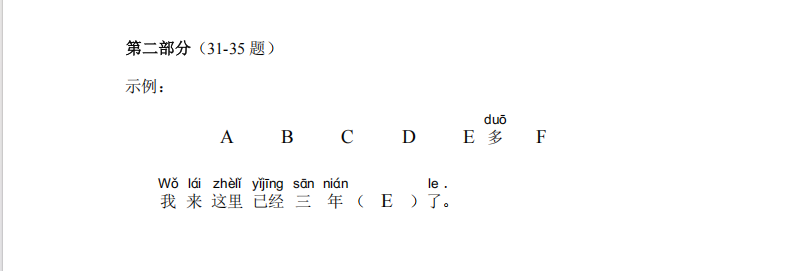
| Part 2 (31–35) | Fill in the blank — choose the missing word from 6 options (A–F). | |
| Part 3 (36–45) | Sentence matching — pair each sentence with its natural partner, from 6 options. | |
| Part 4 (46–50) | Read a short statement + one question → choose the answer from 3 options. | |
| ✍️ Writing 2 parts · 10 Q · 10 min | Part 1 (51–55) | Complete the character — write the missing component (pinyin given). |
| Part 2 (56–60) | Write the missing character in a sentence (pinyin given). |
See & hear real HSK 2 questions
Below are sample questions reproduced from the official 《新版HSK(1-6级)考试结构与样题示例》document — including the real exam audio.
Question: 女的要写什么? (What does the woman need to write?)
Written options: A 姓名 ✓ · B 时间 · C 问题
9. Scoring, Difficulty & How Long It Takes
How HSK 2 is scored
An honest note on the pass mark. As of early 2026, Chinese Testing International had not yet published the official scoring details for the new HSK 2. Under the previous syllabus, HSK 2 was scored out of 200 points with 120 (60%) to pass. Because the new HSK 2 adds a third (writing) section, the scale may change — confirm the current numbers at chinesetest.cn closer to your test date. Whatever the exact figure, aim for about 70%+ in practice tests for a comfortable margin.
How hard is HSK 2, really?
HSK 2 is a clear step up from HSK 1 — twice the vocabulary, real grammar, and a new writing section — but it is still a beginner-band exam, with the same supports:
|
🔁
Audio played twice
|
🔤
Pinyin above all reading
|
🚫🗣️
No speaking section
|
The two things that genuinely make HSK 2 harder than HSK 1: it is cumulative (a weak HSK 1 base shows), and it adds handwriting (a motor skill you must practise early, not cram).
How long does it take to prepare?
| Starting point | Typical timeline to HSK 2 | Notes |
|---|---|---|
| Solid HSK 1 level | 3–5 months | The most common path — 300 new words, HSK 2 grammar, and handwriting practice. |
| From zero (straight to HSK 2) | 8–14 months | Covering HSK 1 + HSK 2 content together; pace depends on study intensity. |
| Intensive / immersion | 2–3 months | Full-time study; works only if you can give it weekday hours. |
Speakers of languages that use Chinese characters (Japanese, Korean) often move faster on recognition and handwriting. Most other learners need the full timeline above.
10. What HSK 2 Is Actually Worth
An honest framing: HSK 2 is still a foundation level, not a career or university credential. University admission and work visas need HSK 4 and above. But for a learner in their first year or two, HSK 2 delivers four things that genuinely matter:
|
🎯
Proof you've left "absolute beginner"
HSK 2 certifies CEFR A2 — you can handle simple, routine exchanges. It's a real, measurable jump from HSK 1.
|
💬
Genuinely useful daily Chinese
Enough to travel, shop, order food, ask directions, and have simple conversations on familiar topics.
|
|
✍️
Your first real handwriting
The 100-character writing base you build here is what makes the heavier writing at HSK 3+ reachable.
|
🪜
The bridge to HSK 3
HSK 3 is the first credential-grade level. The grammar and characters you master at HSK 2 make it far easier to reach.
|
Worth knowing: the HSK 2 certificate is permanently valid — it never expires. HSK 2 also has no speaking test — the separate spoken exam (HSKK / HSK Speaking) is optional and only becomes mandatory from HSK 3 onward. And remember: you can go straight from HSK 2 to HSK 3 — or skip levels entirely — based on your ability.
11. Your HSK 2 Study Plan
This is the four-phase order Mandarin Zone School uses for HSK 2 — designed for a learner who's solid at HSK 1. The key difference from an HSK 1 plan: a handwriting track that runs from day one, because it can't be crammed.
| 1 |
Refresh HSK 1 + start handwriting · ~2 weeks Review HSK 1 vocabulary and grammar (HSK 2 is cumulative). Begin the 100 must-write characters — 10–15 min of pen-and-paper practice daily, every day from here on. |
| 2 |
Core vocabulary + the 17 tasks · ~6–8 weeks Learn the 300 new words in topic clusters, each in a full sentence. Practise the 17 tasks out loud. Keep the daily handwriting going. |
| 3 |
The grammar step-up · ~3–4 weeks Work through the six HSK 2 grammar groups — comparison, 着/过, complements, complex sentences. Drill listening and reading on the official format. |
| 4 |
Mock tests — all 3 sections · ~2–3 weeks Full timed mocks including the writing section. Goal: finish inside 60 minutes and score 80%+. Don't skip the writing part in practice. |
|
🎓 Want a guided path to HSK 2?
Mandarin Zone's HSK 2 track includes structured handwriting coaching, weekly mock tests, and native teachers — online or in Beijing.
|
See HSK courses → |
12. HSK 2 Test Day: Practical Guide
Registering for the exam
|
🌐 Where to register
Online at chinesetest.cn, the official Chinese Testing International portal. Check dates on our 2026 HSK test dates page.
|
💰 Test fee
Roughly USD 30–40 for HSK 2, varying by country. Check your local test center for the exact local price.
|
What to bring — and what to leave at home
|
✅ Bring
|
❌ Leave at home
|
On the day & after
|
⏱️ Pacing
Listening is audio-paced. Reading: ~1 minute per question. Writing: ~1 minute per character — keep moving, don't get stuck.
|
✏️ Writing section
Write neatly and at a normal size. A clear, correct character beats a fancy one. Never leave a writing item blank.
|
📜 Results
Released online (chinesetest.cn) roughly a month later. The certificate is permanently valid.
|
13. Frequently Asked Questions
Mandarin Zone School: HSK 2 Course
An HSK 2 program built around the new 2026 syllabus — the 600-word vocabulary in topic clusters, the HSK 2 grammar step-up, structured handwriting coaching for the new writing section, and weekly mock tests on the official format. Online or in Beijing, with native teachers, since 2008.
| 📚 View HSK 2 course → | 💬 Ask us a question → |
📥 Free HSK 2 Resources
Written by Mandarin Zone School (Beijing · since 2008), based on the official 新版HSK考试大纲 released November 2025 and the official sample papers 新版HSK(1-6级)考试结构与样题示例 released December 2025 by 汉考国际 (Chinese Testing International). Updated for the July 2026 HSK 3.0 rollout. We've helped learners from 40+ countries pass HSK 1–9. About our school →
1. 新版HSK考试大纲 (中外语言交流合作中心 / CLEC, November 2025) — official syllabus [PDF ↗]
2. 新版HSK(1-6级)考试结构与样题示例 (汉考国际 / Chinese Testing International, December 2025) — test format & sample papers [PDF ↗]
3. 汉语水平等级标准 (国家语言文字工作委员会, 2021) — national Chinese language standard