HSK 3.0 Guide 2026: Everything You Need to Know About the New HSK
A learner-first guide to what’s changing, when it takes effect, and what you should study right now (beginner to intermediate).
Quick answers (most asked):
- Can I keep using my current textbook?
Yes. Before July 2026, HSK 1–6 still follow the current format, so existing textbooks are fine. From July 2026, you’ll need to align your study with New HSK requirements (especially for advanced levels). - Did vocabulary get “smaller”?
The New HSK uses a 3-stage, 9-level system and counts vocabulary cumulatively. It’s not always meaningful to compare “old HSK 1–5” word-for-word. What matters is the total requirement by stage and your target level. - Do I need handwriting?
Writing requirements are progressive: lower levels focus more on recognition, while writing becomes increasingly important from the intermediate stage onward.
TL;DR (60 seconds)
- If you need a certificate before July 2026, prepare for the current HSK 1–6 format. Don’t delay.
- If your exam is July 2026 or later, start building toward the New HSK: cumulative vocabulary + characters + real-world skills.
- Not sure which path fits you? Get a free study plan based on your level + exam date.
Need a simple plan? If you’re deciding between the current HSK and the New HSK, start here: HSK Exam Prep (Beijing & Online).
Plan Your HSK 2026 Path
Use these core HSK resources to choose your exam date, decide whether to follow the current HSK or New HSK 3.0, and build a realistic study plan.
📚 Quick Navigation
What is New HSK 3.0?
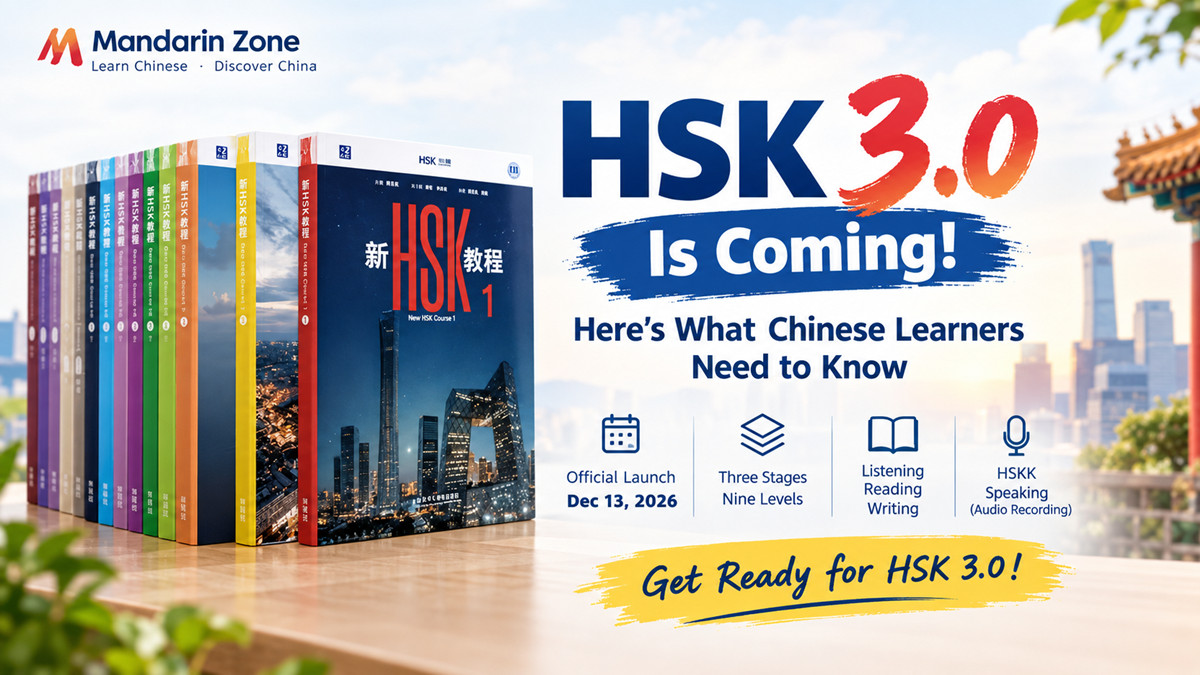
New HSK 3.0 is China’s updated official framework for Chinese language proficiency testing. Released in November 2025 and effective from July 2026, it represents a significant revision from the HSK 3.0 standard announced in 2021.
The most notable change? New HSK 3.0 returns to an “inverted pyramid” structure, significantly reducing vocabulary requirements for levels 1-5 while concentrating more words at level 6. This makes the early stages more achievable for learners.
New HSK 3.0 First Global Trial was held January 31, 2026 — results are now available!
⚠️ Important Timeline for Test-Takers
- November 2025: New HSK 3.0 syllabus officially released ✅
- January 31, 2026: First global trial exams held ✅
- March 16, 2026: Trial exam results released ✅ — Check your score →
- July 2026: July – December 2026: Old and new HSK both available
- Until July 2026: Current HSK exams still follow the old format
Bottom line: If you’re taking HSK before July 2026, use existing materials. From July 2026, the New HSK 3.0 standard applies.
Learn More about HSK Preparation Course
Which HSK Standard Should You Prepare For?
| Your Exam Date | Best Study Path | Next Step |
|---|---|---|
| Before July 2026 | Use current HSK 1–6 materials. | Check 2026 HSK dates |
| July 2026 or later | Align your vocabulary, grammar, writing, and speaking practice with New HSK 3.0. | Compare old vs new HSK |
1. Current HSK vs 2021 HSK 3.0 vs New HSK 3.0: Complete Comparison
Confused about which HSK standard applies to you? Here’s the definitive comparison of all three versions:
| Comparison | HSK 2.0 (Old) Before 2021 |
HSK 3.0 2021-2025 |
New HSK 3.0 (New) July 2026+ |
|---|---|---|---|
| Total Levels | 6 | 9 | 9 |
| Total Vocabulary | 5,000 | 11,092 | 11,000 |
| Total Characters | 2,663 | 3,000 | 3,109 |
| Level 1 Words | 150 | 500 | 300 ✅ |
| Level 2 Words | 300 | 1,272 | 500 ✅ |
| Level 3 Words | 600 | 2,245 | 1,000 ✅ |
| Level 4 Words | 1,200 | 3,245 | 2,000 ✅ |
| Level 5 Words | 2,500 | 4,316 | 3,600 ✅ |
| Level 6 Words | 5,000 | 5,456 | 5,400 |
| Level 7-9 Words | N/A | 11,092 | 11,000 |
| Handwriting Required | All levels | All levels | Progressive ✅ |
| Part-of-Speech Labels | ❌ No | ❌ No | ✅ Yes |
| Grammar Outline | ❌ No | ❌ No | ✅ Yes (24 pages) |
| Topic Outline | ❌ No | ❌ No | ✅ Yes (20 pages) |
Exam Format Changes: Fewer Questions, Shorter Duration
New HSK 3.0 doesn’t just change vocabulary — the exam experience itself has been redesigned. Question types are optimized, total questions reduced, and exam duration shortened for levels 3–6.
| Comparison | HSK 1 | HSK 2 | HSK 3 | HSK 4 | HSK 5 | HSK 6 |
|---|---|---|---|---|---|---|
| Skills Tested(考查能力) | ||||||
| Current HSK | Listening, Reading | Listening, Reading | Listening, Reading, Writing | Listening, Reading, Writing | Listening, Reading, Writing | Listening, Reading, Writing |
| New HSK 3.0 | Listening, Reading | Listening, Reading, Writing ✨ | Listening, Reading, Writing | Listening, Reading, Writing | Listening, Reading, Writing | Listening, Reading, Writing |
| Number of Questions(题量) | ||||||
| Current HSK | 40 | 60 | 80 | 100 | 100 | 101 |
| New HSK 3.0 | 40 | 60 | 70 ↓ | 70 ↓ | 72 ↓ | 82 ↓ |
| Exam Duration(时长) | ||||||
| Current HSK | ~40 min | ~55 min | ~90 min | ~105 min | ~125 min | ~140 min |
| New HSK 3.0 | ~40 min | ~60 min ↑ | ~83 min ↓ | ~85 min ↓ | ~110 min ↓ | ~125 min ↓ |
🎧 Listening Speed Adjustment (HSK 1-2)
HSK 1-2 listening audio has been adjusted from deliberately slow speech to natural-slow speech (正常偏慢语速), making the listening experience more natural and closer to everyday conversation. This means exam audio will sound more realistic — great for practical Chinese skills, but you should practice with real-world audio early on.
✍️ HSK 2 Now Includes Writing
A notable change: HSK Level 2 now tests writing for the first time. Previously, writing was only required from Level 3 onward. This explains why HSK 2’s exam duration increases from ~55 to ~60 minutes despite the same number of questions. The writing requirement at this level is light — based on the shared HSK 1-2 list of just 101 basic characters.
Speaking Test (HSKK) Restructured
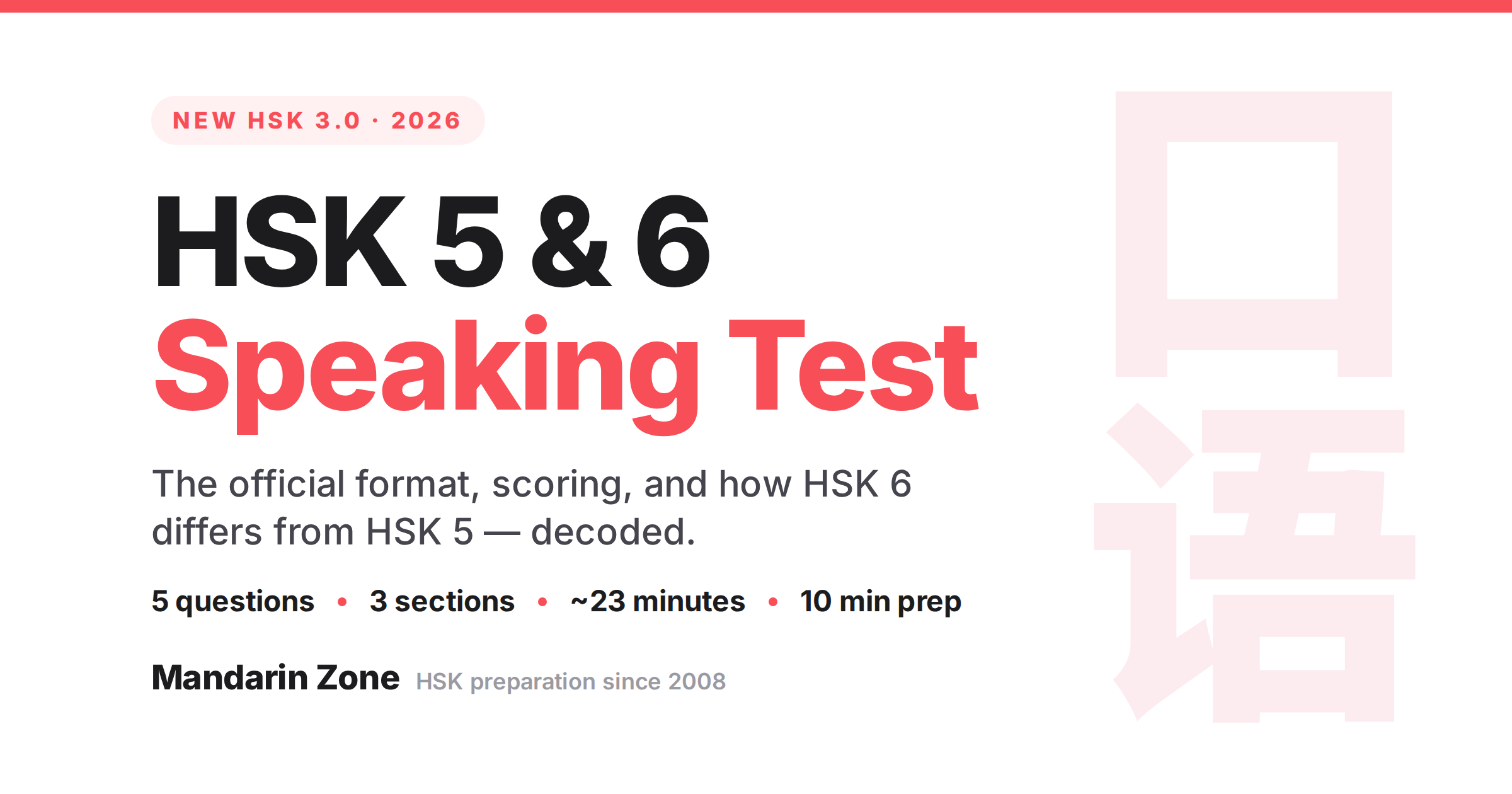
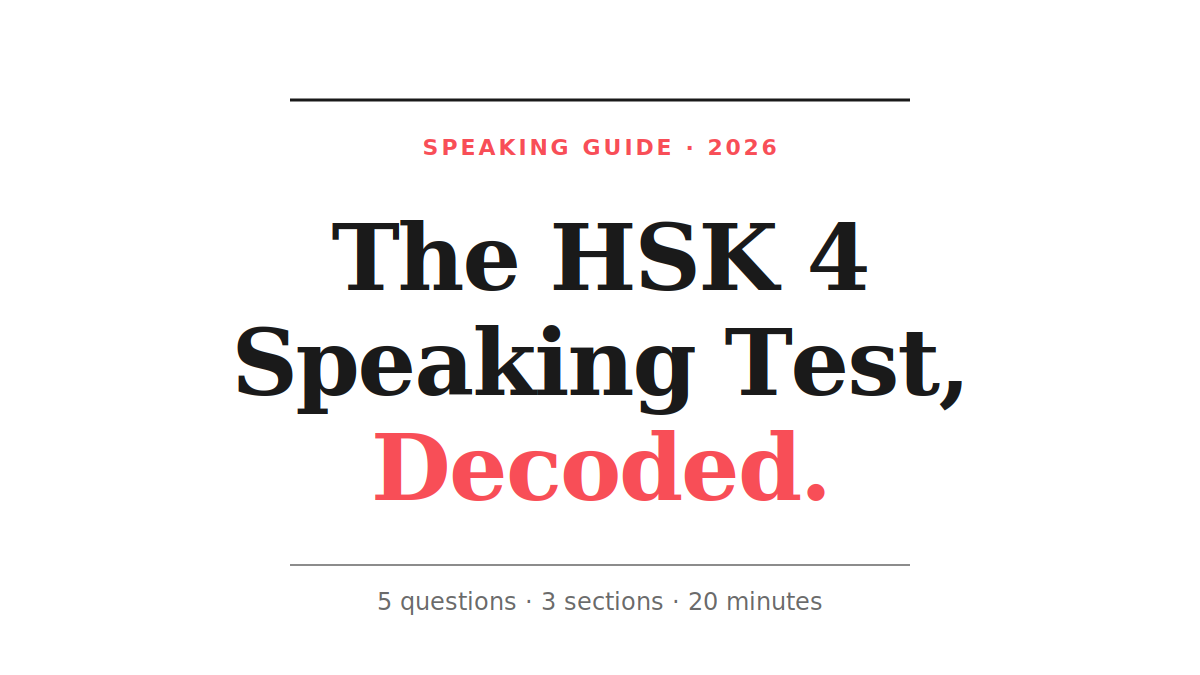
The HSK Speaking Test (HSKK / 口语考试) has also been completely restructured to align with the written exam levels:
Current HSKK
🔵 中级 Intermediate
🟣 高级 Advanced
3 levels, loosely linked to written HSK
New HSK 3.0 Speaking
HSK 4 口语
HSK 5 口语
HSK 6 口语
4 levels, directly matched to written exam levels
💡 Why This Matters
Previously, the HSKK used a separate 3-tier system (Beginner / Intermediate / Advanced) that didn’t clearly correspond to HSK 1–6. Students often struggled to decide which speaking level to register for. Now, the speaking test directly matches written exam levels (HSK 3–6), making it straightforward: if you’re studying for HSK 4, take the HSK 4 Speaking Test. Note that HSK 1-2 do not have a separate speaking test, as these levels focus on foundational listening and reading skills.
📌 As of April 2026: Only the HSK 3-6 speaking sample papers have been officially released by CLEC. The HSK 7-9 speaking format has not yet been announced. We’ll update this guide once official information is available.
Vocabulary: cumulative vs. “new words” (important clarification)
The New HSK counts vocabulary cumulatively. That means higher levels include all words from lower levels.
- “11,000+ words” refers to the total cumulative vocabulary expected by the highest level (Level 9), not “new words added only in Levels 7–9.”
- Levels 7–9 introduce a large amount of advanced content (often estimated as ~6,000–7,000 additional words on top of the intermediate foundation), which is why advanced preparation needs dedicated resources.
- For most learners, the most practical benchmark is your target stage (Basic / Intermediate / Advanced) and its cumulative requirement.
2. New HSK 3.0 Levels: Complete Overview
The New HSK 3.0 system uses three stages and nine levels. Use the table below to choose your target level, then continue to the corresponding Mandarin Zone HSK guide and vocabulary list.
| Stage | Level Guide | Characters | Words | CEFR | Free Resource |
|---|---|---|---|---|---|
| 🌱 Elementary 初等 |
HSK 1 Complete Guide | 246 | 300 | A1 | HSK 1 vocabulary list |
| HSK 2 Complete Guide | 371 | 500 | A1 | HSK 2 vocabulary list | |
| HSK 3 Complete Guide | 655 | 1,000 | A2 | HSK 3 vocabulary · grammar quiz | |
| 📈 Intermediate 中等 |
HSK 4 Complete Guide | 1,096 | 2,000 | B1 | HSK 4 vocabulary · mock test |
| HSK 5 Complete Guide | 1,527 | 3,600 | B2 | HSK 5 vocabulary · grammar quiz | |
| HSK 6 Complete Guide | 1,940 | 5,400 | C1 | HSK 6 vocabulary · HSK 7–9 dates | |
| 🚀 Advanced 高等 |
HSK 7–9 | 3,088 | 11,000 | C2 | HSK 7–9 test dates · trial exam |
Choose Your New HSK Study Path
If you already know your target level, use these guides to move from syllabus information to a concrete study plan.
3. What Can You Actually Do at Each Level?
Numbers don’t tell the whole story. Here’s what you can realistically accomplish at each HSK level — with specific tasks from the official New HSK 3.0 syllabus:
HSK 1-2: Survival Chinese
300-500 words | CEFR A1
- Read your name on a business card or student ID 🪪
- Order food: recognize 包子, 饺子, 面条儿, 茶 on menus
- Ask for directions and understand basic location info
- Introduce yourself at parties and social events
- Read price tags and handle basic shopping
- Tell a doctor you’re sick and understand simple advice like “多休息”
- Fill in your name, age, and birthday on registration forms
- Read train and flight departure info
Perfect for: Tourists, short-term visitors
HSK 3: Daily Life
1,000 words | CEFR A2
- Handle apartment rental conversations 🏠
- Describe your hobbies and share experiences
- Talk about traffic rules and commuting
- Discuss health habits and visit a doctor independently
- Express opinions on weather, environment, and seasons
- Talk about sports events and your favorite activities
- Understand basic news about city development
- Discuss traditional Chinese festivals and customs
Perfect for: Expats, long-term residents
HSK 4: Work Entry
2,000 words | CEFR B1
- Write professional emails and office documents 💼
- Discuss your career history and evaluate job opportunities
- Understand new technology applications and e-commerce trends
- Read articles about science and social issues
- Discuss famous historical figures and events in Chinese
- Navigate HR processes and workplace interactions
- Talk about international exchange and cultural comparisons
- Understand proverbs, famous sayings, and cultural references
Perfect for: University admission, entry-level jobs
HSK 5: Professional
3,600 words | CEFR B2
- Give presentations and manage team projects 🎤
- Discuss enterprise development and business strategy
- Read about ecological balance and environmental protection
- Understand idioms, classical references, and folk legends
- Discuss education policy and vocational training topics
- Analyze product launches and industry trends
- Appreciate traditional Chinese philosophy and art
- Discuss ancient Chinese scientific achievements
Perfect for: Career professionals, graduate students
HSK 6: Advanced
5,400 words | CEFR C1
- Negotiate investments and discuss financial topics 🎓
- Read and analyze news reports and social commentary
- Discuss food safety, public health, and energy policy
- Understand ancient Chinese poetry and appreciate traditional aesthetics
- Discuss community management and urban planning
- Analyze education reform trends and public policy
- Read about historical dynasties and significant artifacts
- Participate in international events and formal discussions
Perfect for: Scholars, diplomats, executives
HSK 7-9: Mastery
11,000 words | CEFR C2
- Write academic papers and defend a thesis in Chinese 🌐
- Read and critique academic literature, spotting logical flaws
- Serve as interpreter at formal diplomatic occasions
- Discuss macroeconomics, legal systems, and public governance
- Analyze digital media literacy and copyright issues
- Deliver polished formal speeches at universities or institutions
- Discuss traditional Chinese cultural symbols across art forms
- Navigate complex multi-clause arguments in written Chinese
Perfect for: Translators, professors, China experts
How Long Does It Take to Pass Each HSK Level?
One of the most common questions we get at Mandarin Zone: “How long will it take me to reach HSK X?” Here’s a realistic estimate based on our 18+ years of teaching experience:
| Level | Words | Intensive Study (4-6 hrs/day) |
Regular Study (1-2 hrs/day) |
Casual Study (3-5 hrs/week) |
|---|---|---|---|---|
| HSK 1 | 300 | 1-2 months | 3-4 months | 6-8 months |
| HSK 2 | 500 | 2-3 months | 4-6 months | 8-12 months |
| HSK 3 | 1,000 | 3-4 months | 6-9 months | 12-18 months |
| HSK 4 | 2,000 | 4-6 months | 9-12 months | 18-24 months |
| HSK 5 | 3,600 | 6-9 months | 12-18 months | 2-3 years |
| HSK 6 | 5,400 | 9-12 months | 18-24 months | 3-4 years |
| HSK 7-9 | 11,000 | 18-24 months | 3-4 years | 5+ years |
⏱️ These Are Cumulative Times (From Zero)
The times above assume you’re starting from scratch. Your actual pace depends on:
- Native language: Japanese/Korean speakers often progress 20-30% faster due to shared vocabulary
- Learning environment: Studying in China can accelerate progress by 30-50%
- Previous language learning: Polyglots typically learn faster
- Study quality: Structured courses beat self-study for most learners
📊 Want a Personalized Study Plan?
Our teachers can assess your current level and create a customized timeline based on your goals and schedule.
4. Recognition Characters vs Writing Characters
One of the most significant changes in New HSK 3.0 is the clear distinction between Recognition Characters (认读字) and Writing Characters (书写字). The syllabus lists both categories separately for every level, with writing demands increasing gradually.
| Level | Recognition Characters (认读字) | Writing Characters (书写字) | What This Means for Learners | ||
|---|---|---|---|---|---|
| New at Level | Cumulative | New at Level | Cumulative | ||
| HSK 1 | 246 | 246 | 101 total for HSK 1-2 combined | Very light writing. Levels 1-2 share a combined list of just 101 basic writing characters (一, 大, 人, 好, etc.). Focus heavily on recognition. | |
| HSK 2 | 125 | 374 | |||
| HSK 3 | 284 | 660 | 151 | 252 | Writing builds up. 151 new writing characters added. Practice writing common characters for short sentences. |
| HSK 4 | 441 | 1,104 | 151 | 403 | Sentence-level writing. Another 151 writing characters. You should now be able to write short paragraphs. |
| HSK 5 | 431 | 1,538 | 151 | 554 | Written expression required. 554 cumulative writing characters. Formal handwriting tasks appear in exams. |
| HSK 6 | 413 | 1,954 | 151 | 705 | Strong writing skills needed. 705 cumulative writing characters for formal documents and essays. |
| HSK 7-9 | 1,148 | 3,109 | 503 | 1,208 | Academic-level writing. 1,208 total writing characters for thesis, reports, and formal prose. |
✍️ Key Insight: Writing Is Progressive, Not Binary
Unlike the old HSK which required handwriting at all levels, the New HSK 3.0 takes a gradual approach:
- HSK 1-2: Just 101 basic characters to write — mostly simple, high-frequency characters like 人, 大, 中, 好
- HSK 3-4: Each level adds about 150 more writing characters — focus on daily life vocabulary
- HSK 5+: Writing demands ramp up significantly — formal written expression becomes a core test component
- Recognition always leads writing: At HSK 4, you recognize 1,096 characters but only need to write 403
💡 Practical tip: For levels 1-4, spend most of your character practice time on recognition (reading + typing). Save dedicated handwriting practice for the characters in the 书写字 list.
5. NEW: Topic Outline at Each Level (话题大纲)
The New HSK 3.0 syllabus specifies exactly which topics are covered at each level, organized into primary topics (一级话题), secondary topics (二级话题), and specific sub-topics (三级话题). This makes it clear what real-world situations you should prepare for.
| Level | Primary Topics 一级话题 |
Secondary Topics 二级话题 |
Specific Sub-topics 三级话题 |
Key Areas Introduced |
|---|---|---|---|---|
| HSK 1 | 5 | 15 | 30 | Basic info, daily life, food, work, Chinese dining culture |
| HSK 2 | 5 | 18 | 34 | + Family life, holidays, surname culture |
| HSK 3 | 6 | 22 | 54 | + Nature & environment, contemporary society, sports, arts |
| HSK 4 | 7 | 31 | 77 | + Science & tech, e-commerce trends, history, international exchange |
| HSK 5 | 7 | 29 | 72 | + Ecology, folk legends, philosophy, ancient science, trade |
| HSK 6 | 7 | 25 | 68 | + Investment/finance, food safety, ancient poetry, dynasty overview |
| HSK 7-9 | Restructured into 2 macro-categories with dozens of sub-topics | 个体与社会 (Individual & Society) + 国家与社会 (Nation & Society): law, economy, media, public health, governance | ||
📋 Example: HSK 4 — 7 Primary Topics in Detail
HSK 4 is where topic coverage expands dramatically (from 54 to 77 sub-topics). Here are the 7 primary categories:
📚 教育情况 Education
💼 职场生活 Workplace
🌿 自然与环境 Nature & Environment
🔬 科学技术 Science & Tech
🏙️ 当代社会 Contemporary Society
🎎 文化与传统 Culture & Tradition
6. NEW: Grammar at Each Level (语法大纲)
The New HSK 3.0 syllabus includes a detailed grammar outline for every level — a first for the HSK system. Here are the key grammar points you need to know at each stage:
HSK 1 Grammar
- “是” sentences — A是B (expressing identity)
- “有” sentences — expressing possession
- Modal verbs: 会, 能, 可以, 想, 要
- Question types: 吗-questions, 什么/谁/哪, A不A
- 了 — completed action, change of state
- 正在 — ongoing action
- Separable verbs: 看病, 睡觉, 说话, 上课
HSK 2 Grammar
- Comparison: A比B + adj, A有/没有B + adj
- “是……的” pattern — emphasizing time/place/manner
- Result complements: 错, 懂, 好, 会, 完
- Direction complements: 来/去, 上/下/进/出
- 着 — state continuation, action persistence
- 过 — past experience
- Complex sentences: 虽然…但是, 因为…所以
HSK 3 Grammar
- “把” sentences — object-fronting for result/location
- Passive voice: 被 + agent + verb
- Potential complements: 得/不 + result verb
- Conditional: 只要…就, 只有…才, 如果…就
- Progressive: 不但…而且, 连…也/都
- Universal: 疑问词+都 (anybody/anything/everywhere)
- Fixed patterns: 越来越, 越…越…, 除了…还
HSK 4 Grammar
- Rhetorical questions: 难道…吗?
- Concessive: 即使…也, 尽管…但是
- Causative: 使/让 + someone + do something
- Contrast: 不是…而是, 一方面…另一方面
- Double negation for emphasis
- Conditional: 不管/无论…都, 既然…就
- Fractions, percentages, multiples expression
HSK 5-6 Grammar
- Complex state complements: V得+clause
- Extended direction complements (abstract meanings)
- Word formation: 超—, 反—, 无—, —化, —性, —式
- Concessive: 哪怕…也, 就算…也
- Purpose clauses: 以便…, 为了…起见
- Conditional: 凡是…都, 除非…才/否则
- Formal patterns: 所, 之, 于, 以 (classical elements)
HSK 7-9 Grammar
- Multi-clause complex sentences (多重复句)
- Discourse analysis: paragraphs organized by time, space, or logic
- Classical particles: 乃, 矣, 罢了, 兹
- Discourse markers: 综上所述, 换句话说, 归根到底
- Advanced comparison: A + adj + 于/过 + B
- Literary fixed patterns: 值此…之际, 视…而定
- Topic continuation & ellipsis in extended writing
💡 Why Grammar Matters More in New HSK 3.0
With reduced vocabulary at levels 1-5, the New HSK 3.0 places greater emphasis on how well you use what you know. Grammar patterns are now explicitly listed in the syllabus for the first time, making it clear that mastering sentence structures is just as important as memorizing word lists. The full grammar outline covers 24 pages of the 406-page syllabus (p.382-406).
7. Modern Vocabulary: Finally Practical Words!
New HSK 3.0 adds many practical, modern vocabulary items that reflect contemporary Chinese life. Many useful words have also been moved from HSK 7-9 down to levels 4-5, making them accessible earlier.
📱 Digital Life (HSK 4-5)
- 扫码 sǎo mǎ – scan QR code
- 网购 wǎng gòu – online shopping
- 点赞 diǎn zàn – like (social media)
- 上传 shàng chuán – upload
- 充值 chōng zhí – top up/recharge
- 下单 xià dān – place order
- 账号 zhàng hào – account
- 浏览 liú lǎn – browse
- 删除 shān chú – delete
- 配送 pèi sòng – delivery
🍜 Food & Daily Life (HSK 3-5)
- 冰激凌 bīng jī líng – ice cream
- 火锅 huǒ guō – hot pot
- 烧烤 shāo kǎo – BBQ
- 豆浆 dòu jiāng – soy milk
- 油条 yóu tiáo – fried dough stick
- 甜品 tián pǐn – dessert
- 红绿灯 hóng lǜ dēng – traffic light
- 安全带 ān quán dài – seatbelt
- 床单 chuáng dān – bed sheet
- 纸巾 zhǐ jīn – tissue
⬇️ Moved from HSK 7-9 to 4-5
- 胳膊 gē bo – arm → now HSK 4
- 咳嗽 ké sou – cough → now HSK 4
- 钥匙 yào shi – key → now HSK 4
- 乒乓球 pīng pāng qiú – ping-pong → now HSK 4
- 失眠 shī mián – insomnia → now HSK 5
- 失恋 shī liàn – heartbreak → now HSK 5
- 迷路 mí lù – get lost → now HSK 5
- 车祸 chē huò – car accident → now HSK 5
- 急诊 jí zhěn – emergency → now HSK 5
- 救护车 jiù hù chē – ambulance → now HSK 5
💡 Modern Concepts Added to HSK 6
新能源 new energy
数字化 digitalization
新媒体 new media
主播 live streamer
电商 e-commerce
客服 customer service
民宿 B&B/homestay
二氧化碳 CO₂
健身房 gym
📖 New HSK 4 Vocabulary Preview
A sample from the official New HSK 3.0 Level 4 word list — 2,000 words total, with part-of-speech labels and example sentences.
| # | Word | Pinyin | POS | Meaning | Example Sentence / Translation |
|---|---|---|---|---|---|
| 1001 | 啊 | ā | interj. | ah; oh (exclamation) | 啊,原来是你! Ā, yuánlái shì nǐ! Ah, it’s you! |
| 1002 | 爱情 | àiqíng | n. | romantic love | 他们之间有美好的爱情。 Tāmen zhījiān yǒu měihǎo de àiqíng. There is a beautiful love between them. |
| 1003 | 安检 | ānjiǎn | v. | security check | 坐飞机前需要安检。 Zuò fēijī qián xūyào ānjiǎn. You need to go through security before boarding a plane. |
| 1004 | 安排 | ānpái | v. | to arrange; to schedule | 老师安排了明天的活动。 Lǎoshī ānpái le míngtiān de huódòng. The teacher arranged tomorrow’s activities. |
| 1005 | 按 | àn | v./prep. | to press; according to | 请按这个按钮。 Qǐng àn zhège ànniǔ. Please press this button. |
Showing 5 of 1,000 words at this level
The complete New HSK 4 vocabulary list includes 1,000 new words (2,000 cumulative) — with pinyin, part-of-speech labels, and bilingual example sentences.
8. Already Studying? Here’s What You Should Do
📅 Taking HSK Before July 2026?
Keep using current HSK 2.0 materials
- Existing textbooks still apply
- Current vocabulary lists (150-5000 words)
- Past exam papers remain valid
- No New HSK 3.0 content in current exams
💡 Tip: Don’t change your study plan—finish what you started!
📅 Taking HSK From July 2026?
Prepare with New HSK 3.0 standard
- Good news: fewer words for levels 1-5!
- Writing is progressive — light at first, heavier from HSK 5
- Learn modern vocabulary early
- Pay attention to part-of-speech labels and grammar patterns
💡 Tip: HSK 2.0 materials still work well as a foundation.
📚 Using HSK 3.0 Materials?
You’re actually over-prepared!
- 2021 HSK 3.0 Level 1 = 500 words
- November 2025 New HSK 3.0 Level 1 = only 300 words
- You’ve learned more than needed
- Focus on practical usage now
💡 Tip: Extra vocabulary is never wasted—it helps real-world communication!
Frequently Asked Questions About New HSK 3.0
When will HSK exams change to the new HSK3.0 format?
New HSK 3.0 was released in November 2025 and will be officially implemented in July 2026. The first global trial exams were held on January 31, 2026, and results were released on March 16, 2026. If you’re taking an HSK exam before July 2026, prepare using existing (HSK 2.0) materials.
What’s the biggest difference between HSK 3.0 and New HSK 3.0?
The main differences are: (1) Significantly reduced vocabulary for levels 1-5, returning to an “inverted pyramid” structure, (2) Clear distinction between Recognition and Writing characters with progressive writing requirements, (3) Part-of-speech labels for all vocabulary, (4) Addition of modern vocabulary like 扫码, 网购, 点赞, (5) Detailed grammar and topic outlines published for the first time, and (6) A 406-page comprehensive syllabus covering tasks, topics, vocabulary, characters, and grammar.
Do I need to practice handwriting for HSK 1-4?
Writing is progressive in the New HSK 3.0. HSK 1-2 share just 101 basic writing characters (simple, high-frequency characters like 人, 大, 好). HSK 3 and 4 each add about 150 more writing characters, so by HSK 4 you need to write 403 characters total. However, the focus at lower levels is still heavily on recognition — at HSK 4, you recognize 1,104 characters but only write 403. Serious handwriting demands ramp up from HSK 5 onward.
Is New HSK 3.0 easier or harder than the 2021 HSK 3.0 draft?
Compared with the 2021 HSK 3.0 draft, New HSK 3.0 is more manageable at lower levels (1–5) due to reduced vocabulary requirements—Level 1 dropped from 500 to 300 words, Level 2 from 1,272 to just 500 words! However, it’s roughly the same difficulty at levels 6 and 7-9. The “inverted pyramid” structure means learners can achieve early milestones faster. Note that grammar is now explicitly tested, so you should study sentence patterns, not just word lists.
How does HSK compare to CEFR (European) levels?
The approximate correspondence is: HSK 1-2 = CEFR A1 (Beginner), HSK 3 = A2 (Elementary), HSK 4 = B1 (Intermediate), HSK 5 = B2 (Upper Intermediate), HSK 6 = C1 (Advanced), HSK 7-9 = C2 (Proficient/Native-like). This can help you compare your Chinese level to other languages.
Will the exam format change with New HSK 3.0?
The New HSK 3.0 syllabus update covers vocabulary, characters, grammar, topics, and task requirements across 406 pages. The first global trial exam was held in January 2026, and results were released in March 2026. Specific exam format details for the full rollout will be announced closer to the July 2026 launch. We’ll update this page when official information is released.
Has the HSKK speaking test been restructured under New HSK 3.0?
Yes — the HSK speaking exam has been reorganized to align with the written exam levels. Official sample papers have been released for HSK 3 口语, HSK 4 口语, HSK 5 口语, and HSK 6 口语. Each level has its own duration, question count, and task types matching the written exam at the same level. HSK 1 and HSK 2 do not have a separate speaking test. The HSK 7-9 speaking format has not yet been officially released as of April 2026 — if you are preparing for advanced levels, watch CLEC announcements for updates.
Should I wait for New HSK 3.0 or take the current exam?
If you need an HSK certificate soon (for university admission, visa, or job), take the current exam. The certificate is equally valid. If you’re studying long-term without deadline pressure, you could wait for New HSK 3.0 as it has lower vocabulary requirements for levels 1-5. Either way, learning Chinese is never wasted!
Download Official New HSK 3.0 Resources
📚 Official New HSK 3.0 Syllabus (Complete)
Download the complete official PDF — the most comprehensive HSK reference document ever released
File Details:
406 Pages | PDF | Released: November 2025 (Updated December 2025)
📋 Task Outline 任务大纲 (p.1–55) |
💬 Topic Outline 话题大纲 (p.55–75) |
📖 Vocabulary 词汇大纲 (p.76–351) |
✍️ Characters 汉字大纲 (p.352–381) |
📐 Grammar 语法大纲 (p.382–406)
⬇️ Download New HSK 3.0 Syllabus (Dec 2025)
📄 Original HSK 3.0 PDF (2021)
Why Study New HSK 3.0 with Mandarin Zone?
- ✅ Curriculum updated for New HSK 3.0
- ✅ Native Chinese teachers trained on the new syllabus
- ✅ Personalized study plans based on your timeline and goals
- ✅ Both online and in-person classes available
New HSK 3.0 Makes Chinese Learning More Achievable
The New HSK 3.0 standard represents a significant improvement for Chinese learners. By reducing vocabulary requirements for levels 1-5 and introducing progressive writing requirements, the new standard makes early progress more achievable while maintaining rigor at advanced levels.
Key takeaways:
- 🗓️ New HSK 3.0 launches July 2026—plan your studies accordingly
- 📉 Compared with the 2021 HSK 3.0 draft, vocabulary requirements are reduced for levels 1–5
- ✍️ Writing is progressive: 101 characters at HSK 1-2, ramping to 1,208 at HSK 7-9
- 📱 Modern vocabulary like 扫码, 网购, 点赞 now included
- 🏷️ Part-of-speech labels help understand word usage
- 📐 Grammar points explicitly listed for every level — study structures, not just words
- 💬 Topic outlines tell you exactly what real-world situations to prepare for
- 📊 CEFR alignment makes international comparison easier
Whether you’re a complete beginner or advancing to higher levels, New HSK 3.0 offers a clearer, more practical path to Chinese proficiency. The best time to start learning Chinese is now!
Continue Your New HSK 3.0 Study Plan
Use these HSK-only resources to turn the New HSK 3.0 syllabus into a concrete exam plan.