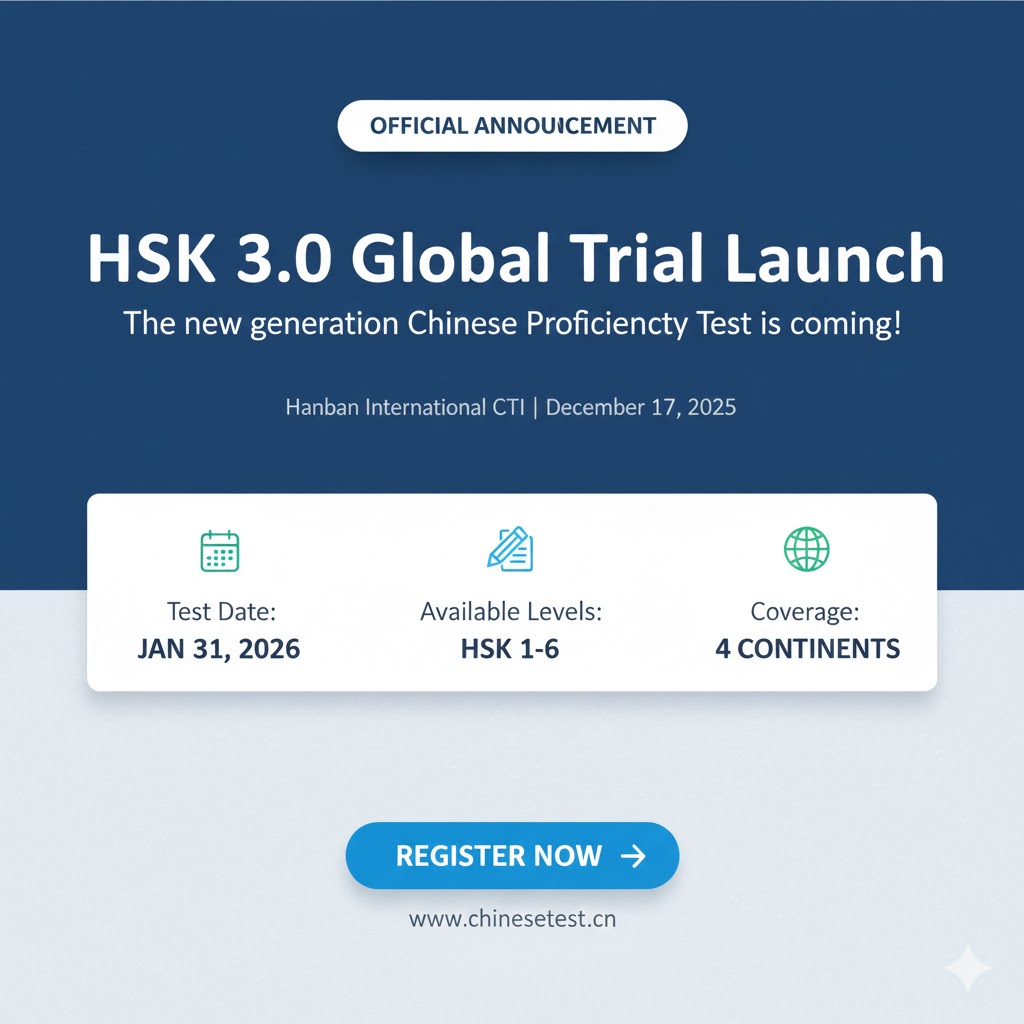
Every regular HSK exam through at least October 2026 is still the old 2.0 version (confirmed with the official testing service). The HSK 3.0 syllabus takes effect July 2026 — but that is the standard, not the exam. No date has been announced for when the 3.0 exam replaces 2.0 for regular candidates. We update this page as the rollout is confirmed.
We checked the overlap level by level. The answer surprised us.
You passed HSK 4 — or 3, or 5, or 6. You put in the work. Then you heard the HSK is changing to a 9-level system, and you started googling.
What you found wasn’t helpful. The advice contradicts itself:
- One site says old HSK 4 roughly equals new HSK 3.
- Another gives vocabulary numbers that don’t match.
- A third quotes a 2021 document that’s already been replaced.
Nobody shows the actual data behind their claims. So we did something nobody else has done: we took the official old and new HSK word lists and cross-referenced them — word by word, level by level.
Every new level contains 30–47% vocabulary that didn’t exist in the old system. Speaking is now mandatory from Level 3. Writing requirements jump at Level 4.
But your certificate is still valid, and your study wasn’t wasted. The new system measures differently — and now you can see exactly where you stand.
Try the tool below. Select your old HSK level and see your personal coverage.
Data: Official HSK 3.0 exam syllabus (中外语言交流合作中心, Nov 2025, 406 pages) · Exam structure: 汉考国际, Dec 2025 · Mandarin Zone School, Beijing · Teaching Chinese to international students since 2008
Want a plan to close your specific gap? Book a free 15-min assessment →
When does HSK 3.0 actually start?
And why most sites get this wrong.
The confusion comes from a single line on the cover of the official syllabus: published November 2025, “implemented July 2026” (实施 2026-07). Many sites read that line and tell you “the new exam starts in July.”
That is not what it means.
“实施 2026-07” is the date the syllabus — the standard — takes effect. It is not the date the exam you sit switches to 3.0. Conflating those two is the single most common error in HSK 3.0 coverage right now.
Here’s the actual situation, kept separate:
The syllabus (the standard) — effective July 2026.
This is when the new 9-level framework becomes the official reference for teaching and test design.
The exam you register for — still 2.0.
As of mid-2026, the testing service confirms every regular HSK exam through at least October 2026 is the old 2.0 version. A limited trial ran at a few centers in early 2026, but regular exams worldwide are still 2.0. No date is announced for when 3.0 replaces it for regular candidates — November 2026 at the very earliest, and not confirmed.
So for most of 2026, “taking the HSK” still means the old format. If a site tells you the new exam is already live, or starts in July, they’ve misread the syllabus.
During the transition, “HSK 4” means two different things
Because both versions coexist as test centers switch at different speeds, the same label can describe two very different standards:
No speaking test
No essay writing
Mandatory speaking
80-word essay writing
Same label, very different standards — and universities haven’t caught up. Most admissions pages still say “HSK 4” without specifying which version, and there is no official equivalency table.
What should you do?
Need a certificate soon?
Take the 2.0 exam now. It’s what every test center is administering through at least October 2026 — no speaking test, and the certificate is permanently valid. There’s no reason to wait for a 3.0 date that hasn’t been set.
Want the newer credential and have time?
Start studying the new HSK 3.0 syllabus now — but know the regular 3.0 exam has no confirmed start date (November 2026 at the earliest). You’d be preparing for a moving target, so keep 2.0 as a fallback.
Not sure?
Take 2.0 now as a safety net — it’s available and fully valid — then sit 3.0 once a date is announced. Both certificates coexist; nothing you earn now is wasted.
Check chinesetest.cn for the latest on when 3.0 exams open in your country, or see our HSK test dates 2026 page.
What the tool can’t tell you
You’ve seen your numbers. Here’s the context behind them.
Why is the HSK 3.0 vocabulary gap so big?
If old HSK 4 has 1,200 words and new HSK 3 requires 1,000, shouldn’t the overlap be almost complete? It would be — if they were the same 1,000 words.
They’re not. The new HSK didn’t reorganize the old word list. It rewrote it. Here’s what that looks like:
下课 class ends
书店 bookstore
一点儿 a little bit
外卖 food delivery
网购 online shopping
点赞 like (social media)
And here’s something that trips people up:
Recognizing the characters ≠ knowing the word
You know 一 and 下, but 一下 means “briefly / give it a try” — not guessable from the parts. 不用 doesn’t mean “don’t use” — it means “no need.” Each compound has its own meaning, grammar and usage. They’re real vocabulary that must be learned individually.
Old HSK 6 holders: 61% of your vocabulary is now classified as Level 7-9 — the advanced tier that didn’t exist before. Only 27% stayed in New Level 6. Your vocabulary spans into the advanced tier, but a Level 7-9 exam would also require advanced speaking and essay writing. (The official 7-9 exam structure has not yet been published.)
HSK 3.0 exam structure: what’s tested at each level
The new HSK changed which skills are tested, not just how many words:
| Level | Listening | Reading | Writing | Speaking |
|---|---|---|---|---|
| HSK 1 | ✓ | ✓ | — | — |
| HSK 2 | ✓ | ✓ | Characters (pinyin-assisted) | — |
| HSK 3 | ✓ | ✓ | Characters + Sentences | ✓ Required |
| HSK 4 | ✓ | ✓ | Essay (80 words) | ✓ Required |
| HSK 5 | ✓ | ✓ | Essay (200 words) | ✓ Required |
| HSK 6 | ✓ | ✓ | Essay (300 words) | ✓ Required |
🗣 Speaking: mandatory from Level 3
Under the old system, the spoken test (HSKK) was separate and optional. Now it’s built in. If you passed old HSK through reading and listening alone, this is likely a bigger challenge than the vocabulary gap.
✍ Writing: big leap at Level 4
Level 2–3: write characters with pinyin help (plus simple sentences at Level 3). Level 4: sentences + an 80-word essay from scratch. Level 6: a 300-word argumentative piece. A fundamentally different skill.
The tool above measures the vocabulary gap — the part we can quantify. Speaking is harder to self-assess. If it’s your weak spot, see our HSK speaking test guide, or book a free assessment below and a teacher will gauge it with you.
⚠ Two common misconceptions corrected
① “Handwriting removed for Levels 1-4” — Not true. We counted them in the official syllabus: the writing-character list (书写字) is 100 characters for Levels 1–2, then about 150 per level (168 for 7–9). Lower levels just test writing with pinyin assistance.
② “Translation tested from Level 4” — No evidence for this in either the syllabus or the exam-structure document. Writing sections involve essays and sentences, not Chinese–English translation.
HSK to CEFR conversion (2026)
Applying to a European university or employer? Here’s how the new HSK maps to CEFR, based on the official 2021 Chinese Proficiency Grading Standards:
| New HSK | CEFR | Description |
|---|---|---|
| HSK 1 | A1 | Beginner — basic phrases |
| HSK 2 | A2 | Elementary — routine exchanges |
| HSK 3 | B1 | Intermediate — travel and work situations |
| HSK 4 | B2 | Upper intermediate — fluent interaction |
| HSK 5 | C1 | Advanced — complex texts, fluent expression |
| HSK 6 | C1-C2 | Proficient — near-native comprehension |
| HSK 7-9 | C2 | Mastery — professional/academic fluency |
For old HSK holders: old HSK 4 was broadly mapped to B2. If you passed old HSK 4, your vocabulary sits between new B1 and B2 — your speaking level depends on your practice history.
HSK 3.0 vocabulary: which numbers are correct?
Three sets of numbers are circulating, and most websites don’t tell you which one they’re using:
| Level | Old HSK 2.0 | 2021 Standard (outdated) | 2025 Syllabus ✓ |
|---|---|---|---|
| 1 | 150 | 500 | 300 |
| 2 | 300 | 1,272 | 500 |
| 3 | 600 | 2,245 | 1,000 |
| 4 | 1,200 | 3,245 | 2,000 |
| 5 | 2,500 | 4,316 | 3,600 |
| 6 | 5,000 | 5,456 | 5,400 |
| 7-9 | — | 11,092 | 11,000 |
The 2021 column (《国际中文教育中文水平等级标准》) comes from a framework document — not the actual test spec. The 2025 column is what you’ll be tested on. If a website says HSK 1 requires 500 words, they’re using outdated data. Everything on this page uses the 2025 syllabus exclusively.
University HSK requirements during the transition
Most Chinese universities still list requirements using old-system labels, and very few have updated for HSK 3.0 yet. Check your target school’s official admissions page directly.
→ HSK Requirements for China’s Top 39 Universities (2026 Guide)
Frequently asked questions about HSK 3.0
Now you know where the gap is
A gap you can see is a gap you can close.
Want a structured plan? Our teachers can map out which words to learn first, how to build speaking skills, and which exam version fits your timeline. 15 minutes, free, no strings.
Mandarin Zone School · Beijing · Since 2008
More from Mandarin Zone:
New HSK 3.0 Explained: 9 Levels & New Requirements
HSK 4 Speaking Test, Decoded (2026 New HSK 3.0)
HSK 4 Guide Complet 2026 : Test, Dates, Inscription
HSK Level 4 — All You Need To Know (Based on 2025 Syllabus)
Free HSK 4 Online Mock Test Series 12
HSK 4 Grammar Guide: 并不, 不一定, 不见得, 又, 还, 也
Mastering HSK 4 Grammar: 差不多, 差点, 几乎, 正好, 只好
Free HSK 4 Grammar Online Quiz
HSK Requirements for China’s Top 39 Universities
HSK Test Guide 2026: Format, Dates, Registration
HSK 4 Vocabulary List + Excel and PDF (Based on 2025 Syllabus)
Methodology: 4,991 old HSK entries cross-referenced against 10,940 unique new HSK 3.0 entries (11,000 total incl. multi-reading characters) from 《HSK 考试大纲》(中外语言交流合作中心, Nov 2025, 406 pp). Exam structure from 《新版HSK(1-6级)考试结构与样题示例》(汉考国际, Dec 2025); Levels 7-9 structure not yet published. Character matching with suffix handling. Definitions: CC-CEDICT. ~186 entries (~3.7%) pending verification; coverage may be 2–3pp higher. Reviewed by Margherita Liu. Analysis: Mandarin Zone School, Beijing (est. 2008), 18 years teaching Chinese to international students.