|
~16 min read
Why Your Child Understands Chinese But Won’t Speak It — The Science, The Real Reasons, and What Actually Works
You ask your child how school was today — in Chinese.
They answer in English: “It was fine.”
You try again, switching to a more specific question in Mandarin. They sigh, glance at their phone, and reply — again in English.
You know they understood every word you said. They just won’t say it back.
If this sounds like your family, you’re not alone. And you haven’t failed.
For many heritage families, two weeks at a summer immersion camp in Beijing does what years of weekend Chinese school couldn’t — it makes speaking feel normal.
Passive bilingualism — a condition where a child can understand a heritage language but consistently refuses or struggles to produce it in speech — affects the vast majority of overseas Chinese families. And the data is sobering:
Chinese
Hispanic
Want to know where your child stands? Take 30 seconds:
According to research published in Demography (Alba et al., 2002), Chinese heritage language disappears roughly 20 percentage points faster than Spanish by the third generation. This isn’t a parenting failure — it’s a well-documented linguistic pattern. And more importantly, it’s a pattern that can be reversed.
Part 1: The Science Behind “I Understand But I Won’t Speak”
Many parents assume the problem is simple: their child is “lazy” about Chinese, or has “forgotten” it. The reality is far more nuanced.
Understanding and speaking use fundamentally different brain pathways. Comprehension primarily activates temporal lobe regions — the brain’s listening and pattern-recognition centers. But producing speech requires additional activation of the dorsolateral prefrontal cortex and the active suppression of the non-target language. In plain terms: understanding Chinese is neurologically “cheaper” than speaking it.
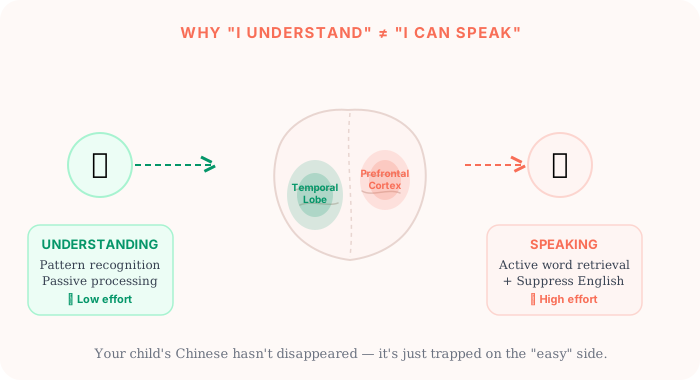
A longitudinal study published in PMC (Gibson et al., 2022) tracked heritage language children over 5.5 years. By age 10, nearly all were English-dominant in expressive skills, but over half remained balanced bilinguals in receptive skills. Their Chinese hadn’t disappeared — it had gone underground.
Passive bilingualism (also called receptive bilingualism) is a condition where a child can understand a heritage language but consistently refuses or is unable to produce it in speech. In Chinese heritage families, this typically manifests as children responding in English to parents’ Chinese questions.
The “Two Selves” Problem
But neuroscience is only half the story. There’s a deeper psychological dimension most parents miss.
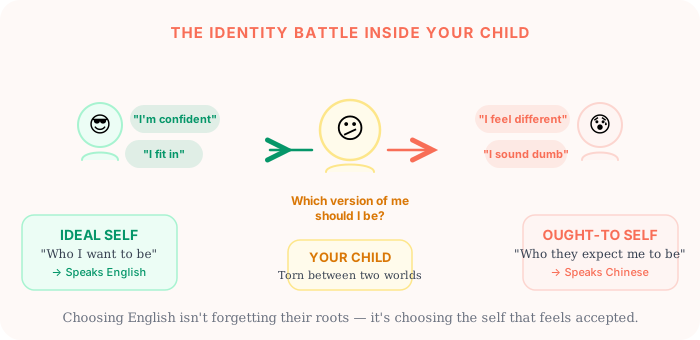
When your child speaks English, their peers perceive them as confident, articulate, and socially fluent. When they speak Chinese, they may feel — or be made to feel — awkward, different, or less capable. Linguists call this indexicality: language choices carry social meaning beyond the words themselves. English indexes confidence and belonging. Chinese may index “otherness” or generational obligation.
Your child isn’t choosing English because they’ve lost their heritage. They’re choosing the version of themselves that feels most accepted.
This means the solution isn’t more vocabulary drills — it’s changing what Chinese means in their social world.
Part 2: The Exposure Equation — Why Weekly Chinese Class Isn’t Enough
Research by Pearson et al. (1997) established the exposure threshold hypothesis: children who receive less than approximately 20% of their waking-hour input in a language are often unwilling to speak it at all. Subsequent studies (Hoff et al., 2012; Thordardottir, 2011) confirmed this range, with higher thresholds needed for expressive fluency.
These thresholds are drawn from research that used exposure percentages as selection criteria, not as prescriptive minimums. The exact figures are debated among linguists. But the directional finding is consistent: there is a minimum input level below which children stop producing the language.
Let’s make this concrete:
This is why weekend Chinese school alone almost never works. It’s not that the teachers are bad or the curriculum is wrong. The math simply doesn’t add up. Over 200,000 students attend more than 634 Chinese heritage language schools across the U.S., yet dropout rates spike in middle school and outcomes are consistently disappointing.
Why Chinese Is Harder to Maintain Than Spanish
Chinese and English share no alphabet, no cognate words, and no script-level transfer. The tonal system adds production complexity absent in European languages. The character-based writing system demands daily practice — miss a few months, and characters fade in ways Spanish spelling simply doesn’t. Chinese heritage families face a structurally harder challenge than most other immigrant communities.
Part 3: The Heritage Chinese Language Triage — Where Is Your Child?
Not every child is in the same situation. Based on our review of the research and 18 years of teaching heritage Chinese learners at Mandarin Zone in Beijing, we’ve developed a diagnostic framework:
Can hold basic conversations. Understands most of what you say. Occasionally initiates Chinese.
Can slide to Yellow in 1–2 years without sustained input.
Maintain Ecosystem
Clearly comprehends Chinese but consistently replies in English. Most common among ages 6–14.
Critical intervention window. Production will keep atrophying.
Reactivate Now
Struggles with basic instructions. Cannot follow conversations. Communication with relatives has broken down.
Functional loss without intensive intervention.
Full Reset Needed
Part 4: Why the Most Common “Solutions” Backfire
Why Forcing Doesn’t Work: The “Anti-Ought-to Self”
In motivational psychology, researchers distinguish between the “ideal self” (who you want to become) and the “ought-to self” (who others expect you to become). For most heritage Chinese children, learning Chinese starts as an “ought-to” activity.
When pushed too hard, this triggers reactance — the human instinct to resist threats to personal autonomy. Children develop an “anti-ought-to self” that actively rejects Chinese as identity assertion. The child screaming “I hate Chinese!” isn’t saying they hate the language — they’re saying they hate being controlled.
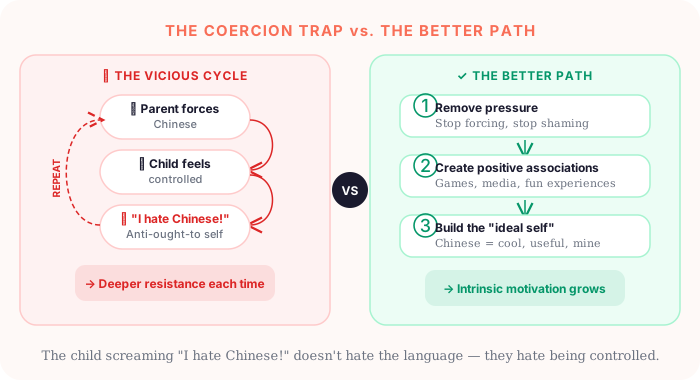
The more effective path is building the “ideal self” — helping your child envision a future where Chinese makes them more interesting, more capable, and more connected.
Part 5: What Actually Works — Strategies by Age
Ages 0-6
Ages 7-12
Ages 13-18
What We Observe at Mandarin Zone: The “Heritage Awakening”
In 18 years of running Chinese language programs in Beijing, we’ve welcomed hundreds of heritage Chinese children. What consistently surprises parents is how quickly these children progress compared to non-heritage learners.
Heritage children arrive with a vast reservoir of dormant Chinese — vocabulary, tonal patterns, grammatical structures — that simply needs reactivation, not construction from scratch. They learn faster, they’re happier, and they’re more confident. They often become leaders in the classroom, helping non-heritage classmates — a complete reversal from the “struggling Chinese student” role they play at home.
The moment when a heritage Chinese child who arrived reluctant and English-dominant suddenly “clicks” into Chinese — typically around day three of full immersion. The child realizes they can communicate, that their Chinese is better than they thought, and that their heritage is an advantage, not a marker of difference.
Stephen came to our Beijing summer camp from Australia. His maternal grandmother speaks fluent Mandarin and Hakka, but his mother grew up entirely in Australia, and his father is Australian. A textbook three-generation language gap: grandmother fluent, mother doesn’t speak, child resists.
Stephen arrived with near-zero Chinese production and noticeable resistance to speaking it.
By day three, he was using Chinese — mixed with English, but Chinese — to communicate with his teachers. By the end of the first week, he was speaking almost entirely in Chinese during calls with his mother and grandmother.
His grandmother watched her language skip a generation — and come back in her grandson.
At our summer camp, children receive 6-7 hours of Chinese daily — approximately 43-50% of their waking hours. Compare that to the 5-6% most overseas families provide. That’s an 8-10x increase in exposure, which is why heritage children typically begin speaking Chinese within the first three days. It’s not magic — it’s the exposure threshold finally being met.
Research confirms that immersion programs produce significant short-term gains. But without continued exposure after returning home, children regress. Parents frequently report: “Chinese improves every summer in China, then slides back.” Immersion should be understood as a catalyst, not a cure. Its lasting value is proving to both parent and child that the language can come back — and providing the motivation to sustain effort after returning home.
Part 6: It’s Not Too Late — Stories of Reversal
A 2023 Frontiers in Psychology paper studied an Australian family who maintained a Chinese-only home policy, purchased Chinese children’s books, made regular trips to China, and — critically — the father discussed Chinese novels with his son. Result: the highest heritage language proficiency among all studied children, with both oral and literacy competence.
The Atlantic profiled a second-generation Chinese American mother who had lost her own Chinese but deliberately taught her children Mandarin decades later — translating children’s books, labeling household objects, watching Chinese-dubbed cartoons. It required what the reporter described as “incredible parental labor.” But it worked.
The common thread: consistent, high-volume input + genuine communicative need + positive emotional associations. No success story relied on a single intervention. All involved building an integrated ecosystem.
Beyond Language: Why This Matters
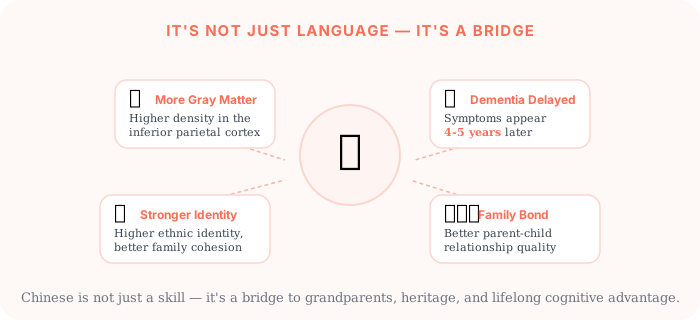
Brain imaging studies published in Nature show greater gray-matter density in bilinguals’ inferior parietal cortex, most pronounced in those who acquired their second language before age 5. Multiple studies confirm bilingualism is associated with delayed onset of dementia symptoms by 4-5 years. And research consistently shows heritage language proficiency strengthens ethnic identity, family cohesion, and parent-child relationships.
Your child’s Chinese is not just a skill. It’s a bridge — to their grandparents, to their heritage, to cognitive advantages that will serve them for a lifetime, and to a sense of identity that no amount of English fluency can replace.
Frequently Asked Questions
Mandarin Zone’s Beijing Summer Camp provides 6-7 hours of daily Chinese immersion — 43-50% of your child’s waking hours. Heritage children typically begin speaking Chinese by Day 3.
References
- Alba, R., Logan, J., Lutz, A., & Stults, B. (2002). “Only English by the Third Generation?” Demography, 39(3), 467–484. Source
- Chen, S.H. et al. (2020). “Heritage Language Socialization in Chinese American Immigrant Families.” PMC. Source
- Shen, X. & Jiang, W. (2025). “From Erosion to Fluency.” Frontiers in Psychology. Source
- Gibson, T.A. et al. (2022). “Bilingual Development in the Receptive and Expressive Domains.” PMC. Source
- Thordardottir, E. (2011). “Bilingual Exposure and Vocabulary Development.” Int. Journal of Bilingualism, 15(4). Source
- Pearson, B.Z. et al. (1997). “The Relation of Input Factors to Lexical Learning by Bilingual Infants.” Applied Psycholinguistics, 18(1), 41–58.
- Hoff, E. et al. (2012). “Dual Language Exposure and Early Bilingual Development.” Journal of Child Language, 39(1), 1–27.
- De Houwer, A. (2007). “Parental Language Input Patterns and Children’s Bilingual Use.” Applied Psycholinguistics, 28(3), 411–424.
- Chondrogianni, V. & Daskalaki, E. (2023). “Short Visits to the Homeland Can Boost Heritage Language Outcomes.” Frontiers in Language Sciences. Source
- Zhu, H., Hopper, T., & Kulaixi, M. (2020). “Heritage Language Maintenance Among Second-generation Chinese-American Children.” Source
- Wang, Y. (2023). “Speaking Chinese or No Breakfast.” Bilingualism: Language and Cognition. Source
- Shen, X. & Jiang, W. (2023). “Parents’ Planning, Children’s Agency and Heritage Language Education.” Frontiers in Psychology. Source
- Bialystok, E. et al. (2012). “The Cognitive Benefits of Being Bilingual.” PMC. Source
- Mechelli, A. et al. (2004). “Structural Plasticity in the Bilingual Brain.” Nature, 431, 757.
- Wong Fillmore, L. (2000). “Loss of Family Languages.” Theory Into Practice, 39, 203–210.
- Caldas, S.J. & Caron-Caldas, S. (2000). “The Influence of Family, School, and Community on Bilingual Preference.”
- PMC (2024). “Leisure and Cultural Identity: Root-seeking Summer Camp.” Frontiers in Psychology. Source