Updated for HSK 3.0 syllabus · Effective July 1, 2026
HSK 3 in Six Numbers
|
1,000
cumulative
vocabulary |
655
cumulative
characters (认读) |
22
communicative
tasks |
|
B1
CEFR
level |
180
passing score
(of 300) |
+67%
vocabulary growth
vs old HSK 3 |
HSK 3 (汉语水平考试三级) is the top of the beginner band — the level where you stop needing translation help and start handling daily life in Chinese on your own. It's the most popular HSK level worldwide, and the natural milestone for anyone who's been studying Mandarin for 6–12 months. This guide is fully updated for the new HSK 3.0 syllabus taking effect on July 1, 2026.
|
📘 Source
406-page official syllabus
Published Nov 2025 by CLEC
|
🎓 Author
Mandarin Zone School
Beijing · Since 2008 · 5,000+ HSK students
|
✅ Pass rate
90% across all HSK levels
Students from 40+ countries
|
The new HSK 3 launches July 1, 2026 — here's what it actually means for you
If you're seeing "new HSK 3" everywhere and wondering whether your current prep is wasted or your old certificate still counts, here are the three answers most people need:
|
✅ If you already have HSK 3
Your certificate is permanently valid. No retake needed. Scholarship scores stay valid 2 years from test date.
|
⏰ If you're preparing now
If you can test before July 2026 and you're close, do it on the old format. Otherwise, switch to new-format prep — most existing study still applies.
|
🆕 If you're starting fresh
Prepare directly for the new HSK 3 format. No reason to learn an exam version that won't exist when you sit it.
|
The headline change: vocabulary 600 → 1,000 (+67%), test format 80 → 70 questions, listening drops the True/False section, writing replaces word-rearrangement with a new picture+word task. Full breakdown in Section 2 below.
📑 In this guide
1. What Is HSK 3?
HSK 3 is the third level of the nine-level HSK 3.0 system, the official Chinese Proficiency Test administered by the Center for Language Education and Cooperation (中外语言交流合作中心) under China's Ministry of Education. Passing HSK 3 means you've crossed the most meaningful threshold in early Chinese learning: from surviving in Chinese to functioning in Chinese.
| Advanced (高等) · HSK 7–9 · CEFR C1–C2 · Single combined exam |
| Intermediate (中等) · HSK 6 · CEFR C1+ |
| Intermediate (中等) · HSK 5 · CEFR C1 |
| Intermediate (中等) · HSK 4 · CEFR B2 |
| ⭐ HSK 3 — Beginner (初等) · CEFR B1 · You are here |
| Beginner (初等) · HSK 2 · CEFR A2 |
| Beginner (初等) · HSK 1 · CEFR A1 |
What HSK 3 means in practical terms
The defining word in every HSK 3 task description is "一般性" ("general"). This single word signals the central characteristic of the level: at HSK 3 you handle everyday, general topics through connected sentences — not paragraph-level production yet (that's HSK 4), but no longer just single phrases either (that was HSK 1–2).
|
🗣️
You can speak about
Daily life, food, transport, shopping, health, family, study, leisure — answering general questions and giving simple multi-sentence introductions
|
📖
You can read
Short notices, ads, emails, social-media posts, simple articles, menus, schedules — everything a tourist or new resident sees daily
|
|
✍️
You can write
One or two complete sentences about your own situation and experiences. Paragraph-level writing is HSK 4, not HSK 3
|
🎯
You can handle
Most travel needs in China, basic shopping, ordering food, asking directions, scheduling appointments, simple work emails
|
Who needs HSK 3?
|
🎓 Scholarship applicants
Minimum threshold for many CSC (Chinese Government Scholarship) and Confucius Institute scholarship applications
|
✈️ Travelers & expats
The level that lets you live, travel, and handle daily situations in China without constant translation help
|
📚 Serious learners
The first HSK level that proves real functional ability — the natural milestone after a year of study
|
📌 What "HSK 3.0" actually means. HSK 3.0 is the informal name for the new HSK system first announced in 2021. The defining change: a move from knowledge-based testing (do you know this word?) to task-based, communicative testing (can you do this in Chinese?). The official syllabus was finalized and published in November 2025, with mandatory rollout from July 1, 2026.
|
🎁 Free download · HSK 3 word list (2026)
All 500 new HSK 3 words · pinyin, English, topic-tagged · PDF + Excel
|
Download free → |
2. What's New in HSK 3 (2026)?
If you've studied for the old HSK 3 (the 600-word version that's been the standard since 2010), the changes under HSK 3.0 are significant. Here are the seven that matter most:
|
📈 BIGGEST CHANGE
+67% more vocabulary
From 600 to 1,000 cumulative words. Exactly the same percentage jump every level sees under HSK 3.0.
|
🔤 NEW
284 recognition characters specified
For the first time, an explicit character list separates "read" from "handwrite" requirements at this level.
|
|
🎯 NEW
22 explicit communicative tasks
Replaces the old vague "can-do" descriptions with measurable, testable performance targets — every task tagged 一般性 (general level).
|
📚 NEW
6 / 22 / 54 topic system
Three-tier topic hierarchy organizes everything you might be tested on. No more guessing about scope.
|
|
📝 NEW
Detailed grammar specification
Explicit lists of word classes, phrases, fixed frames, special sentences, and 9 types of complex sentences.
|
🆙 ADDED
2 dedicated cultural tasks
Tasks 21–22: Chinese food culture (tea, dining customs, chopsticks) and traditional customs (festivals, regional differences). New at HSK 3.
|
|
🆕 CONFIRMED DEC 2025
Test format restructured
80 → 70 questions · listening now 3 parts (was 4 — True/False removed) · writing now includes picture + word task.
|
🗣️ MANDATORY
HSK 3 Speaking now required
HSK 3 registration now requires simultaneous registration for the oral test HSK 3 Speaking (formerly HSKK 初级). No more written-only HSK 3.
|
Confirmed test format changes (December 2025)
The official sample papers reveal that the test structure has changed substantially — not just the syllabus content. Here are the verified differences:
| Section | Old HSK 3 | New HSK 3 (2026) | Key difference |
|---|---|---|---|
| 📻 Listening | 40 items · 4 parts | 30 items · 3 parts | True/False section removed |
| 📖 Reading | 30 items · 3 parts | 30 items · 3 parts | Same count; new sub-format with longer passages |
| ✍️ Writing | 10 items · 2 parts | 10 items · 2 parts | Word-rearrangement removed; picture + word task added |
| Total | 80 items · ~85 min | 70 items · ~83 min | Fewer items, each one weighted more |
From recognition to production
|
⏪ OLD HSK 3 writing
"Arrange these 4 words into a sentence: 我 喜欢 中国 菜"
Pure recognition — words supplied
|
⏩ NEW HSK 3 writing
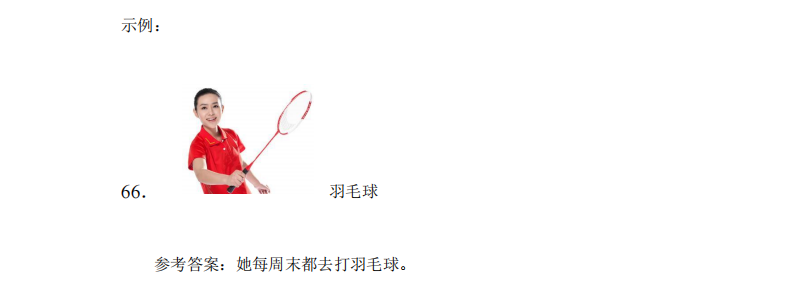
"Picture of a girl playing badminton + the word 羽毛球. Write a sentence."
Free production — you compose the sentence
|
This is the same format the new HSK 4 uses. It teaches a real skill — building sentences from scratch — and prepares you directly for the next level.
Should you take HSK 3 before or after July 2026?
|
✅ Take it BEFORE July 2026 if…
|
📘 Prepare for the NEW format if…
|
Why the New HSK 3 Is Better Designed (Not Just Harder)
The jump from 600 to 1,000 cumulative words makes the new HSK 3 sound harder. But once you look at what changed at this specific level — not just how much — most learners find the new HSK 3 closer to real Chinese, not just a bigger word list.
|
🎯
From textbook drilling to real-life HSK 3 tasks
Old HSK 3: grammar drills and isolated sentences.
New HSK 3: 22 explicit task scenarios that match real travel and daily-life situations — registering at a hotel, asking for help at a bank, telling a friend why you're seeing the doctor, describing the food at a restaurant, talking about your hometown. → HSK 3 now tests Chinese you'll actually use the day you walk out of the test center. |
📱
HSK 3 vocabulary updated for modern life
Removed: outdated 2010-era textbook words.
Added at HSK 3 level: 信用卡 (credit card), 空调 (air conditioner), 耳机 (earphones), 矿泉水 (mineral water), 方便面 (instant noodles), 留学/留学生 (studying abroad), 小区 (residential community), 校园 (campus), 高铁 (high-speed rail, in task descriptions) — plus jobs/study vocabulary like 同事, 校长, 留学. → Today's HSK 3 word list looks like today's life in China. |
|
✍️
284 recognition characters — your handwriting load drops sharply
Old HSK 3: every new character had to be hand-written from memory from day one — adding heavy handwriting drilling to an already crowded study schedule.
New HSK 3: the 284 new characters at this level are recognition characters (认读字) — read on sight, know meaning, but no requirement to handwrite from memory. The writing section still requires handwriting, but only of characters you've practiced specifically — not all 655 cumulative. → Your study time shifts from stroke-order drilling to comprehension and speaking, where it actually matters. |
🎧
HSK 3 skills tested smarter (per Dec 2025 sample papers)
Listening: the keyword-matching True/False section is gone — every question now tests actual comprehension. New short-vs-long sub-formats prepare you for HSK 4.
Reading: Part 3 now has both short passages with 1 question and longer passages with 2 questions — more like real reading, less like flashcard testing. Writing: word rearrangement removed; the new picture + word format means you produce, not just sort. → Fewer questions (80 → 70), but each one tests a real-world skill. |
If you passed the old HSK 3, you might assume the new HSK 3 is just "a bit more vocabulary on top" — but the two word lists overlap less than you'd think. Most of your existing vocabulary still applies, but a meaningful portion of new HSK 3 vocabulary is genuinely new to the syllabus, and the new picture-plus-word writing format demands a skill the old test never required.
Run your own word list through our Gap Finder below to see your exact overlap with the new HSK 3 syllabus — built on the official 2025 word lists, not estimates:
Data: Official HSK 3.0 exam syllabus (中外语言交流合作中心, Nov 2025, 330 pages) · Exam structure: 汉考国际, Dec 2025 · Mandarin Zone School · Beijing · Teaching Chinese to international students since 2008
3. HSK 3 Vocabulary: 500 New Words / 1,000 Cumulative
The new HSK 3 syllabus introduces exactly 500 new words at this level (numbered 501–1000 in the official word list), bringing the cumulative HSK 1–3 total to 1,000 words. Here's how that fits into the full nine-level system:
| Cumulative vocabulary by level | ||
| HSK 1 | 300 | |
| HSK 2 | 500 | |
| ⭐ HSK 3 | 1,000 | |
| HSK 4 | 2,000 | |
| HSK 5 | 3,600 | |
| HSK 6 | 5,400 | |
| HSK 7–9 | 11,000 | |
Topic distribution of the 500 new HSK 3 words
The new vocabulary maps to the six first-level topic domains. Here's a sample from each cluster — every word below has been verified to be on the official HSK 3 word list (not HSK 2 carryover or HSK 4 advance):
|
🏠 Daily life & family
阿姨 · 邻居 · 客人 · 老人 · 丈夫 · 妻子 · 自己 · 朋友 · 同学 · 同事 · 校长 · 服务 · 帮助 · 关心
|
🍽️ Food & shopping
蛋糕 · 面包 · 香蕉 · 饺子 · 方便面 · 矿泉水 · 饮料 · 啤酒 · 筷子 · 勺子 · 碗 · 盘子 · 信用卡 · 价格
|
|
📱 Modern daily life
空调 · 耳机 · 相机 · 照片 · 照相 · 自行车 · 上网 · 网站 · 小区 · 房子 · 房间 · 校园 · 留学 · 留学生
|
🌳 Nature & health
动物 · 动物园 · 山 · 月亮 · 太阳 · 河 · 草 · 树 · 花 · 健康 · 锻炼 · 发烧 · 感冒 · 检查
|
|
📖 Study & work
学期 · 课本 · 课文 · 字典 · 句子 · 练习 · 复习 · 决定 · 选择 · 办公室 · 开会 · 请假 · 经理 · 完成
|
😊 Emotions & descriptors
开心 · 着急 · 担心 · 害怕 · 热情 · 安静 · 可爱 · 干净 · 新鲜 · 重要 · 主要 · 容易 · 难 · 简单
|
|
🔗 Function words & connectors (the multiplier)
如果 · 因为 · 所以 · 然后 · 而且 · 但是 · 可是 · 虽然 · 一边 · 一会儿 · 只要 · 只有 · 必须 · 当然 · 终于
These are only ~3% of new vocabulary but appear in nearly every sentence you produce — each unlocks a complex sentence pattern.
|
|
Word-class distribution at HSK 3
| Nouns 名词 | ~50% |
concrete (people, objects) |
| Verbs 动词 | ~30% |
daily actions |
| Adjectives 形容词 | ~12% |
descriptors & feelings |
| Adverbs & conjunctions | ~6% |
⚠️ critical for reading |
| Measure words 量词 | ~2% |
把, 双, 张, 种, 层, 封, 页, 辆, 节, 段, 头, 句, 公斤, 斤, 角, 米, 块, 刻 |
📥 Complete 500-word HSK 3 list (free)
Searchable, filterable by topic, with pinyin + English + part of speech. PDF, Excel, and printable flashcards.
Download HSK 3 Vocabulary Pack →4. HSK 3 Chinese Characters: 284 Recognition Characters (认读字)
For the first time, the HSK 3.0 syllabus formally separates recognition characters (认读字 — characters you must read on sight) from writing characters (书写字 — characters you must handwrite from memory). At HSK 3, you must recognize 284 new characters, bringing your cumulative recognition total to 655.
|
HSK 1
246
cum. 246
|
HSK 2
125
cum. 371
|
⭐ HSK 3
284
cum. 655
|
HSK 4
441
cum. 1,096
|
HSK 5
431
cum. 1,527
|
HSK 6
413
cum. 1,940
|
What kind of characters are added at HSK 3?
The 284 new characters at HSK 3 split roughly into building-block characters (used in many compounds) and concrete daily-life characters. Many appeared in HSK 1–2 vocabulary as bound morphemes; now they're expected to be recognizable in any compound. Examples (every character below verified to be in the official 284):
|
🫀 Body & health
脸 腿 牙 心 耳 须
|
✋ Action verbs
搬 扫 刷 提 算
|
🍽️ Everyday objects
箱 伞 筷 碗 盘
|
|
🏠 Places
城 街 园 屋 区
|
🌧️ Nature
阳 河 草 树 山
|
🔗 Function morphemes
而 或 且 总 只
|
Recognition vs writing — what the split means in practice
The new HSK's separation of recognition characters (认读字) from writing characters (书写字) isn't just bureaucratic reorganization — it's a fundamental shift in how the test treats character-learning workload. Under the old HSK, every new character had to be hand-written from memory from day one. Under HSK 3.0, the burden is staggered: at HSK 3 you mainly need to recognize characters on sight, with handwriting tested only in the writing section (with pinyin prompts in Part 1, and from a word prompt in Part 2). This roughly halves the cognitive load at HSK 1–3 and frees up time for what beginners actually need: speaking and listening.
|
认读字 · Recognition
284 new at HSK 3
Read on sight · know pinyin · know meaning. Don't have to handwrite from cold memory.
|
书写字 · Handwriting
Combined cross-level list
Handwrite from memory in writing Part 1 (pinyin → character) and Part 2 (compose a sentence using a given word).
|
5. HSK 3 Grammar: The Complete Breakdown
The new HSK 3 grammar syllabus is organized into five major categories: word classes (with morphemes), phrases, fixed sentence frames, sentence components & special sentences, and complex sentences. The tables below reproduce the official 2025 syllabus exactly.
|
5.1
Word classes
词类
|
5.2
Phrases
短语
|
5.3
Fixed frames
固定格式
|
5.4
Special sentences
特殊句型
|
5.5
Complex sentences
复句 ★ key
|
5.1 Word Classes (词类) — New at HSK 3
HSK 3 introduces the first systematic exposure to most of Chinese's adverb and preposition system. The list below is taken directly from the official 2025 syllabus.
| Category | Subtype | New at HSK 3 |
|---|---|---|
| Morphemes 语素 | Prefix 前缀 | 老— |
| Suffix 后缀 | —家、—子、—员 | |
| Noun 名词 | Directional 方位名词 | 东、南、西、北、北方、东方、南方、西方、中间 |
| Verb 动词 | Modal 能愿动词 | 需要、该、应该、愿意、得 |
| Separable 离合词 | V-O type: 放假、见面、结婚、洗澡 V-Comp type: 离开、完成、分开 | |
| Pronoun 代词 | Interrogative 疑问代词 | 怎样 Non-question uses: (1) Universal: 疑问代词+都; 疑问代词+疑问代词 (2) Indefinite use |
| Personal 人称代词 | 别人、咱们 | |
| Demonstrative 指示代词 | 别的、其他 | |
| Measure 量词 | Noun-measure 名量词 | Dedicated: 把、双、张、种、层、封、页、辆、节、所、班、段、头、句、公斤、斤、角、毛、刻、米 Borrowed: 碗、盘 |
| Verb-measure 动量词 | 口、回、遍、声 | |
| Reduplicated 量词重叠 | 个个、张张 | |
| Adverb 副词 ★ critical | Degree 程度 | 比较、还²、更、特别、挺、有些、越、极 |
| Scope 范围 | 就³、一块儿、一共、只、到处、只是 | |
| Time 时间 | 才¹、马上、先、一会儿、刚、刚刚、一直 | |
| Frequency 频率 | 总、总是、又、常常 | |
| Connective 关联 | 一边 | |
| Modal 情态 | 大概、必须、差不多、一定、好像、几乎 | |
| Tone 语气 | 当然、其实、终于、才²、才³、就⁴ | |
| Negation 否定 | 不必、不用 | |
| Preposition 介词 | Introducing object | 为¹、向¹、关于 |
| Direction / path | 向² | |
| Purpose / cause | 为了、为² | |
| Agent / patient | 把、被 | |
| Basis / reference | 根据 | |
| Conjunction 连词 | Word/phrase level | 或、或者 |
| Clause level | 只有、只要、不但、而且、如果、可¹、可是、然后 | |
| Particle 助词 | Other | 的话 |
5.2 Phrases (短语)
|
Structural patterns 结构类型
同位短语 (apposition)
动补短语2 (V + complement, type 2) 数量重叠 (数词+量词+数词+量词) |
Fixed phrases 固定短语
Four-character: 不A 不B
Others: 不一会儿 · 看来 · 在……看来 · 越来越 · 看起来 · 看上去 · 一般来说 · 不怎么样 |
5.3 Fixed Sentence Frames (固定格式)
| Frame | Example |
|---|---|
| 除了……(以外),……还/也/都…… | 除了汉语,他还会说英语。 |
| 从……起 | 从明天起,我要早起。 |
| 对……来说 | 对我来说,这很简单。 |
| 一……也/都+不/没 | 他一句话也没说。 |
| 一点儿也不 | 我一点儿也不累。 |
| 越……越…… | 天气越来越冷。 |
| (在)……以前/以后/前/后 | 下班以后,我去打球。 |
| X什么(啊) | 急什么啊,时间还早呢。 |
| 该……了 | 该吃饭了。 |
| 在……上/下/中 | 在学习上,他很努力。 |
5.4 Sentence Components & Special Sentences (句子成分 / 特殊句型)
| Pattern | Structure | Example |
|---|---|---|
| Sentence components 句子成分 | 主语: 动词/动词短语、形容词/形容词短语作主语 | 学汉语很有意思。 |
| 主语: 主谓短语作主语 | 他来不来,我不知道。 | |
| 定语: 多项定语 | 我的红色的小汽车 | |
| Complements (补语) | 结果补语2: 动+到/住/走/上 | 看到 · 接住 · 走上 |
| 趋向补语2: (1) 表示结果意义: 动+出/起来 (2) 表示动作行为的开始: 动+上/起来 (3) 表示动作行为的持续: 动+下去/下来 | 想起来 · 唱起来 · 写下去 | |
| 可能补语1: 动+得/不+动/形 | 听得懂 · 听不懂 | |
| 程度补语1: (1) 形+得很 · (2) 形/动+极了/坏了 | 高兴得很 · 累极了 | |
| 数量补语3: 表示动作结束到某个时间点的间隔时间 | 他来中国三年了。 | |
| Question types 疑问句 / 反问句 | "怎样+动词" 的特指问句 | 怎样学好汉语? |
| 反问句1: 用反问句表示强调 (不是……吗?) | 这不是你的书吗? | |
| 把-sentence (1) ★ "把"字句1 (3 patterns) | (1) 主+把+宾+动+在/到+处所 | 把书放在桌子上 |
| (2) 主+把+宾1+动+(给)+宾2 | 把礼物送给他 | |
| (3) 主+把+宾+动+结果补语/趋向补语/状态补语 | 把作业写完了 | |
| Passive (被) | (1) 主+被+宾+动+其他成分 | 书被他拿走了。 |
| (2) 主+被+动+其他成分 | 书被拿走了。 | |
| Serial-verb 连动句2 | "着" 表示动作的伴随: 动1+着+动2 | 他笑着说话。 |
| Comparison (比较句2) | (1) A 比 B +更/还+形容词 | 他比我还高。 |
| (2) A 跟 B 一样 | 我跟他一样。 | |
| (3) A 跟 B 一样+形容词 | 我跟他一样高。 | |
| (4) A 不比 B+形容词 | 他不比我高。 | |
| (5) A 比 B+多/少/早/晚+动词+数量短语 | 他比我早来一天。 | |
| Existential (存现句3) | (1) Appearance: 处所+动词+趋向补语/结果补语+动态助词(了)+数量短语+人/物 | 前面跑过来一只狗。 |
| (2) Disappearance: 处所+动词+结果补语+动态助词(了)+数量短语+人/物 | 家里走了一个客人。 | |
| "是……的" "是……的" 句2 | 强调说话人的看法或态度 | 他是会来的。 |
| Reduplicated verb 重动句 | 主+动+宾+动+补语 | 他说汉语说得很好。 |
5.5 Complex Sentences (复句) — Your HSK 3 Power Tools ★
This is where HSK 3 grammar pays off most. The new syllabus formally specifies 9 categories of complex sentences at this level. Mastering these is what lets you produce connected, multi-clause Chinese — the difference between sounding like a beginner and sounding like an intermediate learner.
| Type | Pattern(s) | Example |
|---|---|---|
| 1. Sequential 承接复句 | 先……,再/然后…… | 先洗手,然后吃饭。 |
| 2. Choice 选择复句 | 或者……,或者…… | 或者你来,或者我去。 |
| 3. Coordinate 并列复句 | 一会儿……,一会儿…… | 他一会儿笑,一会儿哭。 |
| 又……,又…… | 这个菜又便宜又好吃。 | |
| 一边……,一边…… | 他一边吃饭,一边看电视。 | |
| 4. Progressive 递进复句 | 不但……,而且…… | 他不但会说汉语,而且说得很好。 |
| 5. Concessive 转折复句 | 虽然……,可是…… | 虽然下雨了,可是我还要去。 |
| 6. Hypothetical 假设复句 | 如果……,就…… | 如果下雨,我就不去了。 |
| ……的话,就…… | 下雨的话,我就不去了。 | |
| 7. Conditional 条件复句 | 只有……,才…… | 只有努力,才能成功。 |
| 只要……,就…… | 只要努力,就能成功。 | |
| 8. Purpose 目的复句 | 为了……,…… | 为了健康,我每天锻炼。 |
| 9. Contracted 紧缩复句 | ……了……(就)…… | 放了假就回国。 |
Compare: HSK 3 has 9 categories of complex sentences. HSK 4 expands to 11, adding causal (因为…所以…) and concessive-conditional (即使…也…). Mastering the HSK 3 nine is the foundation for everything that follows.
5.6 Special Expressions: Approximate Numbers (特殊表达法 — 数的表达法)
|
Approximate numbers (1) — using 大概
用"大概"表示概数
Example: 大概三十个人 |
Approximate numbers (2) — adjacent numerals
相邻数词连用表示概数
Example: 三四个 · 十几个 |
|
1. 把-sentences: students forget the result complement. Never write "我把书看" — must be "我把书看完了". This is on every HSK 3 sample paper.
|
2. Mismatched connector pairs: 虽然+所以 is wrong. Each pair (虽然…可是, 不但…而且, 因为…所以) is fixed — learn as one unit, not two separate words.
|
6. The 22 Communicative Tasks
The defining feature of HSK 3.0 is the move from "knowledge" to "tasks." The new HSK 3 syllabus defines exactly 22 communicative tasks, each described across four skill dimensions (听 listening, 说 speaking, 读 reading, 写 writing). Unlike HSK 4 (where every task is tagged 有一定复杂度, "with complexity"), every HSK 3 task is tagged 一般性 ("general level") — meaning your output is at the connected-sentence level, not yet full paragraphs.
|
Domain 1
Daily life
10
tasks · #1–10
|
Domain 2
Work & ed.
5
tasks · #11–15
|
Domain 3
Society & culture
7
tasks · #16–22
|
Daily life tasks (#1–10) 10 tasks
| # | Task (中文) | English | Key sub-topics |
|---|---|---|---|
| 1 | 介绍个人情况 | Personal info | Appearance, personality, contact, job, marital status |
| 2 | 交流、处理日常事务 | Daily affairs | Lost items, asking favors, bank/phone card setup |
| 3 | 日常交往 | Daily social interaction | Politeness, thanks, apology, suggestions, preferences |
| 4 | 交流饮食情况 | Food & dining | Favorite foods, ordering, eating habits, restaurants |
| 5 | 谈论交通出行 | Transportation | High-speed rail (高铁), travel planning, traffic rules |
| 6 | 交流购物信息 | Shopping | Product selection, comparing, bargaining, reviews |
| 7 | 谈论就医探病、健康观念 | Health & medical | Symptoms, medication, healthy lifestyle, gym |
| 8 | 谈论休闲生活 | Leisure | Travel, holidays, hobbies, music, pets, gatherings |
| 9 | 谈论居住情况 | Housing | Neighborhoods, apartments, household items, room layout |
| 10 | 谈论生活习惯、家庭关系和家庭事务 | Family life | Daily routines, family relationships, household duties |
Work & education tasks (#11–15) 5 tasks
| # | Task (中文) | English | Key sub-topics |
|---|---|---|---|
| 11 | 沟通学习情况 | Study & learning | Courses, classroom activities, study methods, abroad |
| 12 | 交流校园生活 | Campus life | Activities, news, sports day, campus environment |
| 13 | 谈论家庭教育 | Family education | Parenting approaches, children's schooling |
| 14 | 交流日常办公情况 | Office work | Schedule, meetings, email, attendance, colleagues |
| 15 | 谈论职业 | Career | Job changes, choosing a career, overall evaluation |
Society & culture tasks (#16–22) 7 tasks
| # | Task (中文) | English | Key sub-topics |
|---|---|---|---|
| 16 | 谈论自然情况 | Nature | Climate, seasons, animals/plants (pandas, trees), scenery |
| 17 | 介绍某个地方的环境和环保 | Place environment | Geography, eco-practices, local environmental views |
| 18 | 交流社会生活的某个方面 | Modern society | High-speed rail, mobile payment, urban development |
| 19 | 交流文艺活动信息 | Arts & entertainment | Performances, programs, competitions, popularity |
| 20 | 介绍体育项目及比赛 | Sports | Tennis, badminton, volleyball — names, schedules, participants |
| 21 | 介绍中国特色饮食及餐具 | Chinese food culture ★ | Tea and alcohol, main staples, chopsticks & tableware |
| 22 | 介绍中国传统风俗 | Chinese customs ★ | Mid-Autumn / Spring Festival customs, North-South cultural differences |
★ Tasks 21–22 are the 2 dedicated cultural tasks — new at HSK 3 under HSK 3.0. They preview the heavier cultural focus that comes in HSK 4 (which has 5 cultural tasks).
How to read a task description: worked example (Task 1)
Each HSK 3 task is broken down into 5 sub-skills (listening, asking/answering, speaking, reading, writing). Here's Task 1 (介绍个人情况 — Introduce personal info), translated, so you can extrapolate the same structure to all 22:
|
👂
Listen
|
Understand general questions and introductions about personal info — appearance, personality, dress, contact, occupation, marital status — in scenarios like meeting someone, finding a lost person, or looking at a photo.
|
|
❓
Ask
|
Ask general questions about someone's personal info and characteristics; answer such general questions about yourself.
|
|
🗣️
Speak
|
Give a simple introduction of someone's personal info and characteristics to a third party.
|
|
📖
Read
|
Read simple texts describing someone's personal info — missing-person notices, profiles, short bios.
|
|
✍️
Write
|
Write one or two sentences simply describing or introducing someone's personal info.
|
|
Sentences
2
|
Connector used
而且
|
Content areas
3 / 4
|
7. HSK 3 Topics: The Complete 6 / 22 / 54 Hierarchy
Distinct from the 22 tasks (which describe what you can do), the syllabus defines 54 specific topics (which describe what you talk about), organized in three tiers:
|
Tier 1 · 一级
6
broad domains
|
Tier 2 · 二级
22
sub-domains
|
Tier 3 · 三级
54
specific topics
|
Note: HSK 3 has 6 domains; HSK 4 expands to 7 by adding "Science & Technology" (科学技术). All other domains carry over and expand at HSK 4.
| |||
| |||
| |||
| |||
| |||
| |||
8. HSK 3 Test Format & Scoring (2026)
|
Section I
📻 Listening 听力
30 items · 3 parts
~23 min Pictures · short & long dialogues · monologues |
Section II
📖 Reading 阅读
30 items · 3 parts
30 min Q-A matching · cloze · passages |
Section III
✍️ Writing 书写
10 items · 2 parts
20 min Pinyin → character · picture + word → sentence |
Total: 70 items · ~83 minutes (down from 80 items / ~85 min in the old format)
What each section tests (verified against official samples)
| Section | Part | Items | What you do (from official samples) |
|---|---|---|---|
| 📻 Listening 3 parts · 30 items · ~23 min | Part 1 (items 1–10) | 10 | Hear a short two-line dialogue; choose the matching picture from 6 options (A–F). |
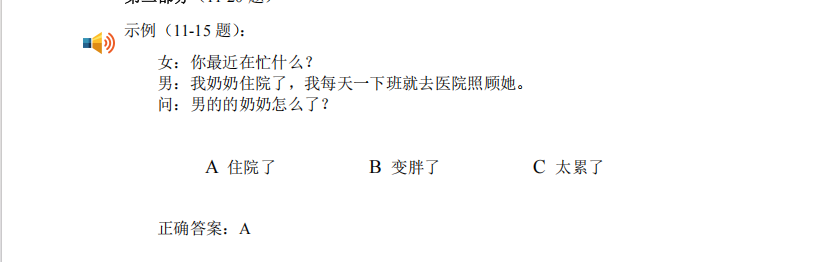
| Part 2 (items 11–20) | 10 | Listen to a dialogue + a question. Choose 1 of 3 written answers. Items 11–15: short 2-line dialogue. Items 16–20: longer 4-line dialogue. | |
| Part 3 (items 21–30) | 10 | Listen to a short monologue + a question. Choose 1 of 3 written answers. | |
| 📖 Reading 3 parts · 30 items · 30 min | Part 1 (items 31–40) | 10 | Q–A sentence matching. Match questions/statements to their best response from 6 options (A–F). |
| Part 2 (items 41–50) | 10 | Fill in the blank. Items 41–45 use a single sentence; items 46–50 use a short dialogue. Choose missing word from 6 options. | |
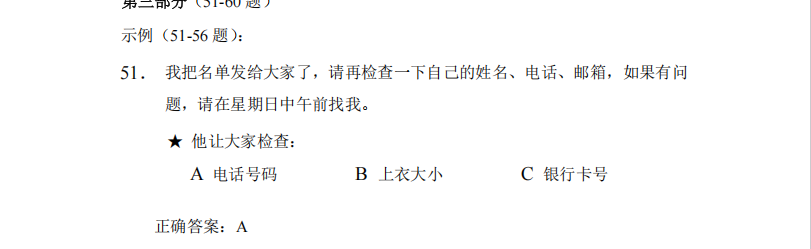
| Part 3 (items 51–60) | 10 | Passage comprehension. Items 51–56: short passage + 1 question. Items 57–60: longer passage + 2 questions. | |
| ✍️ Writing 2 parts · 10 items · 20 min | Part 1 (items 61–65) | 5 | Pinyin → character. A pinyin is given inside a sentence; write the correct Chinese character. |
| Part 2 (items 66–70) | 5 | ★ NEW: Picture + word. You're given a picture and a word — write a complete sentence using the word that relates to the picture. |
See the Real New HSK 3 Questions
Three sample questions reproduced from the official 《新版HSK(1-6级)考试结构与样题示例》document published by 汉考国际 (Chinese Testing International) in December 2025.
Scoring & passing threshold
|
Listening recommended
60+ / 100
|
Reading recommended
70+ / 100
|
Writing recommended
50+ / 100
|
|
✅ Total pass
180 / 300 (official)
No per-section minimum, but section balance matters for scholarship applications
|
||
Registering for HSK 3 or above now requires simultaneous registration for the corresponding HSK Speaking exam (formerly HSKK). For HSK 3 that means HSK 3 Speaking — a roughly 15-minute oral test (including 6 minutes of preparation time) with 15 questions across 3 parts: Listen-and-Repeat (听后重复, 8 questions), Speak-from-Picture (看图说话, 5 questions), and Answer Questions (回答问题, 2 questions). You cannot register for the written exam alone. Budget for both. Read our complete HSK Speaking guide →
9. What HSK 3 Actually Gets You
HSK 3 sits at a special point in the system: it's the most-taken HSK level worldwide because it's the first one that proves real functional ability, achievable in roughly a year of focused study, and useful for scholarships, travel, and daily life in China. What HSK 3 won't do alone is get you into a Chinese university for a Chinese-taught program — that requires HSK 4 (STEM) or HSK 5 (liberal arts).
|
🎓
Scholarships
Minimum threshold for many CSC (Chinese Government Scholarship) and Confucius Institute scholarship tracks, especially for prep year (预科) programs.
|
✈️
Travel & daily life
The level that lets you travel China, order food, take taxis, see a doctor, register at a hotel, and handle most everyday situations without translation help.
|
📈
Bridge to HSK 4
The grammar and vocabulary foundation you build at HSK 3 is what makes HSK 4 reachable in another 3–4 months. Skipping HSK 3 makes HSK 4 much harder.
|
What university programs accept HSK 3?
HSK 3 alone is generally not sufficient for direct admission to degree programs taught in Chinese at top universities. It can, however, get you into:
|
✅ HSK 3 IS USUALLY ENOUGH FOR…
|
❌ HSK 3 IS NOT ENOUGH FOR…
|
Strategy tip: If your end goal is a Chinese-taught degree program, plan HSK 3 as a milestone on the way to HSK 4–5, not as the destination. Many students take HSK 3 to verify their progress and qualify for prep-year programs, then move directly into HSK 4 preparation. → See HSK requirements for top 39 Chinese universities
|
🎓 Personalized HSK 3 Study Plan
Free 30-min consultation · level assessment · custom roadmap to your test date
|
Book free consultation → |
10. The 10-Week HSK 3 Preparation Plan
The plan below assumes you're at solid HSK 2 level today and want to test for HSK 3 in roughly 10 weeks. It's the same framework Mandarin Zone School uses for our HSK 3 intensive cohorts. Adjust the pace up or down to fit your starting level and schedule.
|
1. CONNECTORS
Master the 9 complex-sentence types in Section 5.5 — they're the single biggest leverage point.
|
2. PICTURE→SENTENCE
Writing Part 2's picture+word task is brand new — practice writing 5 sentences/day from images.
|
3. LONGER PASSAGES
Reading Part 3 now has 2-question passages. Train sustained reading, not just keyword scanning.
|
4. SPOKEN OUTPUT
HSK 3 Speaking is now mandatory — practice the three task types (repeat / describe picture / answer questions) weekly from week 1, not the week before.
|
Realistic week-by-week workload
| Starting level | Realistic timeline to HSK 3 | Estimated workload (per learner experience) |
|---|---|---|
| Absolute beginner | 8–12 months | Heavy — daily practice, structured course recommended |
| Solid HSK 1 | 5–8 months | Moderate — consistent weekly study, mix of self-study and course |
| Solid HSK 2 (typical) | 3–4 months (intensive: 10 weeks) | Focused — the realistic plan below assumes this starting point |
| Old HSK 3 holder | 6–10 weeks (gap-fill) | Light — fill new-format gaps; the Gap Finder above shows your exact overlap |
Week-by-week intensive plan (10 weeks)
| Week | Primary focus | Vocab & grammar | Skills & practice |
|---|---|---|---|
| 1 | Foundation refresh | Review HSK 2 vocabulary · 1st 50 HSK 3 words (daily life cluster) | Diagnostic mock test · identify weak section |
| 2 | Tasks 1–5 (daily life) | 100 new words · 把-sentence pattern (1) · 比较句2 | Listening Part 1 drills · 1st HSK 3 Speaking practice (Part 1) |
| 3 | Tasks 6–10 (daily life) | 100 new words · 复句: 因果, 转折, 并列 connectors | Reading Q-A matching · daily picture+word writing |
| 4 | Tasks 11–15 (work/edu) | 100 new words · 假设, 条件 connectors · 是…的句2 | Mid-point mock test · listening monologue practice |
| 5 | Recovery + character work | Review weeks 1–4 · focus on 284 recognition characters | Handwriting practice (pen + paper, 20 min/day) |
| 6 | Tasks 16–20 (society) | 100 new words · 被-sentence · 存现句3 | Reading Part 3 long passages · weekly mock listening |
| 7 | Tasks 21–22 (culture) ★ | 50 culture words · 目的, 选择 connectors | Write 1 short paragraph daily on cultural topics |
| 8 | Integration + weak-area drilling | Review all 500 words · fixed-phrase patterns | Full-length timed mock test #2 |
| 9 | Strategy & speed | Vocabulary recall drills only | Timed-section practice · review error log |
| 10 | Mock tests + HSK 3 Speaking polish | No new content · review only | 2 full mocks · HSK 3 Speaking practice · rest day before test |
Weekly study workload at this pace is substantial — most students find this plan demanding but achievable when they're solid at HSK 2 going in. If you can put in more time, you'll finish ahead of mock test scores; less time, expect to need 12–14 weeks instead of 10. For the HSK 3 Speaking component, see our HSK 3 Speaking complete guide.
11. HSK 3 Test Day: Practical Guide
Registration & logistics
|
🌐 Where to register
Online via www.chinesetest.cn (Chinese Testing International). Some centers also accept walk-in registration up to 2 weeks before the test date.
|
💰 Test fees (HSK 3)
Roughly ~$50 USD for the written test plus ~$30 USD for HSK 3 Speaking (mandatory). Prices vary by country — check your local test center for exact rates and currency.
|
Step-by-step registration
| 1 |
Create an account Register at chinesetest.cn with passport details and a recent photo (white background, JPG, <100KB). |
| 2 |
Choose your test center & date HSK is offered approximately monthly worldwide. Some centers offer the IBT (internet-based) version on additional dates. View upcoming HSK dates. |
| 3 |
Select HSK 3 Pick the written exam HSK 3. |
| 4 |
★ Add HSK 3 Speaking (mandatory) From July 2026, registering for HSK 3 also requires registering for HSK 3 Speaking on the same day. The system will prompt you automatically — don't skip this step. |
| 5 |
Pay & print your admission ticket Pay via Visa/Mastercard/Alipay/WeChat Pay. Print or download the admission ticket — required for entry. |
Test day checklist
|
✅ Must-bring
|
❌ Don't bring
|
In-test time-management strategy
The new HSK 3 is tighter on time than the old version — fewer questions, but each item carries more weight. Here's the recommended pacing:
| Section | Total time | Pacing target |
|---|---|---|
| 📻 Listening | ~23 min | Audio paced — focus on first hearing, use second hearing for confirmation only. Don't second-guess. |
| 📖 Reading | 30 min | ~1 minute per item. Spend less on Parts 1–2 (sentence-level) to save time for Part 3's longer passages. |
| ✍️ Writing | 20 min | ~2 min per Part 1 item · ~3 min per Part 2 sentence. Leave 2 min at end to review character accuracy. |
12. Frequently Asked Questions
Mandarin Zone School: HSK 3 Intensive Course
10-week intensive HSK 3 program built around the new 2026 syllabus. Small classes (max 8 students), all-Chinese-speaking native teachers, weekly mock tests, and personalized feedback on the new picture+word writing format. In Beijing (Sanlitun) or online — we've helped thousands of students pass HSK exams since 2008.
| 📚 View HSK 3 course details → | 💬 Book free assessment → |
📥 Free HSK 3 Resources
Written by Mandarin Zone School (Beijing · since 2008), based on the official 406-page 新版HSK考试大纲 released November 2025 and the official sample papers released December 2025. Verified against the 新版HSK(1-6级)考试结构与样题示例 document from 汉考国际 (Chinese Testing International). Updated for the July 2026 syllabus rollout. We've helped students from 40+ countries pass HSK 1–9 with a 90% pass rate across all levels. About our school →
1. 新版HSK考试大纲 (中外语言交流合作中心, November 2025, 406 pages) — official syllabus
2. 新版HSK(1-6级)考试结构与样题示例 (汉考国际, December 2025) — test format & sample papers
3. 汉语水平等级标准 (国家语言文字工作委员会, 2021) — national language standard