HSK 1 (汉语水平考试一级) is the first and easiest level of the HSK — the official Chinese Proficiency Test. It is the global starting line for learning Mandarin: designed for complete beginners with no prior Chinese background at all. If you can count to ten in Chinese, you have already started. This guide is fully updated for the new HSK 3.0 syllabus taking effect on July 1, 2026.
|
📘 Source
Official 2025 HSK syllabus
Published Nov 2025 by CLEC
|
🎓 Author
Mandarin Zone School
Beijing · Since 2008 · 5,000+ HSK students
|
✅ Pass rate
90% across all HSK levels
Beginners from 40+ countries
|
HSK 1 in 30 seconds — the three things every beginner asks
|
✅ What is it?
The easiest of 9 HSK levels — the official proof you've reached beginner (CEFR A1) Mandarin. No prior Chinese needed to start.
|
🆕 What changed for 2026?
The syllabus doubled the vocabulary (150 → 300 words). The test is still 40 questions in ~40 minutes — listening and reading only.
|
💪 Can a beginner pass it?
Yes. There's no writing and no speaking section, and pinyin is printed above every reading passage. Plan for ~100–150 hours of study.
|
The bottom line: HSK 1 is a foundation, not a finish line — but it's the single best first goal for a new learner. It turns "I want to learn Chinese" into a clear, reachable target. Full details below.
📑 In this guide
1. What Is HSK 1?
HSK 1 is the first level of the nine-level HSK 3.0 system, the official Chinese Proficiency Test administered by the Center for Language Education and Cooperation (中外语言交流合作中心) under China's Ministry of Education. "HSK" stands for 汉语水平考试 (Hànyǔ Shuǐpíng Kǎoshì) — literally "Chinese Level Test." Passing HSK 1 is the official confirmation that you've taken your first real step in Mandarin.
| Advanced (高等) · HSK 7–9 · CEFR C1–C2 · Single combined exam |
| Intermediate (中等) · HSK 6 · CEFR C1+ |
| Intermediate (中等) · HSK 5 · CEFR C1 |
| Intermediate (中等) · HSK 4 · CEFR B2 |
| Beginner (初等) · HSK 3 · CEFR B1 |
| Beginner (初等) · HSK 2 · CEFR A2 |
| ⭐ HSK 1 — Beginner (初等) · CEFR A1 · You start here |
What HSK 1 means in practical terms
HSK 1 sits at the "Breakthrough" level of language learning (CEFR A1). It is not about fluency — it is about your very first useful Chinese. After HSK 1 you can handle short, predictable exchanges built from familiar words, spoken slowly and clearly. Here is what that looks like:
|
🗣️
You can say
Your name, nationality, age and job; greetings, "please," "thank you," "sorry"; numbers, prices, dates and times; what you like and want
|
👂
You can understand
Simple questions and statements spoken slowly — about family, weather, food, shopping, study and daily routines
|
|
📖
You can read
Short, familiar sentences and very simple notices — names, numbers, signs and basic phrases. Pinyin is printed above the characters on the HSK 1 reading test
|
🎯
You can handle
Introducing yourself, basic greetings, ordering simple food, asking a price, telling the time — the survival basics of a first trip to China
|
Who takes HSK 1?
|
🌱 First-time learners
Adults who have studied Chinese for 1–6 months and want a clear, official goal to aim at
|
🧒 Young learners & schools
School Mandarin programs use HSK 1 as an official, motivating benchmark for children
|
✈️ Travelers & hobby learners
Anyone preparing for a trip to China, or learning Mandarin for personal interest, who wants proof of progress
|
📌 What "HSK 3.0" means. "HSK 3.0" is the informal name for the new HSK system, finalized and published in November 2025 with mandatory rollout from July 1, 2026. It expands the HSK from 6 levels to 9 levels and shifts the test from "do you know this word?" to "can you actually do this in Chinese?" For HSK 1, the headline change is simple: the vocabulary doubled.
2. What's New in HSK 1 (2026)?
If you are studying with an older HSK 1 textbook (the 150-word version that was standard from 2010), here is exactly what has changed under the new HSK 3.0 syllabus. The good news for beginners: the test itself is structured almost the same — the changes are mostly in how much you learn, not how you are tested.
| Feature | Old HSK 1 (HSK 2.0) | New HSK 1 (HSK 3.0) | Change |
|---|---|---|---|
| Vocabulary | 150 words | 300 words | ↑ +100% |
| Recognition characters (认读字) | not formally defined | 246 characters | New, now listed |
| Must-write characters (书写字) | not defined | 100 (HSK 1–2 combined) | New, now listed |
| Communicative tasks | broad "can-do" descriptions | 15 specific tasks | Now standardized |
| Topics | unstructured | 5 / 15 / 30 hierarchy | Now structured |
| Test sections | Listening + Reading | Listening + Reading | Unchanged |
| Questions / time | 40 / ~40 min | 40 / ~40 min | Unchanged |
| Question formats | included True/False items | True/False replaced | Refreshed |
So the new HSK 1 is genuinely bigger — but it is still a beginner exam, still listening and reading only, still about 40 minutes. The two changes that matter most:
|
📈 BIGGEST CHANGE
The vocabulary doubled
From 150 to 300 words. This is the same proportional jump every HSK level sees under HSK 3.0 — it is not HSK 1 being singled out. It simply means a bit more study time.
|
🔤 NEW
A clear character list
For the first time the syllabus names exactly which characters a beginner should be able to read (246) and which to handwrite (a 100-character list shared with HSK 2). No more guesswork.
|
Why the New HSK 1 Suits Beginners Better (Not Just "More Words")
Doubling the word list makes the new HSK 1 sound harder. But look at what changed, not just how much: the redesign actually makes a beginner's first months of Chinese more practical and less intimidating.
|
🎯
You learn real-life Chinese, not textbook drills
The new syllabus is built around 15 everyday tasks — introducing yourself, ordering food, asking a price, talking about the weather. Every word you study is attached to something you would genuinely say.
→ HSK 1 prep doubles as survival Chinese for a real trip. |
✍️
Reading and handwriting are now separated
The syllabus splits recognition characters (认读字 — read on sight) from handwriting characters (书写字). At HSK 1 you mainly need to recognize — and the HSK 1 test has no handwriting at all.
→ Far less stroke-order drilling in your first months. |
|
📱
The word list matches modern life
The 300 words include the vocabulary of everyday life today — 手机 (mobile phone), 电脑 (computer), 出租车 (taxi), 电影院 (cinema), 上网-era daily routines.
→ You study words you'll actually use this week. |
🧭
No more guessing what's on the test
The syllabus now spells out the exact 300 words, 246 characters, 15 tasks, 30 topics and grammar points. Your study list is finite and public.
→ You can see the whole finish line from day one. |
The new HSK 1 asks you to learn about twice as much as the old one — but it is still firmly a beginner exam. There is no writing section, no speaking section, recordings are played twice, and pinyin is printed above every reading passage. A motivated beginner with no Chinese background can reach HSK 1 in a few months of steady study. That has not changed.
3. HSK 1 Vocabulary: 300 Words
The new HSK 1 syllabus lists exactly 300 words. Because HSK 1 is the first level, there is no "cumulative" load to worry about — these 300 words are your complete starting vocabulary. Master them and you have the full HSK 1 word base.
| Cumulative vocabulary by level (HSK 3.0) | ||
| ⭐ HSK 1 | 300 | |
| HSK 2 | 600 | |
| HSK 3 | 1,000 | |
| HSK 4 | 2,000 | |
| HSK 5–6 | 5,400 | |
| HSK 7–9 | 11,000 | |
What kind of words are on the HSK 1 list?
The 300 words are the absolute core of spoken Chinese — pronouns, numbers, family members, food, time words and the most common verbs. Here is a sample from each of the five HSK 1 topic areas (every word below is on the official list):
|
👤 Basic information
我 wǒ · 你 nǐ · 他 tā · 名字 míngzi · 人 rén · 中国 Zhōngguó · 朋友 péngyou · 家 jiā · 爸爸 bàba · 岁 suì · 天气 tiānqì · 冷 lěng · 热 rè
|
🛒 Daily life
吃 chī · 喝 hē · 买 mǎi · 钱 qián · 多少 duōshao · 商店 shāngdiàn · 出租车 chūzūchē · 医院 yīyuàn · 看病 kànbìng · 玩 wán
|
|
📚 Education
学习 xuéxí · 学校 xuéxiào · 学生 xuéshēng · 老师 lǎoshī · 汉语 Hànyǔ · 书 shū · 上课 shàngkè · 写 xiě
|
💼 Workplace
工作 gōngzuò · 公司 gōngsī · 上班 shàngbān · 下班 xiàbān · 忙 máng
|
|
🥢 Culture & tradition — plus the high-frequency function words
茶 chá · 包子 bāozi · 饺子 jiǎozi · 面条儿 miàntiáor | 是 shì · 有 yǒu · 不 bù · 没 méi · 很 hěn · 的 de · 了 le · 吗 ma · 和 hé · 一 yī … 十 shí · 百 bǎi
The function words (是, 有, 不, 的, 了, 吗 …) are tiny but appear in almost every sentence — learn these first.
|
|
|
🎁 Free download · Complete HSK 1 word list (2026)
All 300 words · pinyin, English, part of speech & example sentences · PDF
|
Get the word list → |
4. HSK 1 Characters & Pinyin for Beginners
"I'll never be able to read those characters" is the single most common fear of new Chinese learners. For HSK 1, it is also the most misplaced — because of how the test is built. Here is exactly what you do and don't need.
|
认读字 · Recognition
246 characters
The syllabus lists 246 characters a beginner should be able to read and understand on sight. You are never asked to handwrite them on the HSK 1 test.
|
书写字 · Handwriting
100 (HSK 1–2 combined)
HSK 1 and HSK 2 share one 100-character must-write list. Handwriting is first tested at HSK 2 — the HSK 1 exam has no writing section at all.
|
On the HSK 1 reading section, pinyin is printed above every Chinese sentence (you can see this in the official sample papers). That means you can read and answer every question even before your character recognition is solid. The 246 characters will come naturally as you study — but you do not need to have memorized all of them to pass HSK 1.
The good news about HSK 1 characters
|
✍️ Many are simple
The most basic characters are just a few strokes: 一 二 三 人 大 小 口 上 下 中. You already half-know them.
|
🧩 They reappear everywhere
HSK 1 characters combine into HSK 1 words: 中 + 国 → 中国, 学 + 生 → 学生. Learn one, unlock many.
|
📈 They're the highest-value 100
The 100 must-write characters are the most frequent in all of Chinese — time spent on them pays off for years.
|
First, though: pinyin and the 4 tones
Before any characters or vocabulary, every beginner must master pinyin (拼音) — the romanized spelling of Mandarin sounds — and the four tones. This is non-negotiable. Without tones, mā (mother), má (hemp), mǎ (horse) and mà (scold) are the same word to your ear, and nothing you memorize will stay memorized.
|
mā →
Tone 1 · high & level
|
má ↗
Tone 2 · rising
|
mǎ ⌄
Tone 3 · dip then rise
|
mà ↘
Tone 4 · sharp fall
|
5. HSK 1 Grammar Essentials
HSK 1 grammar is small and friendly. There are no complex sentences yet — just the building blocks of basic Chinese. The good news: Chinese has no verb conjugation, no plurals, no genders and no tenses. The six groups below cover essentially everything on the HSK 1 syllabus.
|
GROUP 1
Word order & the 3 basic sentences
Chinese order is Subject – Verb – Object.
• 是 (to be): 我是学生。— "I am a student." • 有 (to have): 我有一个哥哥。— "I have a brother." • Adjective sentence (no 是!): 今天很热。— "Today is hot." |
GROUP 2
Asking questions
• 吗 (yes/no): 你是老师吗?
• Question words: 什么 (what), 谁 (who), 哪儿 (where), 几 / 多少 (how many) • Verb-not-Verb: 你去不去? • 呢 (and you?): 我很好,你呢? |
|
GROUP 3
Numbers, measure words & money
Counting uses number + measure word + noun.
• 一个人 — "one person" (个 is the all-purpose one) • 三本书 — "three books" • 多少钱?— "How much?" → 五块。 |
GROUP 4
Talking about time
• 了 — completed / changed: 我吃了饭。/ 下雨了。
• 在 / 正在 — happening now: 我在看书。 • Time words go before the verb: 我明天去。 |
|
GROUP 5
Saying what you can & want
Helper verbs go before the main verb:
• 会 — can (learned skill): 我会说汉语。 • 能 — can (able to) · 可以 — may • 想 / 要 — want to: 我想去中国。 |
GROUP 6
Saying "no" & joining ideas
• 不 — general "not": 我不喝茶。
• 没(有) — "didn't / don't have": 我没去。 • 和 (and), 也 (also), 的 (possessive): 我的书 |
6. What HSK 1 Covers: 15 Tasks & 30 Topics
The heart of the new HSK 3.0 syllabus is the move from "knowledge" to "tasks." HSK 1 defines 15 communicative tasks — concrete things you can do in Chinese — and a tidy 5 / 15 / 30 topic map of what you talk about. Together they tell you exactly what to study.
The 15 HSK 1 communicative tasks
| # | Task (中文) | What you can do |
|---|---|---|
| 1 | 问答个人基本信息 | Give & ask basic personal info — name, country, age, likes, family |
| 2 | 问答事件信息 | Ask & answer about events — dates, times, places, phone numbers |
| 3 | 问答物品信息 | Name everyday objects and describe size, quantity, new/old |
| 4 | 问答天气 | Talk about the weather — hot, cold, rain, snow |
| 5 | 问答环境信息 | Talk about places — school, shop, cinema; size and location |
| 6 | 日常言语交往 | Everyday courtesies — hello, please, thank you, sorry, goodbye, simple requests |
| 7 | 问答饮食喜好 | Talk about food you like, meals and meal times |
| 8 | 问答出行信息 | Talk about getting around — how and when you travel; ask directions |
| 9 | 问答商品信息 | Shopping — product names, prices, whether something is available |
| 10 | 告知生病、探病 | Say you're unwell; give a simple get-well wish |
| 11 | 交流休闲活动 | Talk about leisure — reading, singing, watching TV |
| 12 | 介绍学习情况 | Talk about your studies — school, subjects, class times |
| 13 | 交流学校情况、课后活动 | Talk about school and after-class activities |
| 14 | 交流工作信息 | Talk about work — job, hours, workplace |
| 15 | 问答中国传统饮食 | Talk about traditional Chinese food — baozi, dumplings, noodles, tea |
The HSK 1 topic map (5 / 15 / 30)
Everything you talk about at HSK 1 fits into 5 broad areas, split into 15 sub-areas and 30 specific topics. If a word or situation isn't on this map, it isn't on HSK 1.
| ||
| ||
| ||
| ||
|
7. HSK 1 Test Format & Sample Questions (2026)
The HSK 1 test has just two sections — Listening and Reading. There is no writing section and no speaking section. Each section has 20 questions split into four small parts of 5 — so you only ever focus on 5 questions at a time.
|
Section I
📻 Listening 听力
20 questions · 4 parts
~12 minutes Every recording is played twice |
Section II
📖 Reading 阅读
20 questions · 4 parts
20 minutes Pinyin printed above every sentence |
Total: 40 questions · ~40 minutes (including time to fill in your personal details and answer sheet)
What each of the 8 parts looks like
| Section | Part | What you do (from the official samples) |
|---|---|---|
| 📻 Listening 4 parts · 20 Q · ~12 min | Part 1 (Q 1–5) | Hear a word or short phrase → choose the matching picture from 3 (A/B/C). |
| Part 2 (Q 6–10) | Hear a question → choose the best spoken reply from 3 written options (A/B/C). | |
| Part 3 (Q 11–15) | Hear a short two-line dialogue → choose the matching picture from 6 (A–F). | |
| Part 4 (Q 16–20) | Hear a short statement + one question → choose the answer from 3 written options (A/B/C). | |
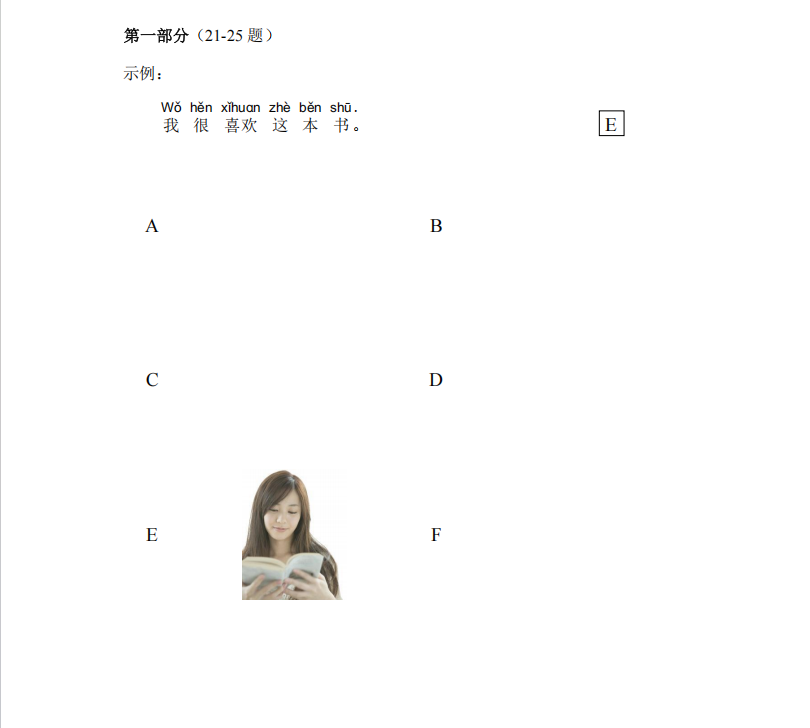
| 📖 Reading 4 parts · 20 Q · 20 min | Part 1 (Q 21–25) | Read a (pinyin-annotated) sentence → choose the matching picture from 6 (A–F). |
| Part 2 (Q 26–30) | Match each of 5 questions to its natural reply, chosen from 6 options (A–F). | |
| Part 3 (Q 31–35) | Fill in the blank — pick the missing word for each sentence from 6 options (A–F). | |
| Part 4 (Q 36–40) | Read a short statement + one question → choose the answer from 3 options (A/B/C). |
See & hear real HSK 1 questions
Below are sample questions reproduced from the official 《新版HSK(1-6级)考试结构与样题示例》document — including the real exam audio, so you can hear for yourself how slow and clear the new HSK 1 listening section actually is.
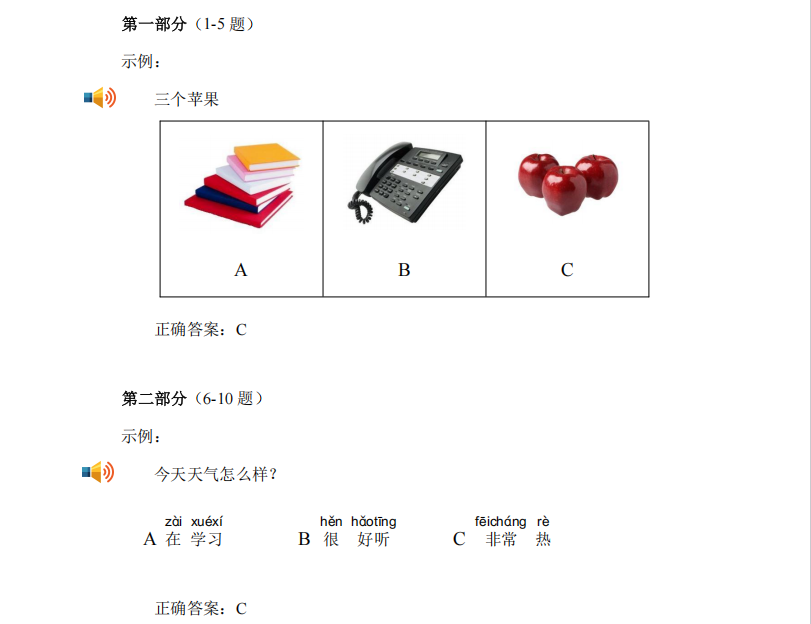
Written options: A 在学习 · B 很好听 · C 非常热 ✓
8. Scoring, Difficulty & How Long It Takes
How HSK 1 is scored
An honest note on the pass mark. As of early 2026, Chinese Testing International had not yet published the official scoring details for the new HSK 1. Under the previous syllabus, HSK 1 was scored out of 200 points (100 listening + 100 reading) with 120 points (60%) needed to pass. We expect the new HSK 1 to keep a similar ~60% threshold — but confirm the current numbers at chinesetest.cn closer to your test date.
Whatever the exact number, the practical target is the same: aim to answer roughly 70%+ of questions correctly in practice tests and you have a comfortable margin.
How hard is HSK 1, really?
The honest answer: HSK 1 is a fair challenge, not an overwhelming one. The new syllabus is harder than the old HSK 1 because the vocabulary doubled — but the design still protects beginners in four important ways:
|
🚫✍️
No writing section
|
🚫🗣️
No speaking section
|
🔤
Pinyin above all reading
|
🔁
Audio played twice
|
How long does it take to prepare?
The official guidance points to roughly 100–150 study hours from absolute beginner to new HSK 1 readiness — about 30% more than the old HSK 1 because of the larger word list. In calendar time, that depends entirely on how you study:
| How you study | Typical timeline | Notes |
|---|---|---|
| Self-study from zero | 4–6 months | ~5–7 hrs/week with apps + a textbook. Slower because you spend time deciding what to study. |
| Structured group class | 2.5–4 months | A fixed sequence and accountability — the most common path for working adults. |
| Intensive / immersion | 4–6 weeks | 20+ hrs/week, full-time. Fastest, if you can give it weekday hours. |
Speakers of languages that already use Chinese characters (Japanese, Korean) often move 20–30% faster, since character recognition comes more easily. Most other learners need the full timeline above.
9. What HSK 1 Is Actually Worth
It's worth being honest: HSK 1 is a foundation, not a career credential. The certificate alone will not get you into a university or a job in China — that takes HSK 4 and above. So why take it? Because for a beginner, HSK 1 delivers four things that genuinely matter:
|
🎯
A real, reachable goal
"Learn Chinese" is vague and endless. "Pass HSK 1 by June" is concrete and finishable. A clear target is what keeps beginners going.
|
💬
Genuinely useful Chinese
HSK 1 vocabulary is survival Chinese — greetings, numbers, food, directions, prices. Enough to handle the basics of a first trip to China.
|
|
🧒
An official benchmark for schools
For young learners and Mandarin programs, HSK 1 is a recognized, motivating milestone — proof of progress for students and parents.
|
🪜
The on-ramp to HSK 2+
HSK 1 builds the pinyin, character and grammar base that makes HSK 2 — and the credential-grade levels beyond — far easier to reach.
|
One more reassurance: the HSK 1 certificate is permanently valid — it never expires. And HSK 1 has no writing or speaking test. The separate spoken exam (HSKK / HSK Speaking) is optional and only becomes mandatory from HSK 3 — so as a beginner you can focus purely on listening and reading.
10. Your HSK 1 Study Plan
Beginners' timelines vary too much for a rigid week-by-week table, so here is the proven four-phase order instead. The order matters more than the speed — do these phases in sequence and each one makes the next easier.
| 1 |
Pinyin & the 4 tones · ~1–2 weeks Master pinyin and tones before anything else. Do not touch vocabulary yet. This is the foundation — rush it and everything after wobbles. |
| 2 |
Core words + first characters · ~6–10 weeks Learn the 300 words in topic clusters, each inside a full sentence. Alongside, start the 100 high-frequency must-write characters with correct stroke order. |
| 3 |
Grammar & the 15 tasks · ~3–4 weeks Work through the six grammar groups and practise each of the 15 tasks out loud — introduce yourself, order food, ask a price, talk about the weather. |
| 4 |
Mock tests & exam practice · ~2–3 weeks Practise full mock tests on the official 8-part format. Goal: finish a complete mock inside 40 minutes and score 80%+ before booking your exam. |
|
🎓 Want a guided path to HSK 1?
Mandarin Zone's beginner track gives you a fixed sequence, weekly mock tests, and teachers who've taught HSK 1 since 2008.
|
See beginner courses → |
11. HSK 1 Test Day: Practical Guide
Registering for the exam
|
🌐 Where to register
Online at chinesetest.cn, the official Chinese Testing International portal. You can sit HSK 1 as a paper test (PBT) or a computer test (IBT) — content is identical.
|
💰 Test fee
HSK 1 is the cheapest level — roughly USD 20–30, varying by country. Check your local test center for the exact local price.
|
What to bring — and what to leave at home
|
✅ Bring
|
❌ Leave at home
|
On the day & after
|
⏱️ Pacing
Listening is audio-paced — just follow it. In Reading you have 20 minutes for 20 questions: about a minute each. Don't get stuck.
|
✏️ Answer everything
There is no penalty for wrong answers — never leave a question blank. If unsure, make your best guess.
|
📜 Results
Scores are released online (chinesetest.cn) roughly a month later. The certificate is permanently valid.
|
12. Frequently Asked Questions
Mandarin Zone School: HSK 1 Beginner Course
A beginner program built around the new 2026 HSK 1 syllabus — pinyin and tones from day one, the 300 words in topic clusters, weekly mock tests on the official format, and native teachers in small classes. Online or in Beijing. We've helped beginners from 40+ countries take their first step in Chinese since 2008.
| 📚 View HSK 1 course → | 💬 Ask us a question → |
📥 Free HSK 1 Resources
Written by Mandarin Zone School (Beijing · since 2008), based on the official 新版HSK考试大纲 released November 2025 and the official sample papers 新版HSK(1-6级)考试结构与样题示例 released December 2025 by 汉考国际 (Chinese Testing International). Updated for the July 2026 HSK 3.0 rollout. We've helped beginners from 40+ countries pass HSK 1 and beyond. About our school →
1. 新版HSK考试大纲 (中外语言交流合作中心 / CLEC, November 2025) — official syllabus [PDF ↗]
2. 新版HSK(1-6级)考试结构与样题示例 (汉考国际 / Chinese Testing International, December 2025) — test format & sample papers [PDF ↗]
3. 汉语水平等级标准 (国家语言文字工作委员会, 2021) — national Chinese language standard