HSK 3.0 Guide 2026: Everything You Need to Know About the New HSK
A learner-first guide to what’s changing, when it takes effect, and what you should study right now (beginner to intermediate).
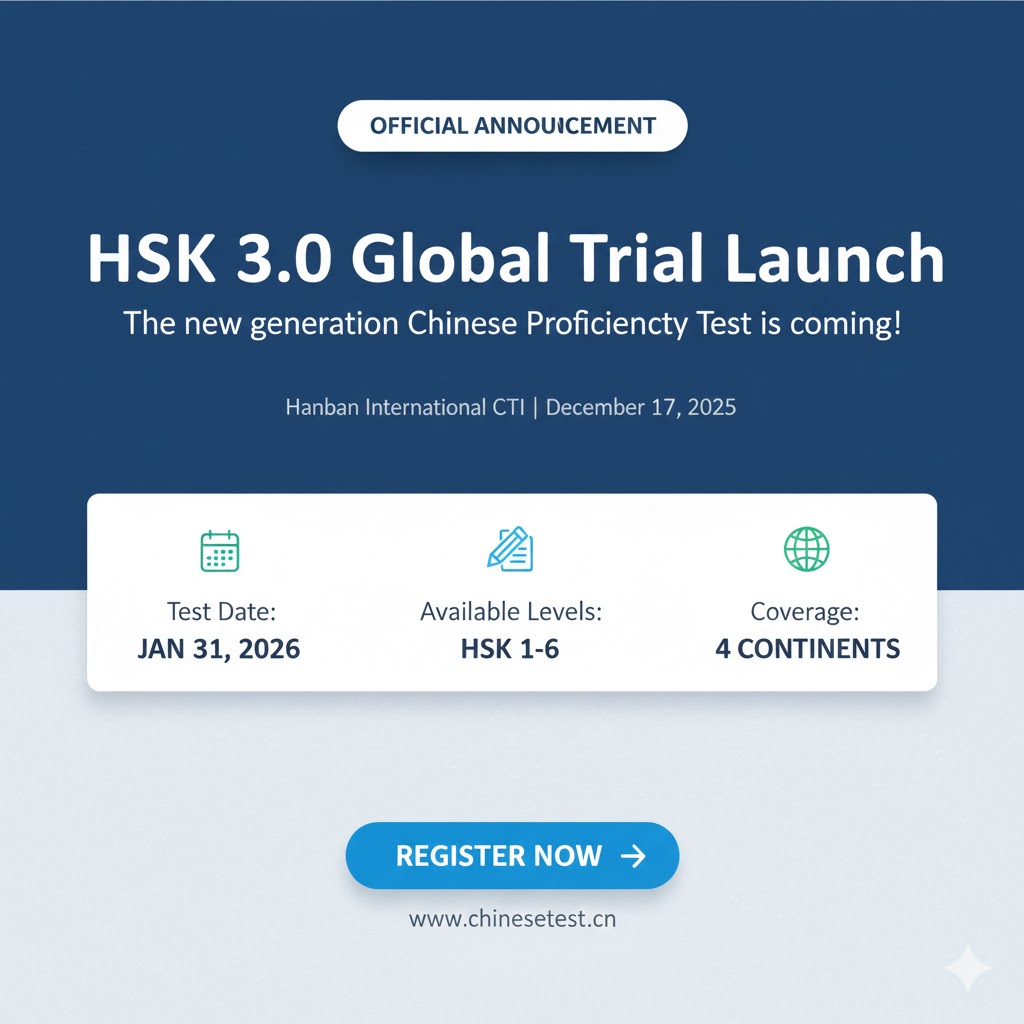
- Global trial exam: Jan 31, 2026
- Results: Mar 14, 2026
- Full rollout: July 2026+
Quick answers (most asked):
- Can I keep using my current textbook?
Yes. Before July 2026, HSK 1–6 still follow the current format, so existing textbooks are fine. After July 2026, you’ll need to align your study with New HSK requirements (especially for advanced levels). - Did vocabulary get “smaller”?
The New HSK uses a 3-stage, 9-level system and counts vocabulary cumulatively. It’s not always meaningful to compare “old HSK 1–5” word-for-word. What matters is the total requirement by stage and your target level. - Do I need handwriting?
Writing requirements are progressive: lower levels focus more on recognition, while writing becomes increasingly important from the intermediate stage onward.
TL;DR (60 seconds)
- If you need a certificate before July 2026, prepare for the current HSK 1–6 format. Don’t delay.
- If your exam is July 2026 or later, start building toward the New HSK: cumulative vocabulary + characters + real-world skills.
- Not sure which path fits you? Get a free study plan based on your level + exam date.
Need a simple plan? If you’re deciding between the current HSK and the New HSK, start here: HSK Exam Prep (Beijing & Online).
📚 Quick Navigation
What is New HSK 3.0?
New HSK 3.0 is China’s updated official framework for Chinese language proficiency testing. Released in November 2025 and effective from July 2026, it represents a significant revision from the HSK 3.0 standard announced in 2021.
The most notable change? New HSK 3.0 returns to an “inverted pyramid” structure, significantly reducing vocabulary requirements for levels 1-5 while concentrating more words at level 6. This makes the early stages more achievable for learners.
New HSK 3.0 First Global Trial started January 31, 2026!
⚠️ Important Timeline for Test-Takers
- November 2025: New HSK 3.0 syllabus officially released
- January 31, 2026: First global trial exams begin
- July 2026: Full implementation of New HSK 3.0 standard
- Until July 2026: Current HSK exams still follow the old format
Bottom line: If you’re taking HSK before July 2026, use existing materials. After July 2026, the new New HSK 3.0 standard applies.
1. HSK 2.0 vs HSK 3.0(2021 syllabus) vs New HSK 3.0(2026 Rollout): Complete Comparison
Confused about which HSK standard applies to you? Here’s the definitive comparison of all three versions:
| Comparison | HSK 2.0 (Old) Before 2021 |
HSK 3.0 2021-2025 |
New HSK 3.0 (New) July 2026+ |
|---|---|---|---|
| Total Levels | 6 | 9 | 9 |
| Total Vocabulary | 5,000 | 11,092 | 11,000 |
| Total Characters | 2,663 | 3,000 | 3,088 |
| Level 1 Words | 150 | 500 | 300 ✅ |
| Level 2 Words | 300 | 1,272 | 500 ✅ |
| Level 3 Words | 600 | 2,245 | 1,000 ✅ |
| Level 4 Words | 1,200 | 3,245 | 2,000 ✅ |
| Level 5 Words | 2,500 | 4,316 | 3,600 ✅ |
| Level 6 Words | 5,000 | 5,456 | 5,400 |
| Level 7-9 Words | N/A | 11,092 | 11,000 |
| Handwriting Required | All levels | All levels | HSK 5+ only ✅ |
| Part-of-Speech Labels | ❌ No | ❌ No | ✅ Yes |
Vocabulary: cumulative vs. “new words” (important clarification)
The New HSK counts vocabulary cumulatively. That means higher levels include all words from lower levels.
- “11,000+ words” refers to the total cumulative vocabulary expected by the highest level (Level 9), not “new words added only in Levels 7–9.”
- Levels 7–9 introduce a large amount of advanced content (often estimated as ~6,000–7,000 additional words on top of the intermediate foundation), which is why advanced preparation needs dedicated resources.
- For most learners, the most practical benchmark is your target stage (Basic / Intermediate / Advanced) and its cumulative requirement.
2. New HSK 3.0 Levels: Complete Overview
| Stage | Level | Characters | Words | CEFR | vs HSK 3.0 | vs HSK 2.0 |
|---|---|---|---|---|---|---|
| 🌱 Elementary 初等 |
Level 1 | 246 | 300 | A1 | -40% | +100% |
| Level 2 | 371 | 500 | A1 | -61% | +67% | |
| Level 3 | 655 | 1,000 | A2 | -55% | +67% | |
| 📈 Intermediate 中等 |
Level 4 | 1,096 | 2,000 | B1 | -38% | +67% |
| Level 5 | 1,527 | 3,600 | B2 | -17% | +44% | |
| Level 6 | 1,940 | 5,400 | C1 | -1% | +8% | |
| 🚀 Advanced 高等 |
Level 7-9 | 3,088 | 11,000 | C2 | -1% | N/A |
3. What Can You Actually Do at Each Level?
Numbers don’t tell the whole story. Here’s what you can realistically accomplish at each HSK level:
HSK 1-2: Survival Chinese
300-500 words | CEFR A1
- Order food at restaurants 🍜
- Ask for directions
- Introduce yourself
- Basic shopping and bargaining
- Understand simple signs and menus
- Tell time and dates
Perfect for: Tourists, short-term visitors
HSK 3: Daily Life
1,000 words | CEFR A2
- Read restaurant menus confidently 📖
- Have casual conversations
- Send text messages
- Understand basic TV shows (with subtitles)
- Describe your hobbies and daily routine
- Handle simple phone calls
Perfect for: Expats, long-term residents
HSK 4: Work Entry
2,000 words | CEFR B1
- Write professional emails 💼
- Participate in simple meetings
- Read news headlines
- Express opinions on various topics
- Handle job interviews (basic)
- Understand most everyday conversations
Perfect for: University admission, entry-level jobs
HSK 5: Professional
3,600 words | CEFR B2
- Give presentations in Chinese 🎤
- Write reports and proposals
- Watch Chinese movies without subtitles
- Read novels and newspapers
- Discuss complex topics fluently
- Work in Chinese-speaking environment
Perfect for: Career professionals, graduate students
HSK 6: Advanced
5,400 words | CEFR C1
- Academic discussions and debates 🎓
- Business negotiations
- Read literature and academic papers
- Write formal documents
- Understand idioms and cultural references
- Near-native comprehension
Perfect for: Scholars, diplomats, executives
HSK 7-9: Mastery
11,000 words | CEFR C2
- Professional interpretation 🌐
- Simultaneous translation
- Write academic papers
- Understand all dialects and slang
- Teach Chinese as a subject
- Native-level proficiency
Perfect for: Translators, professors, China experts
How Long Does It Take to Pass Each HSK Level?
One of the most common questions we get at Mandarin Zone: “How long will it take me to reach HSK X?” Here’s a realistic estimate based on our 18+ years of teaching experience:
| Level | Words | Intensive Study (4-6 hrs/day) |
Regular Study (1-2 hrs/day) |
Casual Study (3-5 hrs/week) |
|---|---|---|---|---|
| HSK 1 | 300 | 1-2 months | 3-4 months | 6-8 months |
| HSK 2 | 500 | 2-3 months | 4-6 months | 8-12 months |
| HSK 3 | 1,000 | 3-4 months | 6-9 months | 12-18 months |
| HSK 4 | 2,000 | 4-6 months | 9-12 months | 18-24 months |
| HSK 5 | 3,600 | 6-9 months | 12-18 months | 2-3 years |
| HSK 6 | 5,400 | 9-12 months | 18-24 months | 3-4 years |
| HSK 7-9 | 11,000 | 18-24 months | 3-4 years | 5+ years |
⏱️ These Are Cumulative Times (From Zero)
The times above assume you’re starting from scratch. Your actual pace depends on:
- Native language: Japanese/Korean speakers often progress 20-30% faster due to shared vocabulary
- Learning environment: Studying in China can accelerate progress by 30-50%
- Previous language learning: Polyglots typically learn faster
- Study quality: Structured courses beat self-study for most learners
📊 Want a Personalized Study Plan?
Our teachers can assess your current level and create a customized timeline based on your goals and schedule.
4. NEW: Recognition Characters vs Writing Characters
One of the most significant changes in New HSK 3.0 is the clear distinction between Recognition Characters (认读字) and Writing Characters (书写字). This acknowledges that reading and writing are different skills with different learning curves.
| Level | Recognition Characters (认读字) |
Writing Characters (书写字) |
What This Means |
|---|---|---|---|
| HSK 1 | 246 | — | Minimal handwriting. Focus on recognition + basic strokes (no heavy writing drills). |
| HSK 2 | 125 | — | Minimal handwriting. Keep the focus on recognition; practice a few key characters if needed. |
| HSK 3 | 284 | — | Writing starts gradually. Begin writing key characters and short sentences (light but consistent). |
| HSK 4 | 441 | — | More writing tasks appear. Build sentence-level writing skills along with recognition. |
| HSK 5 | 431 | 150 | Handwriting starts here. Learn to write 150 characters. |
| HSK 6 | 413 | 150 | Additional 150 writing characters (300 total). |
| HSK 7-9 | 998 | 500 | Advanced written expression required (higher writing load; practice longer responses). |
Handwriting requirements in the New HSK
Writing is assessed progressively. Recognition comes first; writing expectations increase as levels go up.
| Levels | Character recognition | Handwriting requirement |
|---|---|---|
| 1–2 | Yes | No clear handwriting requirement |
| 3–4 | Yes | Partial / emerging handwriting requirements (depends on the syllabus section) |
| 5+ | Yes | Clear handwriting and written expression requirements |
5. Modern Vocabulary: Finally Practical Words!
New HSK 3.0 adds many practical, modern vocabulary items that reflect contemporary Chinese life. Many useful words have also been moved from HSK 7-9 down to levels 4-5, making them accessible earlier.
📱 Digital Life (HSK 4-5)
- 扫码 sǎo mǎ – scan QR code
- 网购 wǎng gòu – online shopping
- 点赞 diǎn zàn – like (social media)
- 上传 shàng chuán – upload
- 充值 chōng zhí – top up/recharge
- 下单 xià dān – place order
- 账号 zhàng hào – account
- 浏览 liú lǎn – browse
- 删除 shān chú – delete
- 配送 pèi sòng – delivery
🍜 Food & Daily Life (HSK 3-5)
- 冰激凌 bīng jī líng – ice cream
- 火锅 huǒ guō – hot pot
- 烧烤 shāo kǎo – BBQ
- 豆浆 dòu jiāng – soy milk
- 油条 yóu tiáo – fried dough stick
- 甜品 tián pǐn – dessert
- 红绿灯 hóng lǜ dēng – traffic light
- 安全带 ān quán dài – seatbelt
- 床单 chuáng dān – bed sheet
- 纸巾 zhǐ jīn – tissue
⬇️ Moved from HSK 7-9 to 4-5
- 胳膊 gē bo – arm → now HSK 4
- 咳嗽 ké sou – cough → now HSK 4
- 钥匙 yào shi – key → now HSK 4
- 乒乓球 pīng pāng qiú – ping-pong → now HSK 4
- 失眠 shī mián – insomnia → now HSK 5
- 失恋 shī liàn – heartbreak → now HSK 5
- 迷路 mí lù – get lost → now HSK 5
- 车祸 chē huò – car accident → now HSK 5
- 急诊 jí zhěn – emergency → now HSK 5
- 救护车 jiù hù chē – ambulance → now HSK 5
💡 Modern Concepts Added to HSK 6
新能源 new energy
数字化 digitalization
新媒体 new media
主播 live streamer
电商 e-commerce
客服 customer service
民宿 B&B/homestay
二氧化碳 CO₂
健身房 gym
6. Already Studying? Here’s What You Should Do
📅 Taking HSK Before July 2026?
Keep using current HSK 2.0 materials
- Existing textbooks still apply
- Current vocabulary lists (150-5000 words)
- Past exam papers remain valid
- No New HSK 3.0 content in current exams
💡 Tip: Don’t change your study plan—finish what you started!
📅 Taking HSK After July 2026?
Prepare with New HSK 3.0 standard
- Good news: fewer words for levels 1-5!
- Focus on recognition, not handwriting (until HSK 5)
- Learn modern vocabulary early
- Pay attention to part-of-speech labels
💡 Tip: HSK 2.0 materials still work well as a foundation.
📚 Using HSK 3.0 Materials?
You’re actually over-prepared!
- HSK 3.0 Level 1 = 500 words
- New HSK 3.0 Level 1 = only 300 words
- You’ve learned more than needed
- Focus on practical usage now
💡 Tip: Extra vocabulary is never wasted—it helps real-world communication!
Frequently Asked Questions About New HSK 3.0
When will HSK exams change to the new HSK3.0 format?
New HSK 3.0 was released in November 2025 and will be officially implemented in July 2026. The first global trial exams began on January 31, 2026. If you’re taking an HSK exam before July 2026, prepare using existing (HSK 2.0) materials.
What’s the biggest difference between HSK 3.0 and New HSK 3.0?
The main differences are: (1) Significantly reduced vocabulary for levels 1-5, returning to an “inverted pyramid” structure, (2) Clear distinction between Recognition and Writing characters—no handwriting required until HSK 5!, (3) Part-of-speech labels for all vocabulary, (4) Addition of modern vocabulary like 扫码, 网购, 点赞, and (5) Removal of uncommon proper nouns and surnames.
Do I need to practice handwriting for HSK 1-4?
No! This is a major change in New HSK 3.0. Levels 1-4 only require character recognition (认读字), not writing. Handwriting requirements (书写字) only begin at HSK 5 with 150 characters, then additional characters at levels 6 and 7-9. This is great news for beginners who can now focus on reading and typing!
Is New HSK 3.0 easier or harder than HSK 3.0?
New HSK 3.0 is significantly easier at lower levels (1-5) due to reduced vocabulary requirements—Level 1 dropped from 500 to 300 words, Level 2 from 1,272 to just 500 words! However, it’s roughly the same difficulty at levels 6 and 7-9. The “inverted pyramid” structure means learners can achieve early milestones faster.
How does HSK compare to CEFR (European) levels?
The approximate correspondence is: HSK 1-2 = CEFR A1 (Beginner), HSK 3 = A2 (Elementary), HSK 4 = B1 (Intermediate), HSK 5 = B2 (Upper Intermediate), HSK 6 = C1 (Advanced), HSK 7-9 = C2 (Proficient/Native-like). This can help you compare your Chinese level to other languages.
Will the exam format change with New HSK 3.0?
The New HSK 3.0 syllabus update focuses on vocabulary, characters, and grammar requirements. Specific exam format details will be announced closer to the July 2026 launch. We’ll update this page when official information is released. The first trial exams (January 2026) will give us more insight into the new format.
Should I wait for New HSK 3.0 or take the current exam?
If you need an HSK certificate soon (for university admission, visa, or job), take the current exam. The certificate is equally valid. If you’re studying long-term without deadline pressure, you could wait for New HSK 3.0 as it has lower vocabulary requirements for levels 1-5. Either way, learning Chinese is never wasted!
Download Official New HSK 3.0 Resources
📚 Official New HSK 3.0 Syllabus (Vocabulary, Characters, Grammar)
Download the complete 317-page official PDF containing all vocabulary, characters, and grammar points
File Details:
Pages: 317 | Format: PDF | Released: November 2025
Vocabulary (p.1-263) | Characters (p.264-293) | Grammar (p.294-315)
Why Study New HSK 3.0 with Mandarin Zone?
- ✅ Curriculum updated for New HSK 3.0
- ✅ Native Chinese teachers trained on the new syllabus
- ✅ Personalized study plans based on your timeline and goals
- ✅ Both online and in-person classes available
New HSK 3.0 Makes Chinese Learning More Achievable
The New HSK 3.0 standard represents a significant improvement for Chinese learners. By reducing vocabulary requirements for levels 1-5 and removing handwriting pressure until HSK 5, the new standard makes early progress more achievable while maintaining rigor at advanced levels.
Key takeaways:
- 🗓️ New HSK 3.0 launches July 2026—plan your studies accordingly
- 📉 Vocabulary reduced 40-60% for levels 1-5
- ✍️ No handwriting required until HSK 5
- 📱 Modern vocabulary like 扫码, 网购, 点赞 now included
- 🏷️ Part-of-speech labels help understand word usage
- 📊 CEFR alignment makes international comparison easier
Whether you’re a complete beginner or advancing to higher levels, New HSK 3.0 offers a clearer, more practical path to Chinese proficiency. The best time to start learning Chinese is now!