New HSK 1 Vocabulary List 2026: All 300 Words with Pinyin, English & Example Sentences
Your complete starter guide to the new HSK 1 exam — the very first step of the revised HSK 3.0 framework. Based on the official 2025 syllabus (《新版HSK考试大纲》) released by CLEC and effective July 1, 2026.
(HSK 1–2 combined)
What Is the New HSK 1 (HSK 3.0)?
The new HSK 1 is the first and easiest level of the revised Chinese Proficiency Test framework. It is the global entry point into the HSK system, designed for complete beginners with no prior Chinese background.
Under the 2025 HSK 3.0 syllabus released by the Center for Language Education and Cooperation (CLEC) and effective July 1, 2026, HSK now spans 9 levels (up from 6). HSK 1 alone has doubled in size — from 150 words under the old HSK 2.0 to 300 words under HSK 3.0 — and for the first time officially defines which characters beginners must be able to write by hand.
The international beginner benchmark — basic everyday phrases, simple personal information, slow clear speech.
Center for Language Education and Cooperation (China's Ministry of Education); Chinese Testing International administers the exam worldwide.
2 sections (Listening · Reading) · 40 questions total · no writing section · no spoken section.
The official entry threshold. Best understood as a foundation that prepares you for HSK 2 rather than as a stand-alone destination.
Your 4-Step HSK 1 Learning Roadmap
If you have never studied Chinese, the size of the HSK 1 syllabus — 300 words, 246 recognition characters, 100 must-write characters — can feel overwhelming. It isn't, if you tackle it in the right order. After teaching 5,000+ beginners since 2008, this is the four-step sequence we use at Mandarin Zone, in this exact order.
Before any vocabulary, master the 21 initials, 39 finals, and 4 tones of pinyin. Without this, you cannot pronounce or memorize a single word reliably. See our pinyin & tones primer ↓
Learn the official 100 must-write characters (shared with HSK 2) using correct stroke order. These radicals and base characters become building blocks for hundreds more. See the list ↓
Drill the 300 HSK 1 words in clusters — by topic and by part of speech — rather than in alphabetical order. Always learn each word with one full sentence. Start with the list ↓
Final 2–3 weeks: mock tests on the official HSK 1 format (4 listening parts + 4 reading parts). Goal: finish a full mock in under 40 minutes and score 80%+. See the format ↓
Pinyin & the 4 Tones — A Quick Primer for HSK 1
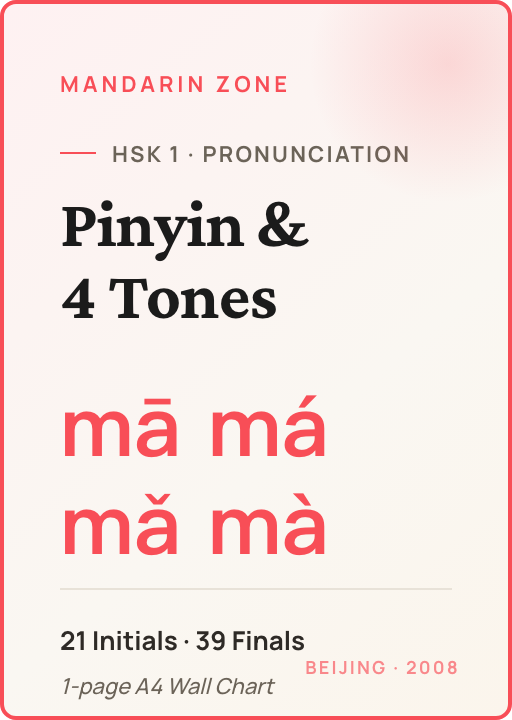
Pinyin (拼音 pīnyīn) is the official Romanization of Mandarin Chinese. Every Chinese syllable is built from an optional initial (consonant), a required final (vowel cluster), and one of five tones (4 contour tones + 1 neutral). Pinyin is how every HSK 1 word in this list is taught, drilled, and tested.
The 4 Tones
Sustained, level pitch, like singing one note. 妈 mā = mother.
Rises like a question in English ("really?"). 麻 má = hemp.
Drops then rises slightly, like reluctant agreement. 马 mǎ = horse.
Sharp drop, like a firm command ("Stop!"). 骂 mà = scold.
Tricky Initials Beginners Mix Up
| Initial | Sounds like | HSK 1 example word |
|---|---|---|
| zh / ch / sh | English "j / ch / sh", tongue curled back (retroflex) | 这 zhè (this) · 吃 chī (eat) · 是 shì (be) |
| z / c / s | English "dz / ts / s", tongue flat | 做 zuò (do) · 菜 cài (dish) · 三 sān (three) |
| j / q / x | "j / ch / sh" but lips wide, tongue forward | 家 jiā (home) · 七 qī (seven) · 学 xué (study) |
| b / p | "b" is unaspirated, "p" has a strong puff of air | 爸 bà (dad) · 朋友 péngyou (friend) |
| d / t | "d" is unaspirated, "t" has aspiration | 大 dà (big) · 听 tīng (listen) |
| g / k | "g" is unaspirated, "k" has aspiration | 哥哥 gēge (older brother) · 看 kàn (look) |
Two Tone-Sandhi Rules You Must Know
| Rule | What changes | HSK 1 examples |
|---|---|---|
| 3+3 → 2+3 | When two Tone-3 syllables meet, the first one becomes Tone 2. | 你好 nǐ hǎo → ní hǎo · 很好 hěn hǎo → hén hǎo |
| 不 (bù) before Tone 4 | "bù" changes to Tone 2 ("bú") before any Tone-4 syllable. | 不是 bù shì → bú shì · 不去 bù qù → bú qù |
You don't have to memorize the rules consciously — listen and imitate. But knowing why your textbook writes "nǐ hǎo" while you hear "ní hǎo" prevents months of confusion.
New HSK 1 vs Old HSK 1: What Beginners Need to Know
The new HSK 3.0 raises the bar significantly at level 1. If you are studying with a 2014-era HSK 1 textbook, here is what is different.
| Metric | Old HSK 1 (HSK 2.0) | New HSK 1 (HSK 3.0) | Change |
|---|---|---|---|
| New words at this level | 150 | 300 | ↑ +100% |
| Recognition characters (认读字) | not formally defined | 246 | New |
| Must-write characters (书写字) | not defined | 100 (HSK 1–2 combined) | New |
| Topic categorization | general / unstructured | 5 first-level · 15 second-level · 30 third-level | Structured |
| Defined tasks (能做) | broad descriptors | 15 specific everyday tasks | Standardized |
| Test sections | 2 (Listening · Reading) | 2 (Listening · Reading) | — |
| Total questions / duration | 40 / ≈ 40 min | 40 / ≈ 40 min | — |
Combined 1–2 must-write list. One of the most interesting design choices in HSK 3.0 is that levels 1 and 2 share a single 100-character must-write list rather than each defining its own. This reflects the reality that beginners can only meaningfully learn to hand-write a small set of high-frequency characters in the first 6 months of study.
Practical takeaway. The new HSK 1 expects roughly twice the vocabulary breadth — but spread across more structured, more practical daily-life topics. If you passed the old HSK 1 in 2024, plan on roughly 30–50 extra study hours to be ready for the new HSK 1 in 2026.
Complete New HSK 1 Vocabulary List (All 300 Words)
Every word below appears in the official 2025 HSK 3.0 syllabus published by CLEC (pp. 77–83). Each entry includes pinyin, part of speech, English meaning, and a beginner-friendly example sentence — tap the + button to expand the example. Use the topic filter to study one theme at a time.
300 words shown
| # | Chinese | Pinyin | POS | English | Topic | |
|---|---|---|---|---|---|---|
| 1 | 爱 | ài | v. | to love | Daily Life | |
例句我爱我的家人。 PinyinWǒ ài wǒ de jiārén. EnglishI love my family. | ||||||
| 2 | 八 | bā | num. | eight | Grammar / Function | |
例句今天是八月八号。 PinyinJīntiān shì bā yuè bā hào. EnglishToday is August 8th. | ||||||
| 3 | 爸爸 | bàba | n. | father; dad | Basic Info | |
例句爸爸在家里看电视。 PinyinBàba zài jiālǐ kàn diànshì. EnglishDad is watching TV at home. | ||||||
| 4 | 吧 | ba | part. | (particle) suggestion / softening | Grammar / Function | |
例句我们走吧。 PinyinWǒmen zǒu ba. EnglishLet's go. | ||||||
| 5 | 白天 | báitiān | n. | daytime | Grammar / Function | |
例句白天我在公司工作。 PinyinBáitiān wǒ zài gōngsī gōngzuò. EnglishI work at the company during the day. | ||||||
| 6 | 百 | bǎi | num. | hundred | Grammar / Function | |
例句这本书一百块钱。 PinyinZhè běn shū yì bǎi kuài qián. EnglishThis book costs one hundred yuan. | ||||||
| 7 | 半 | bàn | num./(adv.) | half | Grammar / Function | |
例句现在三点半。 PinyinXiànzài sān diǎn bàn. EnglishIt's half past three now. | ||||||
| 8 | 包子 | bāozi | n. | steamed stuffed bun | Culture | |
例句早饭我吃了两个包子。 PinyinZǎofàn wǒ chī le liǎng gè bāozi. EnglishI ate two steamed buns for breakfast. | ||||||
| 9 | 杯子 | bēizi | n. | cup; glass | Daily Life | |
例句请给我一个杯子。 PinyinQǐng gěi wǒ yí gè bēizi. EnglishPlease give me a cup. | ||||||
| 10 | 本1 | běn | mw. | (measure word for books) | Grammar / Function | |
例句我买了三本书。 PinyinWǒ mǎi le sān běn shū. EnglishI bought three books. | ||||||
| 11 | 边 | biān | n./suf. | side; edge | Grammar / Function | |
例句学校在路的左边。 PinyinXuéxiào zài lù de zuǒbiān. EnglishThe school is on the left side of the road. | ||||||
| 12 | 病 | bìng | n./v. | illness; to be sick | Daily Life | |
例句他生病了,不能来上课。 PinyinTā shēngbìng le, bù néng lái shàngkè. EnglishHe is sick and can't come to class. | ||||||
| 13 | 不 | bù | adv. | no; not | Grammar / Function | |
例句我不喝咖啡。 PinyinWǒ bù hē kāfēi. EnglishI don't drink coffee. | ||||||
| 14 | 不客气 | bú kèqi | phr. | you're welcome | Daily Life | |
例句不客气,这是我应该做的。 PinyinBú kèqi, zhè shì wǒ yīnggāi zuò de. EnglishYou're welcome, it's what I should do. | ||||||
| 15 | 不要 | búyào | adv. | don't; do not want | Grammar / Function | |
例句请不要在这里吃东西。 PinyinQǐng búyào zài zhèlǐ chī dōngxi. EnglishPlease don't eat here. | ||||||
| 16 | 菜 | cài | n. | dish; vegetable | Culture | |
例句妈妈做的菜很好吃。 PinyinMāma zuò de cài hěn hǎochī. EnglishThe dishes Mom makes are very delicious. | ||||||
| 17 | 茶 | chá | n. | tea | Culture | |
例句你想喝茶吗? PinyinNǐ xiǎng hē chá ma? EnglishWould you like to drink tea? | ||||||
| 18 | 唱 | chàng | v. | to sing | Daily Life | |
例句她很喜欢唱歌。 PinyinTā hěn xǐhuan chànggē. EnglishShe really likes to sing. | ||||||
| 19 | 超市 | chāoshì | n. | supermarket | Daily Life | |
例句我去超市买水果。 PinyinWǒ qù chāoshì mǎi shuǐguǒ. EnglishI'm going to the supermarket to buy fruit. | ||||||
| 20 | 车 | chē | n. | vehicle; car | Daily Life | |
例句他开车去上班。 PinyinTā kāichē qù shàngbān. EnglishHe drives to work. | ||||||
| 21 | 吃 | chī | v. | to eat | Daily Life | |
例句你吃饭了吗? PinyinNǐ chīfàn le ma? EnglishHave you eaten? | ||||||
| 22 | 出租车 | chūzūchē | n. | taxi | Daily Life | |
例句我们坐出租车去机场。 PinyinWǒmen zuò chūzūchē qù jīchǎng. EnglishWe take a taxi to the airport. | ||||||
| 23 | 穿 | chuān | v. | to wear (clothing) | Daily Life | |
例句今天很冷,多穿点衣服。 PinyinJīntiān hěn lěng, duō chuān diǎn yīfu. EnglishIt's cold today, wear more clothes. | ||||||
| 24 | 打电话 | dǎ diànhuà | v.o. | to make a phone call | Daily Life | |
例句我给妈妈打电话了。 PinyinWǒ gěi māma dǎ diànhuà le. EnglishI called Mom. | ||||||
| 25 | 大 | dà | adj. | big; large | Grammar / Function | |
例句这个房间很大。 PinyinZhège fángjiān hěn dà. EnglishThis room is very big. | ||||||
| 26 | 大家 | dàjiā | pron. | everyone | Grammar / Function | |
例句大家好,我是新同学。 PinyinDàjiā hǎo, wǒ shì xīn tóngxué. EnglishHello everyone, I'm a new classmate. | ||||||
| 27 | 大学 | dàxué | n. | university | Education | |
例句她在大学学中文。 PinyinTā zài dàxué xué Zhōngwén. EnglishShe studies Chinese at university. | ||||||
| 28 | 大学生 | dàxuéshēng | n. | university student | Education | |
例句他是一个大学生。 PinyinTā shì yí gè dàxuéshēng. EnglishHe is a college student. | ||||||
| 29 | 到 | dào | v. | to arrive; up to | Grammar / Function | |
例句我到学校了。 PinyinWǒ dào xuéxiào le. EnglishI've arrived at school. | ||||||
| 30 | 的 | de | part. | (possessive / modifier particle) | Grammar / Function | |
例句这是我的书。 PinyinZhè shì wǒ de shū. EnglishThis is my book. | ||||||
| 31 | 第 | dì | pref. | (ordinal prefix: -th, 1st, 2nd) | Grammar / Function | |
例句他是我的第一个朋友。 PinyinTā shì wǒ de dì yī gè péngyou. EnglishHe is my first friend. | ||||||
| 32 | 弟弟 | dìdi | n. | younger brother | Basic Info | |
例句我弟弟今年十岁。 PinyinWǒ dìdi jīnnián shí suì. EnglishMy younger brother is ten years old this year. | ||||||
| 33 | 点1 | diǎn | mw./(n.) | o'clock; spot; a little | Grammar / Function | |
例句现在是下午两点。 PinyinXiànzài shì xiàwǔ liǎng diǎn. EnglishIt's 2 PM now. | ||||||
| 34 | 店 | diàn | n. | shop; store | Daily Life | |
例句这家店卖什么? PinyinZhè jiā diàn mài shénme? EnglishWhat does this shop sell? | ||||||
| 35 | 电话 | diànhuà | n. | telephone | Daily Life | |
例句你的电话号码是多少? PinyinNǐ de diànhuà hàomǎ shì duōshao? EnglishWhat is your phone number? | ||||||
| 36 | 电脑 | diànnǎo | n. | computer | Daily Life | |
例句我用电脑写作业。 PinyinWǒ yòng diànnǎo xiě zuòyè. EnglishI use a computer to do homework. | ||||||
| 37 | 电视 | diànshì | n. | television | Daily Life | |
例句晚上我喜欢看电视。 PinyinWǎnshang wǒ xǐhuan kàn diànshì. EnglishI like watching TV in the evening. | ||||||
| 38 | 电影 | diànyǐng | n. | movie; film | Daily Life | |
例句我们去看电影吧。 PinyinWǒmen qù kàn diànyǐng ba. EnglishLet's go watch a movie. | ||||||
| 39 | 电影院 | diànyǐngyuàn | n. | cinema; movie theater | Daily Life | |
例句电影院在超市的旁边。 PinyinDiànyǐngyuàn zài chāoshì de pángbiān. EnglishThe cinema is next to the supermarket. | ||||||
| 40 | 东西 | dōngxi | n. | thing; stuff | Daily Life | |
例句我去商店买东西。 PinyinWǒ qù shāngdiàn mǎi dōngxi. EnglishI'm going to the store to buy things. | ||||||
| 41 | 都 | dōu | adv. | all; both | Grammar / Function | |
例句我们都是中国人。 PinyinWǒmen dōu shì Zhōngguó rén. EnglishWe are all Chinese. | ||||||
| 42 | 读 | dú | v. | to read | Education | |
例句请读这个句子。 PinyinQǐng dú zhège jùzi. EnglishPlease read this sentence. | ||||||
| 43 | 读书 | dúshū | v. | to study; to read books | Education | |
例句他很喜欢读书。 PinyinTā hěn xǐhuan dúshū. EnglishHe really likes reading. | ||||||
| 44 | 对 | duì | adj./prep./(v./mw.) | correct; toward | Grammar / Function | |
例句你说得对。 PinyinNǐ shuō de duì. EnglishYou're right. | ||||||
| 45 | 对不起 | duìbuqǐ | v. | sorry; excuse me | Daily Life | |
例句对不起,我来晚了。 PinyinDuìbuqǐ, wǒ lái wǎn le. EnglishSorry, I'm late. | ||||||
| 46 | 多 | duō | adj./v./pron./(num./adv.) | many; much; how (in questions) | Grammar / Function | |
例句你家有多少人? PinyinNǐ jiā yǒu duōshao rén? EnglishHow many people are in your family? | ||||||
| 47 | 多少 | duōshao | pron. | how many; how much | Grammar / Function | |
例句这个多少钱? PinyinZhège duōshao qián? EnglishHow much is this? | ||||||
| 48 | 儿子 | érzi | n. | son | Basic Info | |
例句他的儿子很聪明。 PinyinTā de érzi hěn cōngming. EnglishHis son is very smart. | ||||||
| 49 | 二 | èr | num. | two (the number) | Grammar / Function | |
例句我家有二十本书。 PinyinWǒ jiā yǒu èrshí běn shū. EnglishMy family has twenty books. | ||||||
| 50 | 饭 | fàn | n. | meal; cooked rice | Culture | |
例句该吃饭了。 PinyinGāi chīfàn le. EnglishIt's time to eat. | ||||||
| 51 | 饭店 | fàndiàn | n. | restaurant; hotel | Daily Life | |
例句我们去那家饭店吃饭。 PinyinWǒmen qù nà jiā fàndiàn chīfàn. EnglishLet's go eat at that restaurant. | ||||||
| 52 | 房间 | fángjiān | n. | room | Daily Life | |
例句我的房间不大。 PinyinWǒ de fángjiān bú dà. EnglishMy room is not big. | ||||||
| 53 | 非常 | fēicháng | adv. | extremely; very | Grammar / Function | |
例句今天天气非常好。 PinyinJīntiān tiānqì fēicháng hǎo. EnglishThe weather today is very good. | ||||||
| 54 | 飞机 | fēijī | n. | airplane | Daily Life | |
例句我坐飞机去北京。 PinyinWǒ zuò fēijī qù Běijīng. EnglishI fly to Beijing. | ||||||
| 55 | 分 | fēn | mw./(v./n.) | minute; cent; to divide | Grammar / Function | |
例句现在是三点十分。 PinyinXiànzài shì sān diǎn shí fēn. EnglishIt's 3:10 now. | ||||||
| 56 | 分钟 | fēnzhōng | mw. | minute (duration) | Grammar / Function | |
例句请等我五分钟。 PinyinQǐng děng wǒ wǔ fēnzhōng. EnglishPlease wait five minutes for me. | ||||||
| 57 | 高兴 | gāoxìng | adj. | happy; glad | Daily Life | |
例句认识你我很高兴。 PinyinRènshi nǐ wǒ hěn gāoxìng. EnglishI'm very happy to meet you. | ||||||
| 58 | 歌 | gē | n. | song | Daily Life | |
例句这首歌很好听。 PinyinZhè shǒu gē hěn hǎotīng. EnglishThis song sounds really nice. | ||||||
| 59 | 哥哥 | gēge | n. | older brother | Basic Info | |
例句哥哥在北京工作。 PinyinGēge zài Běijīng gōngzuò. EnglishMy older brother works in Beijing. | ||||||
| 60 | 个 | gè | mw. | (general measure word) | Grammar / Function | |
例句我要一个苹果。 PinyinWǒ yào yí gè píngguǒ. EnglishI want an apple. | ||||||
| 61 | 给 | gěi | v./(prep.) | to give; for | Grammar / Function | |
例句妈妈给我买了一本书。 PinyinMāma gěi wǒ mǎi le yì běn shū. EnglishMom bought me a book. | ||||||
| 62 | 公司 | gōngsī | n. | company; firm | Workplace | |
例句他在一家大公司工作。 PinyinTā zài yì jiā dà gōngsī gōngzuò. EnglishHe works at a big company. | ||||||
| 63 | 工作 | gōngzuò | v./n. | job; to work | Workplace | |
例句你在哪儿工作? PinyinNǐ zài nǎr gōngzuò? EnglishWhere do you work? | ||||||
| 64 | 狗 | gǒu | n. | dog | Daily Life | |
例句我家有一只狗。 PinyinWǒ jiā yǒu yì zhī gǒu. EnglishMy family has a dog. | ||||||
| 65 | 贵 | guì | adj. | expensive; honorable | Daily Life | |
例句这件衣服太贵了。 PinyinZhè jiàn yīfu tài guì le. EnglishThis piece of clothing is too expensive. | ||||||
| 66 | 国 | guó | n. | country; nation | Basic Info | |
例句中国是一个大国。 PinyinZhōngguó shì yí gè dà guó. EnglishChina is a big country. | ||||||
| 67 | 还 | hái | adv. | still; also; yet | Grammar / Function | |
例句我还没有吃饭。 PinyinWǒ hái méiyǒu chīfàn. EnglishI haven't eaten yet. | ||||||
| 68 | 孩子 | háizi | n. | child; children | Basic Info | |
例句孩子们在外面玩。 PinyinHáizimen zài wàimiàn wán. EnglishThe children are playing outside. | ||||||
| 69 | 汉语 | Hànyǔ | n. | Chinese (language) | Education | |
例句我在学汉语。 PinyinWǒ zài xué Hànyǔ. EnglishI am learning Chinese. | ||||||
| 70 | 汉字 | Hànzì | n. | Chinese character | Education | |
例句汉字很有意思。 PinyinHànzì hěn yǒu yìsi. EnglishChinese characters are very interesting. | ||||||
| 71 | 好 | hǎo | adj./(adv.)/(v.) | good; well | Grammar / Function | |
例句你好!你今天怎么样? PinyinNǐ hǎo! Nǐ jīntiān zěnmeyàng? EnglishHello! How are you today? | ||||||
| 72 | 好吃 | hǎochī | adj. | delicious; tasty | Culture | |
例句这个菜真好吃。 PinyinZhège cài zhēn hǎochī. EnglishThis dish is really delicious. | ||||||
| 73 | 好看 | hǎokàn | adj. | good-looking; nice to look at | Daily Life | |
例句那部电影很好看。 PinyinNà bù diànyǐng hěn hǎokàn. EnglishThat movie is really good. | ||||||
| 74 | 好听 | hǎotīng | adj. | pleasant to hear | Daily Life | |
例句她的声音很好听。 PinyinTā de shēngyīn hěn hǎotīng. EnglishHer voice sounds very nice. | ||||||
| 75 | 好玩儿 | hǎowánr | adj. | fun; amusing | Daily Life | |
例句这个地方很好玩儿。 PinyinZhège dìfang hěn hǎowánr. EnglishThis place is really fun. | ||||||
| 76 | 号 | hào | n./mw. | number; date (of month) | Grammar / Function | |
例句今天几月几号? PinyinJīntiān jǐ yuè jǐ hào? EnglishWhat's the date today? | ||||||
| 77 | 喝 | hē | v. | to drink | Daily Life | |
例句我每天喝很多水。 PinyinWǒ měitiān hē hěn duō shuǐ. EnglishI drink a lot of water every day. | ||||||
| 78 | 和1 | hé | prep./conj. | and; with | Grammar / Function | |
例句我和朋友一起去。 PinyinWǒ hé péngyou yìqǐ qù. EnglishI go together with my friend. | ||||||
| 79 | 很 | hěn | adv. | very | Grammar / Function | |
例句她很漂亮。 PinyinTā hěn piàoliang. EnglishShe is very beautiful. | ||||||
| 80 | 后 | hòu | n. | after; behind | Grammar / Function | |
例句学校在医院的后面。 PinyinXuéxiào zài yīyuàn de hòumiàn. EnglishThe school is behind the hospital. | ||||||
| 81 | 回 | huí | v./(mw.) | to return; to go back | Grammar / Function | |
例句我想回家。 PinyinWǒ xiǎng huí jiā. EnglishI want to go home. | ||||||
| 82 | 会1 | huì | v. | can; will (be able to) | Grammar / Function | |
例句你会说中文吗? PinyinNǐ huì shuō Zhōngwén ma? EnglishCan you speak Chinese? | ||||||
| 83 | 火车 | huǒchē | n. | train | Daily Life | |
例句坐火车去上海要五个小时。 PinyinZuò huǒchē qù Shànghǎi yào wǔ gè xiǎoshí. EnglishIt takes five hours to go to Shanghai by train. | ||||||
| 84 | 鸡蛋 | jīdàn | n. | (chicken) egg | Culture | |
例句早饭我吃了一个鸡蛋。 PinyinZǎofàn wǒ chī le yí gè jīdàn. EnglishI ate an egg for breakfast. | ||||||
| 85 | 几 | jǐ | pron./num. | how many (small number); several | Grammar / Function | |
例句你家有几口人? PinyinNǐ jiā yǒu jǐ kǒu rén? EnglishHow many people are in your family? | ||||||
| 86 | 家 | jiā | n./mw./(suf.) | home; family; household | Basic Info | |
例句我家在北京。 PinyinWǒ jiā zài Běijīng. EnglishMy home is in Beijing. | ||||||
| 87 | 家人 | jiārén | n. | family member(s) | Basic Info | |
例句我非常想我的家人。 PinyinWǒ fēicháng xiǎng wǒ de jiārén. EnglishI miss my family very much. | ||||||
| 88 | 见 | jiàn | v. | to see; to meet | Daily Life | |
例句很高兴见到你。 PinyinHěn gāoxìng jiàndào nǐ. EnglishNice to meet you. | ||||||
| 89 | 件 | jiàn | mw. | (measure word: items, matters) | Grammar / Function | |
例句我买了一件新衣服。 PinyinWǒ mǎi le yí jiàn xīn yīfu. EnglishI bought a new piece of clothing. | ||||||
| 90 | 饺子 | jiǎozi | n. | dumpling (Chinese) | Culture | |
例句过年的时候我们吃饺子。 PinyinGuònián de shíhou wǒmen chī jiǎozi. EnglishWe eat dumplings during Chinese New Year. | ||||||
| 91 | 叫 | jiào | v./(prep.) | to be called; to call | Basic Info | |
例句我叫李明。 PinyinWǒ jiào Lǐ Míng. EnglishMy name is Li Ming. | ||||||
| 92 | 姐姐 | jiějie | n. | older sister | Basic Info | |
例句姐姐比我大三岁。 PinyinJiějie bǐ wǒ dà sān suì. EnglishMy older sister is three years older than me. | ||||||
| 93 | 今年 | jīnnián | n. | this year | Grammar / Function | |
例句今年我二十岁。 PinyinJīnnián wǒ èrshí suì. EnglishI'm twenty years old this year. | ||||||
| 94 | 今天 | jīntiān | n. | today | Grammar / Function | |
例句今天星期几? PinyinJīntiān xīngqī jǐ? EnglishWhat day is it today? | ||||||
| 95 | 九 | jiǔ | num. | nine | Grammar / Function | |
例句他们家有九口人。 PinyinTāmen jiā yǒu jiǔ kǒu rén. EnglishThere are nine people in their family. | ||||||
| 96 | 觉得 | juéde | v. | to feel; to think | Daily Life | |
例句我觉得中文很有意思。 PinyinWǒ juéde Zhōngwén hěn yǒu yìsi. EnglishI think Chinese is very interesting. | ||||||
| 97 | 开 | kāi | v. | to open; to drive; to start | Grammar / Function | |
例句请开门。 PinyinQǐng kāi mén. EnglishPlease open the door. | ||||||
| 98 | 开车 | kāichē | v. | to drive (a vehicle) | Daily Life | |
例句我不会开车。 PinyinWǒ bú huì kāichē. EnglishI can't drive. | ||||||
| 99 | 看 | kàn | v. | to look; to watch | Daily Life | |
例句我在看书。 PinyinWǒ zài kàn shū. EnglishI'm reading a book. | ||||||
| 100 | 看病 | kànbìng | v. | to see a doctor | Daily Life | |
例句他去医院看病了。 PinyinTā qù yīyuàn kànbìng le. EnglishHe went to the hospital to see a doctor. | ||||||
| 101 | 看见 | kànjiàn | v. | to see; to catch sight of | Daily Life | |
例句我看见他了。 PinyinWǒ kànjiàn tā le. EnglishI saw him. | ||||||
| 102 | 可以 | kěyǐ | v./adj. | can; may; permitted | Grammar / Function | |
例句我可以坐这儿吗? PinyinWǒ kěyǐ zuò zhèr ma? EnglishMay I sit here? | ||||||
| 103 | 课 | kè | n. | lesson; class | Education | |
例句今天有三节课。 PinyinJīntiān yǒu sān jié kè. EnglishThere are three classes today. | ||||||
| 104 | 口 | kǒu | n./mw. | mouth; (measure word for people) | Grammar / Function | |
例句我们家有五口人。 PinyinWǒmen jiā yǒu wǔ kǒu rén. EnglishThere are five people in our family. | ||||||
| 105 | 块 | kuài | mw. | (measure word: yuan; piece) | Grammar / Function | |
例句这个苹果两块钱。 PinyinZhège píngguǒ liǎng kuài qián. EnglishThis apple costs two yuan. | ||||||
| 106 | 来 | lái | v. | to come | Grammar / Function | |
例句你来我家玩吧。 PinyinNǐ lái wǒ jiā wán ba. EnglishCome to my house to play. | ||||||
| 107 | 老师 | lǎoshī | n. | teacher | Education | |
例句老师在教室里。 PinyinLǎoshī zài jiàoshì lǐ. EnglishThe teacher is in the classroom. | ||||||
| 108 | 了 | le | part. | (particle: completed action / change) | Grammar / Function | |
例句我吃了早饭了。 PinyinWǒ chī le zǎofàn le. EnglishI've eaten breakfast. | ||||||
| 109 | 冷 | lěng | adj. | cold | Basic Info | |
例句北京的冬天很冷。 PinyinBěijīng de dōngtiān hěn lěng. EnglishWinter in Beijing is very cold. | ||||||
| 110 | 里 | lǐ | n. | inside; in | Grammar / Function | |
例句书在书包里。 PinyinShū zài shūbāo lǐ. EnglishThe book is in the bag. | ||||||
| 111 | 两1 | liǎng | num. | two (with measure word) | Grammar / Function | |
例句我有两个姐姐。 PinyinWǒ yǒu liǎng gè jiějie. EnglishI have two older sisters. | ||||||
| 112 | 零 | líng | num. | zero | Grammar / Function | |
例句他今年十岁零三个月。 PinyinTā jīnnián shí suì líng sān gè yuè. EnglishHe is ten years and three months old this year. | ||||||
| 113 | 六 | liù | num. | six | Grammar / Function | |
例句我六点起床。 PinyinWǒ liù diǎn qǐchuáng. EnglishI get up at six o'clock. | ||||||
| 114 | 妈妈 | māma | n. | mother; mom | Basic Info | |
例句妈妈在做饭。 PinyinMāma zài zuòfàn. EnglishMom is cooking. | ||||||
| 115 | 吗 | ma | part. | (yes/no question particle) | Grammar / Function | |
例句你是学生吗? PinyinNǐ shì xuéshēng ma? EnglishAre you a student? | ||||||
| 116 | 买 | mǎi | v. | to buy | Daily Life | |
例句我想买一件衣服。 PinyinWǒ xiǎng mǎi yí jiàn yīfu. EnglishI want to buy a piece of clothing. | ||||||
| 117 | 卖 | mài | v. | to sell | Daily Life | |
例句他在卖水果。 PinyinTā zài mài shuǐguǒ. EnglishHe is selling fruit. | ||||||
| 118 | 忙 | máng | adj./v. | busy | Daily Life | |
例句最近工作很忙。 PinyinZuìjìn gōngzuò hěn máng. EnglishWork has been very busy recently. | ||||||
| 119 | 猫 | māo | n. | cat | Daily Life | |
例句她家的猫很可爱。 PinyinTā jiā de māo hěn kě'ài. EnglishHer cat is very cute. | ||||||
| 120 | 没关系 | méi guānxi | phr. | it's okay; no problem | Daily Life | |
例句没关系,不用担心。 PinyinMéi guānxi, búyòng dānxīn. EnglishIt's okay, don't worry. | ||||||
| 121 | 没事 | méishì | v. | it's fine; no problem | Daily Life | |
例句你没事吧? PinyinNǐ méishì ba? EnglishAre you alright? | ||||||
| 122 | 没有 | méiyǒu | v./adv. | to not have; (there) isn't | Grammar / Function | |
例句我没有手机。 PinyinWǒ méiyǒu shǒujī. EnglishI don't have a phone. | ||||||
| 123 | 妹妹 | mèimei | n. | younger sister | Basic Info | |
例句妹妹在上小学。 PinyinMèimei zài shàng xiǎoxué. EnglishMy younger sister is in elementary school. | ||||||
| 124 | 们 | men | suf. | (plural marker for people) | Grammar / Function | |
例句同学们好! PinyinTóngxuémen hǎo! EnglishHello, classmates! | ||||||
| 125 | 米饭 | mǐfàn | n. | cooked rice | Culture | |
例句中国人喜欢吃米饭。 PinyinZhōngguó rén xǐhuan chī mǐfàn. EnglishChinese people like to eat rice. | ||||||
| 126 | 面包 | miànbāo | n. | bread | Culture | |
例句早上我吃了一个面包。 PinyinZǎoshang wǒ chī le yí gè miànbāo. EnglishI ate a piece of bread in the morning. | ||||||
| 127 | 面条儿 | miàntiáor | n. | noodles | Culture | |
例句我中午吃面条儿。 PinyinWǒ zhōngwǔ chī miàntiáor. EnglishI eat noodles for lunch. | ||||||
| 128 | 明年 | míngnián | n. | next year | Grammar / Function | |
例句明年我想去中国。 PinyinMíngnián wǒ xiǎng qù Zhōngguó. EnglishI want to go to China next year. | ||||||
| 129 | 明天 | míngtiān | n. | tomorrow | Grammar / Function | |
例句明天你有时间吗? PinyinMíngtiān nǐ yǒu shíjiān ma? EnglishDo you have time tomorrow? | ||||||
| 130 | 名字 | míngzi | n. | name | Basic Info | |
例句请问你叫什么名字? PinyinQǐngwèn nǐ jiào shénme míngzi? EnglishMay I ask what your name is? | ||||||
| 131 | 哪 | nǎ | pron. | which; where | Grammar / Function | |
例句你是哪国人? PinyinNǐ shì nǎ guó rén? EnglishWhat country are you from? | ||||||
| 132 | 哪个 | nǎge | pron. | which one | Grammar / Function | |
例句哪个是你的杯子? PinyinNǎge shì nǐ de bēizi? EnglishWhich one is your cup? | ||||||
| 133 | 哪里 | nǎlǐ | pron. | where | Grammar / Function | |
例句你住在哪里? PinyinNǐ zhù zài nǎlǐ? EnglishWhere do you live? | ||||||
| 134 | 哪儿 | nǎr | pron. | where | Grammar / Function | |
例句你要去哪儿? PinyinNǐ yào qù nǎr? EnglishWhere are you going? | ||||||
| 135 | 哪些 | nǎxiē | pron. | which (plural) | Grammar / Function | |
例句你喜欢哪些水果? PinyinNǐ xǐhuan nǎxiē shuǐguǒ? EnglishWhich fruits do you like? | ||||||
| 136 | 那 | nà | pron./(conj.) | that | Grammar / Function | |
例句那是我的老师。 PinyinNà shì wǒ de lǎoshī. EnglishThat is my teacher. | ||||||
| 137 | 那边 | nàbiān | pron. | that side; over there | Grammar / Function | |
例句你的朋友在那边。 PinyinNǐ de péngyou zài nàbiān. EnglishYour friend is over there. | ||||||
| 138 | 那个 | nàge | pron. | that one | Grammar / Function | |
例句那个人是谁? PinyinNàge rén shì shéi? EnglishWho is that person? | ||||||
| 139 | 那里 | nàlǐ | pron. | there | Grammar / Function | |
例句我想去那里看看。 PinyinWǒ xiǎng qù nàlǐ kànkan. EnglishI want to go there to take a look. | ||||||
| 140 | 那儿 | nàr | pron. | there | Grammar / Function | |
例句那儿有一个商店。 PinyinNàr yǒu yí gè shāngdiàn. EnglishThere's a shop over there. | ||||||
| 141 | 那些 | nàxiē | pron. | those | Grammar / Function | |
例句那些书是谁的? PinyinNàxiē shū shì shéi de? EnglishWhose are those books? | ||||||
| 142 | 男 | nán | adj. | male | Basic Info | |
例句那个男同学很高。 PinyinNàge nán tóngxué hěn gāo. EnglishThat male classmate is very tall. | ||||||
| 143 | 男朋友 | nánpéngyou | n. | boyfriend | Basic Info | |
例句她的男朋友是美国人。 PinyinTā de nánpéngyou shì Měiguó rén. EnglishHer boyfriend is American. | ||||||
| 144 | 呢 | ne | part. | (question particle: and …?) | Grammar / Function | |
例句你呢?你喜欢什么? PinyinNǐ ne? Nǐ xǐhuan shénme? EnglishAnd you? What do you like? | ||||||
| 145 | 能 | néng | v. | can; be able to | Grammar / Function | |
例句你能帮我吗? PinyinNǐ néng bāng wǒ ma? EnglishCan you help me? | ||||||
| 146 | 你 | nǐ | pron. | you | Grammar / Function | |
例句你好,你是新来的吗? PinyinNǐ hǎo, nǐ shì xīn lái de ma? EnglishHello, are you new here? | ||||||
| 147 | 你好 | nǐ hǎo | phr. | hello | Daily Life | |
例句你好,很高兴认识你。 PinyinNǐ hǎo, hěn gāoxìng rènshi nǐ. EnglishHello, nice to meet you. | ||||||
| 148 | 你们 | nǐmen | pron. | you (plural) | Grammar / Function | |
例句你们想吃什么? PinyinNǐmen xiǎng chī shénme? EnglishWhat do you all want to eat? | ||||||
| 149 | 年 | nián | n./mw. | year | Grammar / Function | |
例句一年有十二个月。 PinyinYì nián yǒu shí'èr gè yuè. EnglishThere are twelve months in a year. | ||||||
| 150 | 您 | nín | pron. | you (polite) | Grammar / Function | |
例句请问您贵姓? PinyinQǐngwèn nín guì xìng? EnglishMay I ask your surname? | ||||||
| 151 | 牛奶 | niúnǎi | n. | (cow) milk | Culture | |
例句我每天早上喝牛奶。 PinyinWǒ měitiān zǎoshang hē niúnǎi. EnglishI drink milk every morning. | ||||||
| 152 | 女 | nǚ | adj. | female | Basic Info | |
例句班里有十个女同学。 PinyinBān lǐ yǒu shí gè nǚ tóngxué. EnglishThere are ten female classmates in the class. | ||||||
| 153 | 女儿 | nǚ’ér | n. | daughter | Basic Info | |
例句他的女儿今年五岁。 PinyinTā de nǚ'ér jīnnián wǔ suì. EnglishHis daughter is five years old this year. | ||||||
| 154 | 女朋友 | nǚpéngyou | n. | girlfriend | Basic Info | |
例句他还没有女朋友。 PinyinTā hái méiyǒu nǚpéngyou. EnglishHe doesn't have a girlfriend yet. | ||||||
| 155 | 女士 | nǚshì | n. | lady; Ms.; Madam | Daily Life | |
例句这位女士是我们的老师。 PinyinZhè wèi nǚshì shì wǒmen de lǎoshī. EnglishThis lady is our teacher. | ||||||
| 156 | 朋友 | péngyou | n. | friend | Daily Life | |
例句他是我最好的朋友。 PinyinTā shì wǒ zuì hǎo de péngyou. EnglishHe is my best friend. | ||||||
| 157 | 便宜 | piányi | adj. | cheap; inexpensive | Daily Life | |
例句这个很便宜,只要十块钱。 PinyinZhège hěn piányi, zhǐ yào shí kuài qián. EnglishThis is very cheap, only ten yuan. | ||||||
| 158 | 漂亮 | piàoliang | adj. | pretty; beautiful | Daily Life | |
例句你今天穿的衣服真漂亮。 PinyinNǐ jīntiān chuān de yīfu zhēn piàoliang. EnglishThe clothes you're wearing today are really beautiful. | ||||||
| 159 | 苹果 | píngguǒ | n. | apple | Daily Life | |
例句我喜欢吃苹果。 PinyinWǒ xǐhuan chī píngguǒ. EnglishI like eating apples. | ||||||
| 160 | 七 | qī | num. | seven | Grammar / Function | |
例句一个星期有七天。 PinyinYí gè xīngqī yǒu qī tiān. EnglishThere are seven days in a week. | ||||||
| 161 | 起床 | qǐchuáng | v. | to get up (out of bed) | Daily Life | |
例句我每天早上七点起床。 PinyinWǒ měitiān zǎoshang qī diǎn qǐchuáng. EnglishI get up at seven every morning. | ||||||
| 162 | 千 | qiān | num. | thousand | Grammar / Function | |
例句这部手机三千块钱。 PinyinZhè bù shǒujī sān qiān kuài qián. EnglishThis phone costs three thousand yuan. | ||||||
| 163 | 前 | qián | n. | front; before | Grammar / Function | |
例句学校前面有一家书店。 PinyinXuéxiào qiánmiàn yǒu yì jiā shūdiàn. EnglishThere's a bookstore in front of the school. | ||||||
| 164 | 钱 | qián | n. | money | Daily Life | |
例句你有钱吗? PinyinNǐ yǒu qián ma? EnglishDo you have money? | ||||||
| 165 | 请 | qǐng | v. | please; to invite | Daily Life | |
例句请坐! PinyinQǐng zuò! EnglishPlease have a seat! | ||||||
| 166 | 请问 | qǐngwèn | v. | excuse me; may I ask | Daily Life | |
例句请问,去火车站怎么走? PinyinQǐngwèn, qù huǒchēzhàn zěnme zǒu? EnglishExcuse me, how do I get to the train station? | ||||||
| 167 | 去 | qù | v. | to go | Grammar / Function | |
例句我明天去学校。 PinyinWǒ míngtiān qù xuéxiào. EnglishI'm going to school tomorrow. | ||||||
| 168 | 去年 | qùnián | n. | last year | Grammar / Function | |
例句去年我去了上海。 PinyinQùnián wǒ qù le Shànghǎi. EnglishLast year I went to Shanghai. | ||||||
| 169 | 热 | rè | adj. | hot | Basic Info | |
例句夏天很热。 PinyinXiàtiān hěn rè. EnglishSummer is very hot. | ||||||
| 170 | 人 | rén | n. | person; people | Grammar / Function | |
例句那个人是我的老师。 PinyinNàge rén shì wǒ de lǎoshī. EnglishThat person is my teacher. | ||||||
| 171 | 认识 | rènshi | v. | to know; to be acquainted | Daily Life | |
例句我认识他。 PinyinWǒ rènshi tā. EnglishI know him. | ||||||
| 172 | 日 | rì | mw./(n.) | day; sun | Grammar / Function | |
例句今天是十月一日。 PinyinJīntiān shì shí yuè yī rì. EnglishToday is October 1st. | ||||||
| 173 | 三 | sān | num. | three | Grammar / Function | |
例句我有三个好朋友。 PinyinWǒ yǒu sān gè hǎo péngyou. EnglishI have three good friends. | ||||||
| 174 | 商店 | shāngdiàn | n. | shop; store | Daily Life | |
例句商店几点关门? PinyinShāngdiàn jǐ diǎn guānmén? EnglishWhat time does the shop close? | ||||||
| 175 | 上 | shàng | n./v. | up; on; above; previous | Grammar / Function | |
例句猫在桌子上。 PinyinMāo zài zhuōzi shàng. EnglishThe cat is on the table. | ||||||
| 176 | 上班 | shàngbān | v. | to go to work | Workplace | |
例句爸爸每天八点上班。 PinyinBàba měitiān bā diǎn shàngbān. EnglishDad goes to work at eight every day. | ||||||
| 177 | 上课 | shàngkè | v. | to attend class | Education | |
例句我们八点半上课。 PinyinWǒmen bā diǎn bàn shàngkè. EnglishWe start class at 8:30. | ||||||
| 178 | 上午 | shàngwǔ | n. | morning; before noon | Grammar / Function | |
例句上午我有两节课。 PinyinShàngwǔ wǒ yǒu liǎng jié kè. EnglishI have two classes in the morning. | ||||||
| 179 | 上学 | shàngxué | v. | to attend school | Education | |
例句孩子们每天走路上学。 PinyinHáizimen měitiān zǒulù shàngxué. EnglishThe children walk to school every day. | ||||||
| 180 | 少 | shǎo | adj./v. | few; little | Grammar / Function | |
例句这个学校的学生很少。 PinyinZhège xuéxiào de xuéshēng hěn shǎo. EnglishThis school has very few students. | ||||||
| 181 | 谁 | shéi/shuí | pron. | who | Grammar / Function | |
例句他是谁? PinyinTā shì shéi? EnglishWho is he? | ||||||
| 182 | 什么 | shénme | pron. | what | Grammar / Function | |
例句你在做什么? PinyinNǐ zài zuò shénme? EnglishWhat are you doing? | ||||||
| 183 | 生病 | shēngbìng | v. | to get sick | Daily Life | |
例句他昨天生病了。 PinyinTā zuótiān shēngbìng le. EnglishHe got sick yesterday. | ||||||
| 184 | 十 | shí | num. | ten | Grammar / Function | |
例句我有十本书。 PinyinWǒ yǒu shí běn shū. EnglishI have ten books. | ||||||
| 185 | 时候 | shíhou | n. | time; moment | Grammar / Function | |
例句你什么时候来? PinyinNǐ shénme shíhou lái? EnglishWhen are you coming? | ||||||
| 186 | 时间 | shíjiān | n. | time; period of time | Grammar / Function | |
例句我没有时间。 PinyinWǒ méiyǒu shíjiān. EnglishI don't have time. | ||||||
| 187 | 事 | shì | n. | matter; thing; affair | Basic Info | |
例句你有什么事? PinyinNǐ yǒu shénme shì? EnglishWhat's the matter? | ||||||
| 188 | 是 | shì | v. | to be (am/is/are) | Grammar / Function | |
例句我是中国人。 PinyinWǒ shì Zhōngguó rén. EnglishI am Chinese. | ||||||
| 189 | 手机 | shǒujī | n. | mobile phone | Daily Life | |
例句我的手机在哪儿? PinyinWǒ de shǒujī zài nǎr? EnglishWhere is my phone? | ||||||
| 190 | 书 | shū | n. | book | Education | |
例句这本书很有意思。 PinyinZhè běn shū hěn yǒu yìsi. EnglishThis book is very interesting. | ||||||
| 191 | 书店 | shūdiàn | n. | bookstore | Daily Life | |
例句我去书店买了两本书。 PinyinWǒ qù shūdiàn mǎi le liǎng běn shū. EnglishI went to the bookstore and bought two books. | ||||||
| 192 | 水 | shuǐ | n. | water | Daily Life | |
例句请给我一杯水。 PinyinQǐng gěi wǒ yì bēi shuǐ. EnglishPlease give me a glass of water. | ||||||
| 193 | 水果 | shuǐguǒ | n. | fruit | Daily Life | |
例句多吃水果对身体好。 PinyinDuō chī shuǐguǒ duì shēntǐ hǎo. EnglishEating more fruit is good for health. | ||||||
| 194 | 睡 | shuì | v. | to sleep | Daily Life | |
例句他在睡觉。 PinyinTā zài shuìjiào. EnglishHe is sleeping. | ||||||
| 195 | 睡觉 | shuìjiào | v. | to sleep; to go to bed | Daily Life | |
例句我每天晚上十点睡觉。 PinyinWǒ měitiān wǎnshang shí diǎn shuìjiào. EnglishI go to sleep at ten every night. | ||||||
| 196 | 说 | shuō | v. | to speak; to say | Daily Life | |
例句请你再说一次。 PinyinQǐng nǐ zài shuō yí cì. EnglishPlease say it again. | ||||||
| 197 | 说话 | shuōhuà | v. | to speak; to talk | Daily Life | |
例句上课的时候不要说话。 PinyinShàngkè de shíhou búyào shuōhuà. EnglishDon't talk during class. | ||||||
| 198 | 四 | sì | num. | four | Grammar / Function | |
例句我家有四口人。 PinyinWǒ jiā yǒu sì kǒu rén. EnglishThere are four people in my family. | ||||||
| 199 | 岁 | suì | mw. | years old; year of age | Basic Info | |
例句你今年多大岁数? PinyinNǐ jīnnián duō dà suìshu? EnglishHow old are you this year? | ||||||
| 200 | 他 | tā | pron. | he; him | Grammar / Function | |
例句他是我的同学。 PinyinTā shì wǒ de tóngxué. EnglishHe is my classmate. | ||||||
| 201 | 它 | tā | pron. | it (object / animal) | Grammar / Function | |
例句我的猫很可爱,它喜欢睡觉。 PinyinWǒ de māo hěn kě'ài, tā xǐhuan shuìjiào. EnglishMy cat is very cute; it likes to sleep. | ||||||
| 202 | 她 | tā | pron. | she; her | Grammar / Function | |
例句她是我的姐姐。 PinyinTā shì wǒ de jiějie. EnglishShe is my older sister. | ||||||
| 203 | 他们 | tāmen | pron. | they (masc. / mixed) | Grammar / Function | |
例句他们都是学生。 PinyinTāmen dōu shì xuéshēng. EnglishThey are all students. | ||||||
| 204 | 它们 | tāmen | pron. | they (objects / animals) | Grammar / Function | |
例句这些花很漂亮,它们是红色的。 PinyinZhèxiē huā hěn piàoliang, tāmen shì hóngsè de. EnglishThese flowers are beautiful; they are red. | ||||||
| 205 | 她们 | tāmen | pron. | they (feminine) | Grammar / Function | |
例句她们是我的同学。 PinyinTāmen shì wǒ de tóngxué. EnglishThey (female) are my classmates. | ||||||
| 206 | 太 | tài | adv. | too; excessively | Grammar / Function | |
例句这个太贵了。 PinyinZhège tài guì le. EnglishThis is too expensive. | ||||||
| 207 | 天 | tiān | n./mw. | day; sky | Grammar / Function | |
例句今天天气很好。 PinyinJīntiān tiānqì hěn hǎo. EnglishThe weather is great today. | ||||||
| 208 | 天气 | tiānqì | n. | weather | Basic Info | |
例句今天天气怎么样? PinyinJīntiān tiānqì zěnmeyàng? EnglishHow's the weather today? | ||||||
| 209 | 听 | tīng | v. | to listen; to hear | Daily Life | |
例句我喜欢听音乐。 PinyinWǒ xǐhuan tīng yīnyuè. EnglishI like listening to music. | ||||||
| 210 | 听见 | tīngjiàn | v. | to hear (perceive sound) | Daily Life | |
例句你听见了吗? PinyinNǐ tīngjiàn le ma? EnglishDid you hear that? | ||||||
| 211 | 同学 | tóngxué | n. | classmate; fellow student | Education | |
例句我和同学一起去学校。 PinyinWǒ hé tóngxué yìqǐ qù xuéxiào. EnglishI go to school together with my classmate. | ||||||
| 212 | 外 | wài | n. | outside; foreign | Grammar / Function | |
例句外面在下雨。 PinyinWàimiàn zài xià yǔ. EnglishIt's raining outside. | ||||||
| 213 | 外边 | wàibian | n. | outside | Grammar / Function | |
例句孩子们在外边玩。 PinyinHáizimen zài wàibian wán. EnglishThe children are playing outside. | ||||||
| 214 | 玩 | wán | v. | to play; to have fun | Daily Life | |
例句周末我和朋友出去玩。 PinyinZhōumò wǒ hé péngyou chūqù wán. EnglishI go out to have fun with friends on weekends. | ||||||
| 215 | 晚 | wǎn | adj. | late; evening | Grammar / Function | |
例句现在很晚了,我要睡觉了。 PinyinXiànzài hěn wǎn le, wǒ yào shuìjiào le. EnglishIt's very late now, I need to go to sleep. | ||||||
| 216 | 晚饭 | wǎnfàn | n. | dinner; evening meal | Culture | |
例句晚饭你想吃什么? PinyinWǎnfàn nǐ xiǎng chī shénme? EnglishWhat do you want to eat for dinner? | ||||||
| 217 | 晚上 | wǎnshang | n. | evening; at night | Grammar / Function | |
例句晚上我们一起吃饭。 PinyinWǎnshang wǒmen yìqǐ chīfàn. EnglishLet's eat together in the evening. | ||||||
| 218 | 喂1 | wèi | interj. | hello (on phone); hey | Daily Life | |
例句喂,请问是李先生吗? PinyinWèi, qǐngwèn shì Lǐ xiānsheng ma? EnglishHello, is this Mr. Li? | ||||||
| 219 | 问 | wèn | v. | to ask | Daily Life | |
例句我问你一个问题。 PinyinWǒ wèn nǐ yí gè wèntí. EnglishI'll ask you a question. | ||||||
| 220 | 问题 | wèntí | n. | question; problem | Daily Life | |
例句这个问题不难。 PinyinZhège wèntí bù nán. EnglishThis question is not difficult. | ||||||
| 221 | 我 | wǒ | pron. | I; me | Grammar / Function | |
例句我是学生。 PinyinWǒ shì xuéshēng. EnglishI am a student. | ||||||
| 222 | 我们 | wǒmen | pron. | we; us | Grammar / Function | |
例句我们是好朋友。 PinyinWǒmen shì hǎo péngyou. EnglishWe are good friends. | ||||||
| 223 | 五 | wǔ | num. | five | Grammar / Function | |
例句我每天工作五个小时。 PinyinWǒ měitiān gōngzuò wǔ gè xiǎoshí. EnglishI work five hours every day. | ||||||
| 224 | 午饭 | wǔfàn | n. | lunch | Culture | |
例句午饭我吃了米饭和菜。 PinyinWǔfàn wǒ chī le mǐfàn hé cài. EnglishI had rice and dishes for lunch. | ||||||
| 225 | 喜欢 | xǐhuan | v. | to like; to be fond of | Daily Life | |
例句我喜欢看电影。 PinyinWǒ xǐhuan kàn diànyǐng. EnglishI like watching movies. | ||||||
| 226 | 下 | xià | n./v./mw. | down; below; next | Grammar / Function | |
例句书在桌子下面。 PinyinShū zài zhuōzi xiàmiàn. EnglishThe book is under the table. | ||||||
| 227 | 下雨 | xià yǔ | v.o. | to rain | Basic Info | |
例句明天可能会下雨。 PinyinMíngtiān kěnéng huì xià yǔ. EnglishIt might rain tomorrow. | ||||||
| 228 | 下班 | xiàbān | v. | to finish work | Workplace | |
例句你几点下班? PinyinNǐ jǐ diǎn xiàbān? EnglishWhat time do you get off work? | ||||||
| 229 | 下课 | xiàkè | v. | to finish class | Education | |
例句下课了,我们去吃饭吧。 PinyinXiàkè le, wǒmen qù chīfàn ba. EnglishClass is over, let's go eat. | ||||||
| 230 | 下午 | xiàwǔ | n. | afternoon | Grammar / Function | |
例句下午我去商店买东西。 PinyinXiàwǔ wǒ qù shāngdiàn mǎi dōngxi. EnglishI'm going shopping at the store this afternoon. | ||||||
| 231 | 先生 | xiānsheng | n. | Mr.; sir; gentleman | Daily Life | |
例句李先生,您好! PinyinLǐ xiānsheng, nín hǎo! EnglishHello, Mr. Li! | ||||||
| 232 | 现在 | xiànzài | n. | now; at present | Grammar / Function | |
例句现在几点了? PinyinXiànzài jǐ diǎn le? EnglishWhat time is it now? | ||||||
| 233 | 想 | xiǎng | v. | to want; to think; to miss | Grammar / Function | |
例句我想去中国学汉语。 PinyinWǒ xiǎng qù Zhōngguó xué Hànyǔ. EnglishI want to go to China to learn Chinese. | ||||||
| 234 | 小 | xiǎo | adj./pref. | small; little | Grammar / Function | |
例句这个房间很小。 PinyinZhège fángjiān hěn xiǎo. EnglishThis room is very small. | ||||||
| 235 | 小朋友 | xiǎopéngyǒu | n. | child; little friend | Basic Info | |
例句小朋友们在唱歌。 PinyinXiǎopéngyǒumen zài chànggē. EnglishThe children are singing. | ||||||
| 236 | 小时 | xiǎoshí | n. | hour | Grammar / Function | |
例句我学了两个小时的中文。 PinyinWǒ xué le liǎng gè xiǎoshí de Zhōngwén. EnglishI studied Chinese for two hours. | ||||||
| 237 | 小学 | xiǎoxué | n. | primary school | Education | |
例句我的孩子在上小学。 PinyinWǒ de háizi zài shàng xiǎoxué. EnglishMy child is in elementary school. | ||||||
| 238 | 小学生 | xiǎoxuéshēng | n. | primary school student | Education | |
例句他是一个小学生。 PinyinTā shì yí gè xiǎoxuéshēng. EnglishHe is an elementary school student. | ||||||
| 239 | 些 | xiē | mw. | (some; a few) | Grammar / Function | |
例句给我一些水。 PinyinGěi wǒ yìxiē shuǐ. EnglishGive me some water. | ||||||
| 240 | 写 | xiě | v. | to write | Education | |
例句请写你的名字。 PinyinQǐng xiě nǐ de míngzi. EnglishPlease write your name. | ||||||
| 241 | 谢谢 | xièxie | v. | thank you | Daily Life | |
例句谢谢你的帮助。 PinyinXièxie nǐ de bāngzhù. EnglishThank you for your help. | ||||||
| 242 | 新 | xīn | adj. | new | Grammar / Function | |
例句我买了一个新手机。 PinyinWǒ mǎi le yí gè xīn shǒujī. EnglishI bought a new phone. | ||||||
| 243 | 星期 | xīngqī | n. | week | Grammar / Function | |
例句这个星期你忙吗? PinyinZhège xīngqī nǐ máng ma? EnglishAre you busy this week? | ||||||
| 244 | 星期日 | xīngqīrì | n. | Sunday | Grammar / Function | |
例句星期日我不上班。 PinyinXīngqīrì wǒ bú shàngbān. EnglishI don't work on Sundays. | ||||||
| 245 | 星期天 | xīngqītiān | n. | Sunday | Grammar / Function | |
例句星期天我们去公园吧。 PinyinXīngqītiān wǒmen qù gōngyuán ba. EnglishLet's go to the park on Sunday. | ||||||
| 246 | 休息 | xiūxi | v. | to rest; to take a break | Daily Life | |
例句你应该休息一下。 PinyinNǐ yīnggāi xiūxi yíxià. EnglishYou should take a rest. | ||||||
| 247 | 学 | xué | v. | to study; to learn | Education | |
例句我在学中文。 PinyinWǒ zài xué Zhōngwén. EnglishI am learning Chinese. | ||||||
| 248 | 学生 | xuéshēng | n. | student | Education | |
例句我们都是学生。 PinyinWǒmen dōu shì xuéshēng. EnglishWe are all students. | ||||||
| 249 | 学习 | xuéxí | v. | to study; to learn | Education | |
例句他学习很努力。 PinyinTā xuéxí hěn nǔlì. EnglishHe studies very hard. | ||||||
| 250 | 学校 | xuéxiào | n. | school | Education | |
例句我们的学校很大。 PinyinWǒmen de xuéxiào hěn dà. EnglishOur school is very big. | ||||||
| 251 | 雪 | xuě | n. | snow | Basic Info | |
例句冬天北京常常下雪。 PinyinDōngtiān Běijīng chángcháng xià xuě. EnglishIt often snows in Beijing in winter. | ||||||
| 252 | 要 | yào | v. | to want; will; must | Grammar / Function | |
例句我要一杯咖啡。 PinyinWǒ yào yì bēi kāfēi. EnglishI want a cup of coffee. | ||||||
| 253 | 也 | yě | adv. | also; too | Grammar / Function | |
例句我也喜欢吃中国菜。 PinyinWǒ yě xǐhuan chī Zhōngguó cài. EnglishI also like eating Chinese food. | ||||||
| 254 | 一 | yī | num. | one | Grammar / Function | |
例句我有一个弟弟。 PinyinWǒ yǒu yí gè dìdi. EnglishI have a younger brother. | ||||||
| 255 | 衣服 | yīfu | n. | clothes; clothing | Daily Life | |
例句这件衣服真好看。 PinyinZhè jiàn yīfu zhēn hǎokàn. EnglishThis piece of clothing is really good-looking. | ||||||
| 256 | 医生 | yīshēng | n. | doctor | Daily Life | |
例句她是一个医生。 PinyinTā shì yí gè yīshēng. EnglishShe is a doctor. | ||||||
| 257 | 医院 | yīyuàn | n. | hospital | Daily Life | |
例句医院离学校很近。 PinyinYīyuàn lí xuéxiào hěn jìn. EnglishThe hospital is very close to the school. | ||||||
| 258 | 一半 | yíbàn | num. | one half | Grammar / Function | |
例句我吃了一半的苹果。 PinyinWǒ chī le yíbàn de píngguǒ. EnglishI ate half of the apple. | ||||||
| 259 | 一下 | yíxià | num.mw./(adv.) | (verb softener: a bit; awhile) | Grammar / Function | |
例句请你等一下。 PinyinQǐng nǐ děng yíxià. EnglishPlease wait a moment. | ||||||
| 260 | 椅子 | yǐzi | n. | chair | Daily Life | |
例句请坐在椅子上。 PinyinQǐng zuò zài yǐzi shàng. EnglishPlease sit on the chair. | ||||||
| 261 | 一点儿 | yìdiǎnr | num.mw. | a little; a bit | Grammar / Function | |
例句我会说一点儿中文。 PinyinWǒ huì shuō yìdiǎnr Zhōngwén. EnglishI can speak a little Chinese. | ||||||
| 262 | 一些 | yìxiē | num.mw. | some; a few | Grammar / Function | |
例句我买了一些水果。 PinyinWǒ mǎi le yìxiē shuǐguǒ. EnglishI bought some fruit. | ||||||
| 263 | 有 | yǒu | v. | to have; there is | Grammar / Function | |
例句我有一只猫。 PinyinWǒ yǒu yì zhī māo. EnglishI have a cat. | ||||||
| 264 | 有的 | yǒude | pron. | some (of them) | Grammar / Function | |
例句有的人喜欢茶,有的人喜欢咖啡。 PinyinYǒude rén xǐhuan chá, yǒude rén xǐhuan kāfēi. EnglishSome people like tea, some people like coffee. | ||||||
| 265 | 有点儿 | yǒudiǎnr | adv. | a little (bit); somewhat | Grammar / Function | |
例句今天有点儿冷。 PinyinJīntiān yǒudiǎnr lěng. EnglishIt's a bit cold today. | ||||||
| 266 | 有些 | yǒuxiē | pron./(adv.) | some | Grammar / Function | |
例句有些事情很难说。 PinyinYǒuxiē shìqing hěn nán shuō. EnglishSome things are hard to say. | ||||||
| 267 | 雨 | yǔ | n. | rain | Basic Info | |
例句外面的雨很大。 PinyinWàimiàn de yǔ hěn dà. EnglishThe rain outside is heavy. | ||||||
| 268 | 元 | yuán | mw. | yuan (currency unit) | Grammar / Function | |
例句这本书十五元。 PinyinZhè běn shū shíwǔ yuán. EnglishThis book is fifteen yuan. | ||||||
| 269 | 月 | yuè | n. | month; moon | Grammar / Function | |
例句这个月我很忙。 PinyinZhège yuè wǒ hěn máng. EnglishI'm very busy this month. | ||||||
| 270 | 再 | zài | adv. | again | Grammar / Function | |
例句请再说一次。 PinyinQǐng zài shuō yí cì. EnglishPlease say it one more time. | ||||||
| 271 | 在 | zài | v./prep./adv. | at; in; to be located | Grammar / Function | |
例句他在家里。 PinyinTā zài jiā lǐ. EnglishHe is at home. | ||||||
| 272 | 再见 | zàijiàn | v. | goodbye | Daily Life | |
例句再见,明天见! PinyinZàijiàn, míngtiān jiàn! EnglishGoodbye, see you tomorrow! | ||||||
| 273 | 早 | zǎo | adj. | early; morning | Grammar / Function | |
例句你今天来得很早。 PinyinNǐ jīntiān lái de hěn zǎo. EnglishYou came very early today. | ||||||
| 274 | 早饭 | zǎofàn | n. | breakfast | Culture | |
例句你吃早饭了吗? PinyinNǐ chī zǎofàn le ma? EnglishHave you eaten breakfast? | ||||||
| 275 | 早上 | zǎoshang | n. | morning | Grammar / Function | |
例句早上好! PinyinZǎoshang hǎo! EnglishGood morning! | ||||||
| 276 | 怎么 | zěnme | pron. | how; why | Grammar / Function | |
例句这个字怎么读? PinyinZhège zì zěnme dú? EnglishHow do you read this character? | ||||||
| 277 | 怎么样 | zěnmeyàng | pron. | how is it; how about | Grammar / Function | |
例句这个电影怎么样? PinyinZhège diànyǐng zěnmeyàng? EnglishHow is this movie? | ||||||
| 278 | 找 | zhǎo | v. | to look for; to seek | Daily Life | |
例句我在找我的手机。 PinyinWǒ zài zhǎo wǒ de shǒujī. EnglishI'm looking for my phone. | ||||||
| 279 | 这 | zhè | pron. | this | Grammar / Function | |
例句这是什么? PinyinZhè shì shénme? EnglishWhat is this? | ||||||
| 280 | 这边 | zhèbiān | pron. | this side; over here | Grammar / Function | |
例句请到这边来。 PinyinQǐng dào zhèbiān lái. EnglishPlease come over here. | ||||||
| 281 | 这个 | zhège | pron. | this one | Grammar / Function | |
例句这个东西多少钱? PinyinZhège dōngxi duōshao qián? EnglishHow much is this thing? | ||||||
| 282 | 这里 | zhèlǐ | pron. | here | Grammar / Function | |
例句这里很漂亮。 PinyinZhèlǐ hěn piàoliang. EnglishIt's very beautiful here. | ||||||
| 283 | 这儿 | zhèr | pron. | here | Grammar / Function | |
例句你来这儿做什么? PinyinNǐ lái zhèr zuò shénme? EnglishWhat are you doing here? | ||||||
| 284 | 这些 | zhèxiē | pron. | these | Grammar / Function | |
例句这些书都是我的。 PinyinZhèxiē shū dōu shì wǒ de. EnglishThese books are all mine. | ||||||
| 285 | 真 | zhēn | adv./(adj.) | really; truly | Grammar / Function | |
例句今天真热! PinyinJīntiān zhēn rè! EnglishIt's really hot today! | ||||||
| 286 | 正在 | zhèngzài | adv. | (in the middle of) doing | Grammar / Function | |
例句我正在写作业。 PinyinWǒ zhèngzài xiě zuòyè. EnglishI'm doing my homework right now. | ||||||
| 287 | 只 | zhī | mw. | (measure word: animals; one of pair) | Grammar / Function | |
例句桌子上有一只杯子。 PinyinZhuōzi shàng yǒu yì zhī bēizi. EnglishThere is a cup on the table. | ||||||
| 288 | 知道 | zhīdào | v. | to know (a fact) | Grammar / Function | |
例句我不知道他的名字。 PinyinWǒ bù zhīdào tā de míngzi. EnglishI don't know his name. | ||||||
| 289 | 中国 | Zhōngguó | n. | China | Basic Info | |
例句中国有很多好吃的东西。 PinyinZhōngguó yǒu hěn duō hǎochī de dōngxi. EnglishChina has a lot of delicious food. | ||||||
| 290 | 中文 | Zhōngwén | n. | Chinese (language / writing) | Education | |
例句你的中文说得很好。 PinyinNǐ de Zhōngwén shuō de hěn hǎo. EnglishYour Chinese is very good. | ||||||
| 291 | 中午 | zhōngwǔ | n. | noon; midday | Grammar / Function | |
例句中午我们一起吃饭吧。 PinyinZhōngwǔ wǒmen yìqǐ chīfàn ba. EnglishLet's eat lunch together. | ||||||
| 292 | 中学 | zhōngxué | n. | middle/high school | Education | |
例句她在一所中学教书。 PinyinTā zài yì suǒ zhōngxué jiāoshū. EnglishShe teaches at a middle school. | ||||||
| 293 | 中学生 | zhōngxuéshēng | n. | middle/high school student | Education | |
例句他是一个中学生。 PinyinTā shì yí gè zhōngxuéshēng. EnglishHe is a middle school student. | ||||||
| 294 | 住 | zhù | v. | to live; to reside | Daily Life | |
例句你住在哪儿? PinyinNǐ zhù zài nǎr? EnglishWhere do you live? | ||||||
| 295 | 桌子 | zhuōzi | n. | table; desk | Daily Life | |
例句桌子上有一本书。 PinyinZhuōzi shàng yǒu yì běn shū. EnglishThere is a book on the table. | ||||||
| 296 | 字 | zì | n. | character; word | Education | |
例句这个字怎么写? PinyinZhège zì zěnme xiě? EnglishHow do you write this character? | ||||||
| 297 | 昨天 | zuótiān | n. | yesterday | Grammar / Function | |
例句昨天我去了商店。 PinyinZuótiān wǒ qù le shāngdiàn. EnglishI went to the store yesterday. | ||||||
| 298 | 坐 | zuò | v. | to sit; to take (transport) | Daily Life | |
例句我们坐车去学校。 PinyinWǒmen zuò chē qù xuéxiào. EnglishWe take a car to school. | ||||||
| 299 | 做 | zuò | v. | to do; to make | Daily Life | |
例句你在做什么工作? PinyinNǐ zài zuò shénme gōngzuò? EnglishWhat work do you do? | ||||||
| 300 | 做饭 | zuò fàn | v.o. | to cook (a meal) | Culture | |
例句我每天都做饭。 PinyinWǒ měitiān dōu zuòfàn. EnglishI cook every day. | ||||||
The 100 Must-Write Characters (HSK 1–2 Combined)
Under HSK 3.0, characters are split into two categories: recognition characters (认读字), which you only need to read, and must-write characters (书写字), which you have to reproduce by hand. At HSK 1 this distinction matters because Chinese writing is the steepest learning curve for beginners — and the syllabus deliberately limits the must-write set to a manageable handful.
(HSK 1 alone)
(HSK 1 + HSK 2 combined)
Why HSK 1 and HSK 2 share one must-write list. HSK 3.0 recognizes that handwriting Chinese characters is the slowest part of beginner study. Rather than splitting the load between two levels, the syllabus consolidates the core 100 characters across HSK 1 + HSK 2 — letting beginners build muscle memory on the highest-frequency characters first. From HSK 3 onward, each level adds its own dedicated must-write list (HSK 3 alone adds 150 more).
The 100 Characters (in syllabus order)
Source: 《新版HSK考试大纲》p. 374, "HSK(一级)~(二级)书写字". The official syllabus publishes them in a single combined list without splitting by level.
Survival Phrases You Can Use Today
One of the best things about HSK 1 is that every single sentence you can build is immediately useful in real life. Even with just 300 words, you can introduce yourself, order food, ask for directions, and have a basic workplace exchange. Here are the 35+ highest-impact phrases organized by the five HSK 1 topic categories.
All phrases use only HSK 1 vocabulary — practise them out loud, in front of a mirror, until you can produce them without thinking.
👤 Basic Info 8 phrases
🛒 Daily Life 10 phrases
📚 Education 7 phrases
💼 Workplace 5 phrases
🥢 Food & Culture 7 phrases
Common HSK 1 Confusions (from Our Beijing Classrooms)
After 18 years of teaching beginners at Mandarin Zone's Sanlitun teaching center in Beijing, we keep a running list of the word pairs that confuse new learners most. Every pair below sits entirely within the HSK 1 syllabus — no advanced grammar, no HSK 2+ leakage — so you can learn the distinctions now without waiting for higher levels.
是 vs 有
English uses one verb — "to be" — for both identity ("I am a student") and possession ("There is a cat"). Chinese uses two completely different verbs, and beginners mix them up constantly.
| Word | Function | Example |
|---|---|---|
| 是shì | "to be" = identify / equate (A = B) | 我是学生。 Wǒ shì xuésheng. I am a student. (I = student) |
| 有yǒu | "to have / there is" = possession / existence | 我有一个哥哥。 Wǒ yǒu yí ge gēge. I have an older brother. |
二 vs 两
Both mean "two" — but Chinese uses them in completely different situations. Getting this wrong is the #1 most common beginner error in spoken Chinese.
| Word | Function | Example |
|---|---|---|
| 二èr | "two" as a pure number — counting, ordinals, phone numbers, math | 一、二、三 / 第二课 / 二月 yī, èr, sān / dì èr kè / èr yuè 1, 2, 3 / Lesson 2 / February |
| 两liǎng | "two" before a measure word — when you're counting THINGS | 两个人 / 两杯茶 / 两本书 liǎng ge rén / liǎng bēi chá / liǎng běn shū two people / two cups of tea / two books |
几 vs 多少
Both ask "how many" — but they assume different scales. Asking the wrong one sounds polite but odd, like asking a crowd of 500 "are there a few of you?"
| Word | Function | Example |
|---|---|---|
| 几jǐ | "how many" expecting a small number (under ~10). Requires a measure word. | 你家有几口人? Nǐ jiā yǒu jǐ kǒu rén? How many people are in your family? (expected: 2–8) |
| 多少duōshǎo | "how many / how much" — open scale, can be huge. Measure word is optional. | 这个多少钱? Zhè ge duōshǎo qián? How much is this? (could be 5 or 5,000 — no assumption) |
没 vs 不
Chinese has two negation words, and using the wrong one is grammatically wrong, not just unnatural. The rule is mechanical and worth memorizing day one.
| Word | Function | Example |
|---|---|---|
| 不bù | Negates everything except 有 — present, future, habits, willingness, adjectives. | 我不喝茶。 / 今天不冷。 Wǒ bù hē chá. / Jīntiān bù lěng. I don't drink tea. / Today is not cold. |
| 没méi | Negates 有, and negates past actions ("didn't do"). | 我没有钱。 / 昨天我没去。 Wǒ méi yǒu qián. / Zuótiān wǒ méi qù. I don't have money. / I didn't go yesterday. |
吗 vs 呢
Both are question particles attached at the end of a sentence, but they ask very different kinds of questions. Mixing them up is the second-most-common beginner mistake after tones.
| Word | Function | Example |
|---|---|---|
| 吗ma | Turns any statement into a yes/no question. | 你是学生吗? Nǐ shì xuésheng ma? Are you a student? (answer: yes / no) |
| 呢ne | "What about ___?" — bounces a previous question back. Often used after a noun. | 我很好,你呢? Wǒ hěn hǎo, nǐ ne? I'm fine, and you? (bouncing the question back) |
These five confusions account for roughly 60% of HSK 1 grammar errors we see in mock tests. Our small-class HSK 1 program at Mandarin Zone walks through every distinction with native-speaker drills, weekly mock listening tests, and personal feedback from teachers with 10+ years of experience teaching absolute beginners.
📅 Book a Free Placement Call →The New HSK 1 Test Format & Sample Questions
The new HSK 1 has two sections (Listening · Reading), 40 questions total, and runs about 40 minutes including time to fill in the answer sheet. There is no writing and no speaking section. Each section is split into 4 small parts of 5 questions each — so you only ever need to focus on 5 items at a time.
| Section | Parts | Questions | Time |
|---|---|---|---|
| Listening (听力) | 4 × 5 = 20 | 20 | ≈ 12 min |
| Reading (阅读) | 4 × 5 = 20 | 20 | 20 min |
| Total | 8 parts | 40 | ≈ 40 min |
The official sample exam (新版HSK(1-6级)考试结构与样题示例, 汉考国际, 2025-12) shows the exact question format you will see in July 2026. Here is what each part actually looks like and how to approach it.
Listening — 4 parts × 5 questions
Word ↔ Picture Match
Q 1–5You hear a single word twice. Choose the matching picture from three options (A/B/C).
Short Sentence ↔ Picture Match
Q 6–10You hear a full short sentence twice. Choose the matching picture from three options.
Dialogue ↔ Word Choice
Q 11–15You hear a 2-line dialogue. Then look at 3 candidate words (with pinyin) and pick the one that best matches the dialogue's topic.
男:你好,很高兴认识你!
Short Passage + Multiple Choice
Q 16–20You hear a 1–2 sentence statement, then a single question about it. Choose from 3 options.
问:说话人下午去哪里?
Reading — 4 parts × 5 questions
Sentence ↔ Picture Match
Q 21–25A pinyin-annotated sentence is given. Choose the matching picture from 6 options (A–F).
Question ↔ Response Match
Q 26–305 questions on the left, 6 possible answers (A–F) on the right. Match each question to its natural response.
Fill-in-the-Blank
Q 31–355 short sentences each have one blank. 6 word options (A–F) are given — pick the right one for each blank.
Short Passage + Multiple Choice
Q 36–40A 1-line statement (with pinyin), a single question. Choose from 3 options.
★ 说话人想知道什么?
How Long Does It Take to Pass the New HSK 1?
CLEC suggests roughly 100–150 study hours from absolute beginner to new HSK 1 readiness under the 2025 syllabus — about 30% more than the old HSK 1 demanded, due to the doubled vocabulary. Real timelines vary by background, study intensity, and language family.
Apps + textbook + free YouTube tutorials. Slowest because most of the time goes into figuring out what to study rather than studying.
Weekly classes give a fixed sequence and accountability. This is the most common path for working adults aiming for HSK 1.
Full-time language school or summer-intensive in Beijing. Fastest path — works only if you can dedicate weekday daytime hours to study.
Speakers of related languages (Japanese, Korean, Vietnamese) typically pass HSK 1 noticeably faster — shared characters or vocabulary shorten the recognition curve by 20–30%. Speakers of European languages usually need the full timeline.
Self-study to the new HSK 1 typically takes 4–6 months. Mandarin Zone beginners reach exam-ready in 2.5–4 months through our structured beginner track, daily WeChat support, and weekly mock tests on the official 2025 HSK 1 format.
🎓 See Beginner Chinese Courses →What Can You Actually Do with a New HSK 1 Certificate?
Honest answer: HSK 1 is a foundation, not a destination. The certificate by itself rarely opens doors for university or work in China. What it does do — and what makes it valuable — is give you a measurable, official milestone and the skills below.
Real-world communication
Introduce yourself, ask basic questions, count, tell time, order food, manage simple shopping, ask for directions, and exchange greetings — the 15 "can do" tasks officially defined in the HSK 1 syllabus (pp. 2–5).
For young learners & schools
HSK 1 is widely used as a benchmark for primary and secondary school Mandarin programs worldwide. It gives parents and teachers an internationally recognized proficiency anchor.
A motivating first milestone
The single biggest reason adult learners quit Chinese in the first 3 months is loss of motivation. Setting HSK 1 as a 3–4 month goal gives a concrete finish line — far more effective than vague "I want to learn Chinese."
Unlocks the path to HSK 2+
Most useful certificates start at HSK 4 (universities, scholarships, jobs). HSK 1 is the structured entry point — without HSK 1's 300-word base, HSK 2's 600-word demand is overwhelming.
For a full breakdown of where each HSK level opens doors, see HSK Requirements at Chinese Universities.
HSK 1 vs HSK 2 — Where Should You Start?
Many beginners ask whether they should take HSK 1 at all or skip directly to HSK 2. The answer depends on your starting point and the value you place on the certificate itself.
| If you... | Start with HSK 1 | Skip to HSK 2 |
|---|---|---|
| Are an absolute beginner | ✓ The natural entry point | Risky — HSK 2 assumes HSK 1 vocab |
| Already know 200+ words | HSK 1 will feel slow | ✓ Save time and one test fee |
| Need a motivating milestone | ✓ Reachable in 3–4 months | 5–7 months — longer wait |
| Need it for university / scholarship | Rarely accepted alone | HSK 2 is the realistic floor |
| Want to test your study method | ✓ Low stakes, fast feedback | Riskier first exam |
| Vocabulary at this level (new HSK 3.0) | 300 new words, 300 cumulative | 300 new words, 600 cumulative |
Our recommendation. Take HSK 1 first if you are starting from zero — the 3–4 month payoff and the confidence boost are worth the modest exam fee. Skip directly to HSK 2 only if you already have meaningful exposure (e.g., a semester of college Chinese, a heritage background, or 200+ active words) and your endgame is a credential that opens doors (HSK 4+).
Ready to plan beyond HSK 1? See our complete new HSK 2 vocabulary list and the full HSK study roadmap.
Free Downloads
More Free HSK 1 Study Resources
Frequently Asked Questions About the New HSK 1
Is HSK 1 difficult?
For complete beginners with no prior Chinese exposure, HSK 1 takes 3–6 months of regular study to pass — most learners describe it as 'a fair challenge, not overwhelming.' The new HSK 3.0 doubled the vocabulary from 150 to 300 words, so it is harder than the old HSK 1, but still designed as a beginner exam. There is no writing or speaking section, and pinyin is printed above every character in the reading section — meaning you do not need to recognize all 246 HSK 1 characters by sight to pass.
Do I need to learn to write Chinese characters for HSK 1?
The HSK 1 exam itself does not test handwriting — both sections are multiple choice. However, the new HSK 3.0 syllabus formally defines 100 must-write characters across HSK 1 + HSK 2 combined (《新版HSK考试大纲》p. 374). While these are not directly tested on HSK 1, learning to write them is the single best investment for the next 2–3 years of your Chinese study — they are the highest-frequency characters and become the building blocks for everything that follows.
How many words does HSK 1 require?
Under the 2025 HSK 3.0 syllabus, HSK 1 introduces 300 new vocabulary words at this level (pp. 77–83). Because HSK 1 is the first level, there is no 'cumulative' load — these 300 are your full vocabulary base. This is double the 150 words required under the old HSK 2.0 syllabus.
What CEFR level is the new HSK 1?
The new HSK 1 corresponds to CEFR level A1 — the international 'Breakthrough' beginner benchmark. A learner who passes the new HSK 1 can introduce themselves, ask and answer basic personal questions, recognize familiar names and very simple sentences, and understand slow, clearly articulated standard Mandarin in highly predictable contexts (greetings, numbers, shopping, simple times).
Is there a writing or speaking section in HSK 1?
No. The new HSK 1 has only two sections — Listening (20 questions, ≈ 12 minutes) and Reading (20 questions, 20 minutes). There is no writing section and no spoken section. If you want to certify spoken Chinese, the separate HSKK (Hànyǔ Shuǐpíng Kǒuyǔ Kǎoshì / HSK Speaking) test is used.
Where do I register for the HSK 1 exam?
The new HSK 1 is administered worldwide by Chinese Testing International (CTI). Register through the official portal at chinesetest.cn. Test dates vary by country and test center; major cities typically offer the paper test (PBT) 6–10 times per year and the computer test (IBT) more frequently. The exam fee is roughly USD 20–30 for HSK 1, depending on country.
How is the new HSK 1 scored?
The official pass-mark for the new HSK 1 has not yet been published by CTI as of May 2026. Under the previous HSK 2.0, HSK 1 was scored out of 200 with 120 points (60%) needed to pass. We expect the new HSK 3.0 to retain a similar 60% pass threshold, but confirm closer to your exam date via chinesetest.cn or your local test center.
Should I take HSK 1 or skip directly to HSK 2?
If you are starting from zero and want a clear, reachable goal — take HSK 1. The 3–4 month payoff, low exam fee, and confidence boost make it worthwhile. Skip directly to HSK 2 only if you already have meaningful Chinese exposure (a semester of college Chinese, a heritage background, or already-active vocabulary of 200+ words), and your endgame is a credential that opens doors at HSK 4 or above.
Ready to Take Your First Step Into Chinese?
Mandarin Zone has been preparing absolute beginners for HSK in Beijing's Sanlitun district since 2008 — 18 years of focused HSK instruction. With a 97% HSK 1 pass rate across 5,000+ students from 40+ countries, our beginner track is built for learners with zero prior Chinese.
- Small in-person beginner classes in Beijing
- Live online classes (any timezone)
- Pinyin & tone training built into every lesson
- Weekly mock tests on the 2025 HSK 1 format
- Stroke order, listening drills & spoken practice
- Personal study plan tailored to your timeline