2026 Updated Guide · Mandarin Zone
HSKK Exam Guide 2026: Format, Levels, Scoring & Speaking Preparation
This guide explains what HSKK is, how the Chinese speaking test works, how to choose the right speaking level, what examiners reward, and how to prepare efficiently when your test date is close.
If you are within 6–8 weeks of your exam, a personalized speaking plan matters more than reading random tips.
What most HSKK guides miss
1
HSKK is structured performance, not free talk.
2
Coherence beats fancy vocabulary.
3
Timed recording is the fastest improvement lever.
HSKK 2026 Planning Hub
Before you prepare for HSKK, confirm three things: your test date, whether your registration page says current HSKK or New HSK 3.0 Speaking, and which written HSK level you are targeting.
HSKK or HSK 3.0 Speaking in 2026? Quick status
Current HSKK still matters. Many regular HSK 1–6 registration pages in 2026 may still label the speaking test as HSKK / HSK Speaking.
HSK 3.0 Speaking is level-matched. If your page says HSK 3 / 4 / 5 / 6 Speaking, prepare for that specific speaking level.
Speaking cannot be self-graded reliably. Tone, pacing, logic, and completeness need outside feedback.
Check your registration page first. Test centers and notices are the clearest signal before you buy materials.
Which speaking test are you preparing for?
Look at your registration page or test-center notice. Then use the matching path below.
It says HSK 3.0 or HSK 4 SpeakingPrepare for the new level-matched speaking format. For example, HSK 4 written comes with HSK 4 Speaking. Start with the
New HSK 3.0 guide and the
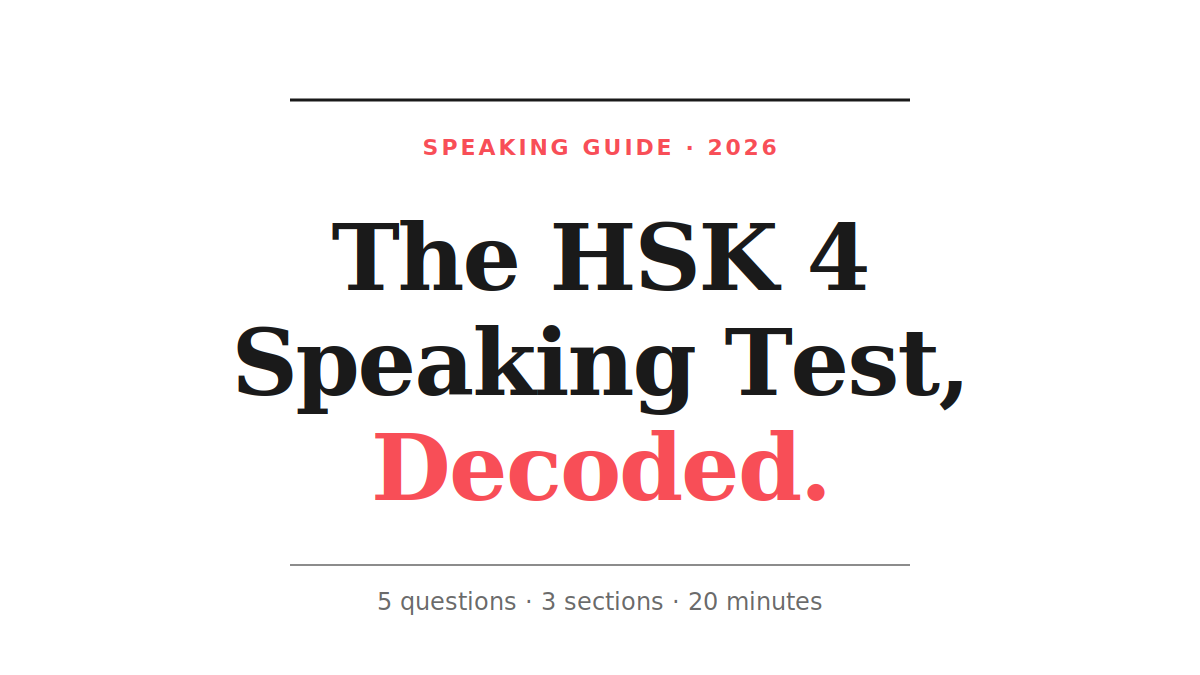
HSK 4 speaking guide.
It says HSKK / HSK SpeakingPrepare for the current three broad HSKK levels: Elementary, Intermediate, or Advanced. This guide explains that format below.
Not sure?Send us your registration screenshot and target level. We can help you check the format before you start training.
Free format check →
Not sure which HSKK level you need?
Tell us your current HSK level and target date. We’ll suggest the right HSKK level and a realistic preparation roadmap.
Free Roadmap Request
If the shortcode doesn’t render inside a Custom HTML block, move it into a Shortcode block right below this card.
What is HSKK?
HSKK is the official spoken Chinese proficiency test. In most test centers, you record your spoken answers with a microphone. Examiners focus on pronunciation, clarity, coherence, task completion, and whether you can complete the speaking tasks under time pressure.
★
A useful truth about HSKK
HSKK is not “free speaking.” It is structured speaking under constraints. High scorers don’t necessarily speak faster; they speak more organized: Position → Reasons → Example → Conclusion. Train the structure, and your score improves even if your vocabulary grows slowly.
HSKK Levels at a Glance
The current HSKK has three broad levels. Each level rewards a different skill: speed, structure, or logic.
Elementary HSKK
27 questionsabout 17 min
RepeatListen & answerShort answers
Real challenge: speed — hear, repeat, and answer without losing tones.
Intermediate HSKK
14 questionsabout 21 min
RepeatPicture speakingAnswer questions
Real challenge: structure — you know the words, but can you organize them?
Advanced HSKK
6 questionsabout 24 min
RetellRead aloudLong answers
Real challenge: logic — fluency is not enough; answers must be clear and well-reasoned.
Official pages may count preparation time differently. Always follow the level and format shown on your actual registration page.
Current HSKK vs New HSK 3.0 Speaking
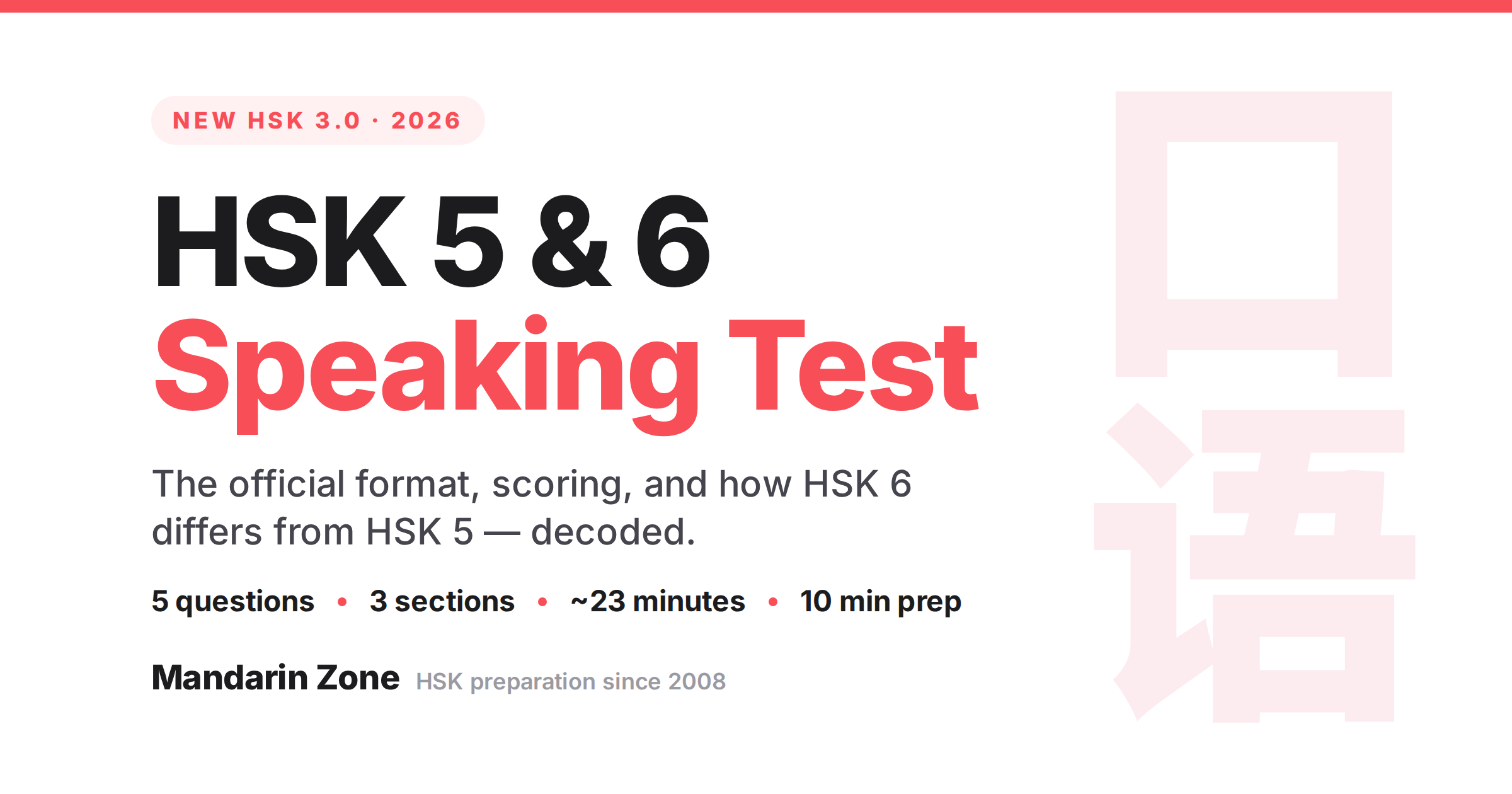
Under the New HSK 3.0 system, speaking becomes more directly matched with written exam levels: HSK 3 Speaking, HSK 4 Speaking, HSK 5 Speaking, and HSK 6 Speaking. This makes level selection clearer, especially for learners preparing for HSK 4 and above.
Current HSKK
Elementary HSKK
Intermediate HSKK
Advanced HSKK
If your registration page says HSKK Intermediate, prepare for HSKK Intermediate. If it says HSK 4 Speaking, prepare for the level-matched New HSK 3.0 speaking format.
Most HSKK tests include several task types. Typical parts include:
1
Short responses or repeating prompts
2
Narration or description based on a picture or topic
3
Long answer with opinion, reasoning, example, and conclusion
The highest-ROI answer structure
Use this structure for most HSKK prompts:
A
Answer — your position in one sentence
R
Reasons — two short reasons
E
Example — one concrete example
C
Conclusion — a clean wrap-up
How HSKK is Scored
Clarity & Pronunciation
Clear tones and stable rhythm matter more than advanced vocabulary.
Coherence
Organized answers score higher than scattered sentences.
Task Completion
Finishing the prompt often matters more than being perfect.
How to Prepare for HSKK
A simple weekly loop that works:
1
Train templates for common topics.
2
Record timed answers 10–15 minutes/day.
3
Fix one weakness per week such as tones, fillers, linking, or speed.
4
Mock test weekly under real timing.
Try a task yourself
Picture · about 2 min
Imagine a busy train station: people rushing, one person helping a stranger find their platform. Describe the scene, guess what happened before, and say what you would do.
Open answer · 2–2.5 min
In Chinese: Is spending time and money learning new skills more valuable than buying things? Why? Do not pause the recording.
What you can and cannot do alone
You can do alone
Build topic vocabularyMemorize answer structuresRecord timed practice answersReview common prompts
You cannot reliably do alone
Hear your own tone errorsCatch repeated grammar mistakesJudge whether your logic is clearFix pacing and time control
Self-study gives you practice, but not reliable correction.
HSKK Preparation Path by Written HSK Level
HSK 3 learners
Focus on daily topics, short answers, clear tones, and basic organization.
HSK 3 complete guide →
HSK 4 learners
Train picture description, short opinions, and a stable A-R-E-C response structure.
HSK 4 speaking guide →
HSK 6 learners
Work on retelling, argument logic, flexible phrasing, and advanced speaking stamina.
HSK 6 complete guide →
Want a structured HSK / HSKK roadmap?
Start from our HSK course page, or message us and we’ll suggest the fastest plan based on your current level and test deadline.
Common HSKK Mistakes
Answers are too short
Fix: Use A-R-E-C to deliver a complete answer.
Over-memorized scripts
Fix: Memorize structures and linking words, not full paragraphs.
Pronunciation collapses under stress
Fix: Train slow and clear recordings first. Clarity scores.
No timed practice
Fix: 10–15 minutes/day beats two hours once a week.
How to Register for HSKK
Basic steps:
1
Create an account on the official registration site.
2
Choose your test center, test date, and HSKK level.
3
Pay early, because popular dates and centers can fill up.
Related HSK Speaking & Exam Resources
Turn this guide into a real HSKK pass plan
Share your current level, target HSKK format, and test date. We can suggest the right speaking drills, mock-test rhythm, and correction schedule.
FAQ
Do I need HSKK if I already passed HSK?
HSK mainly tests listening, reading, and writing. HSKK specifically evaluates speaking performance under exam conditions. If your university, scholarship, employer, or test center requires speaking, you may need both.
Can I improve HSKK quickly?
Yes. Training structure, timed recordings, and targeted feedback often improves speaking scores faster than memorizing more vocabulary lists.
Will HSKK disappear in 2026?
Not for every test date or test center at once. HSK 3.0 Speaking is level-matched, but many regular exam pages may still show HSKK / HSK Speaking. Always confirm the label on your registration page.
HSK 4 in 2026: HSKK Intermediate or HSK 4 Speaking?
If your registration says HSKK / HSK Speaking Intermediate, prepare HSKK Intermediate. If it says HSK 3.0 or HSK 4 Speaking, prepare the new HSK 4 speaking format. When in doubt, ask your test center or request a free format check.
Is HSK 3.0 Speaking harder than HSKK?
Not always. Task types may overlap. The main difference is structure: level-matched speaking tests versus broad HSKK bands. For most learners, the hard part is timed speaking performance, not the label.
What is the best next step?
Start by choosing your test date from the
2026 HSK / HSKK schedule, then confirm your speaking format and use a structured plan with timed mocks.