All You Need to Know About the HSK Test (2026 Update)
Last updated: January 2026
HSK (Hanyu Shuiping Kaoshi, 汉语水平考试) is the official standardized exam used to measure Chinese proficiency for non-native speakers.
If you’re a beginner or intermediate learner, this guide will help you understand the levels, formats, registration process, and what’s changing in 2026.
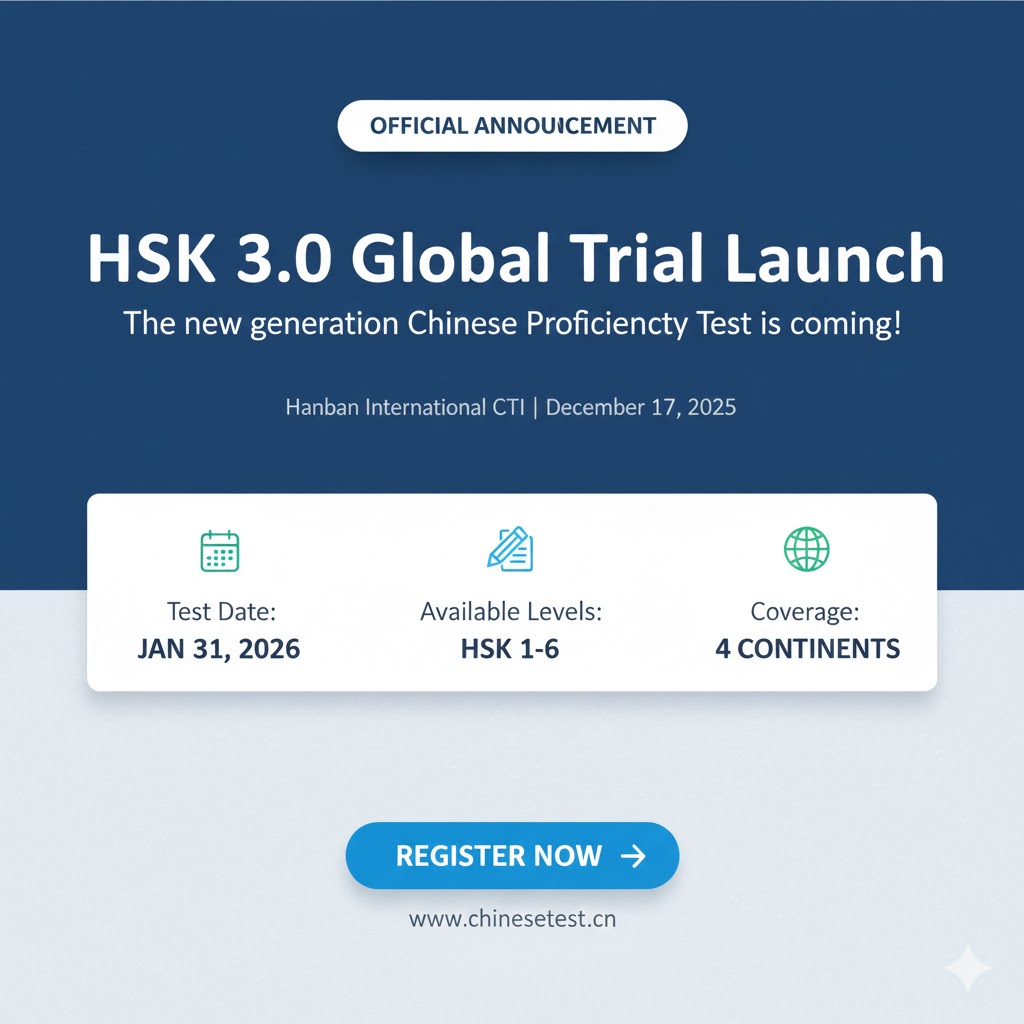
Big 2026 change: The New HSK (HSK 3.0) is being rolled out. The first global trial took place on January 31, 2026 at selected test centers worldwide, with both paper-based and internet-based formats depending on the center. (For Levels 3–6, speaking must be registered together.)
:contentReference[oaicite:0]{index=0}
The official New HSK syllabus was released in November 2025 and is planned to be implemented from July 2026.
Quick Navigation
1) Which HSK should I take in 2026?
This is the #1 confusion right now. Here’s a simple rule:
- If you need an HSK certificate before July 2026: you will most likely follow the current HSK (often called “HSK 2.0”) materials and format. (The New HSK is scheduled to roll out from July 2026.) :contentReference[oaicite:2]{index=2}
- If your exam is July 2026 or later: start aligning your study plan with the New HSK 3.0 structure (9 levels + updated vocabulary/grammar design). :contentReference[oaicite:3]{index=3}
- If you’re not sure: read our New HSK breakdown here → New HSK 3.0 Changes Explained (2026).
Want a clear study plan for YOUR exam date?
Our HSK Preparation Course helps you choose the right version (current HSK vs New HSK),
set a realistic target level, and prepare with a structured timeline.
2) How many levels are there in the HSK exam?
Current HSK (HSK 2.0) has 6 levels: HSK 1–HSK 6.
New HSK 3.0 expands the framework to 9 levels (Levels 1–9).
A common way to understand it:
- Beginner: Levels 1–3
- Intermediate: Levels 4–6
- Advanced: Levels 7–9
If you want the full comparison (HSK 2.0 vs New HSK 3.0), see:
New HSK 3.0 (2026 rollout) explained.
3) HSK requirements (vocabulary & characters)
Most learners measure progress by vocabulary and characters.
Below are two separate references: the current HSK (still widely used before July 2026) and the New HSK vocabulary structure.
3.1 Current HSK (HSK 2.0) — common reference
This table reflects the widely used “HSK 2.0” benchmarks (the format most learners still prepare for today):
| HSK Level | Characters | Vocabulary | What you can do (simplified) |
|---|---|---|---|
| HSK 1 | 150 | 150 | Understand & use very simple phrases; basic daily needs. |
| HSK 2 | 300 | 300 | Handle routine tasks & simple exchanges on familiar topics. |
| HSK 3 | 600 | 600 | Basic communication in daily life, study, work, travel. |
| HSK 4 | 1000 | 1200 | Discuss a wider range of topics with native speakers. |
| HSK 5 | 1500 | 2500 | Read newspapers/magazines; understand films; speak more fully. |
| HSK 6 | 2500 | 5000 | Comprehend complex written/spoken Chinese; express yourself fluently. |
Source note: these values are also used in the original version of this article. :contentReference[oaicite:4]{index=4}
3.2 New HSK 3.0 vocabulary structure (official syllabus)
The New HSK vocabulary list is labeled by level inside the official syllabus, and the numbering shows where each level starts.
For example, the vocabulary list shows HSK 1 reaching item 300, and HSK 2 starting at 301; HSK 2 reaches 500, and HSK 3 starts at 501, etc.
| New HSK Level | Cumulative Vocabulary (approx.) | Evidence in official list |
|---|---|---|
| Level 1 | ~300 | Level 1 includes item 300; Level 2 starts at 301. :contentReference[oaicite:5]{index=5} |
| Level 2 | ~500 | Level 2 includes item 500; Level 3 starts at 501. :contentReference[oaicite:6]{index=6} |
| Level 3 | ~1000 | Level 3 includes item 1000; Level 4 starts at 1001. :contentReference[oaicite:7]{index=7} |
| Level 4 | ~2000 | Level 4 includes item 2000; Level 5 starts at 2001. :contentReference[oaicite:8]{index=8} |
Bonus: In the New HSK syllabus, each vocabulary item is shown with pinyin and part-of-speech labels (词性), which helps beginners learn usage more accurately. :contentReference[oaicite:9]{index=9}
3.3 Characters: recognition vs writing (New HSK syllabus)
The New HSK syllabus separates character knowledge into recognition (认读字) and writing (书写字).
This is useful for beginners because reading/typing often grows faster than handwriting.
- The syllabus has a dedicated list of HSK Level 1 recognition characters (HSK(一级)认读字). :contentReference[oaicite:10]{index=10}
- It also provides a combined list for HSK Level 1–2 writing characters (HSK(一级)~(二级)书写字). :contentReference[oaicite:11]{index=11}
- There are separate writing lists for higher levels (example: HSK Level 4 writing characters and HSK Level 5 writing characters). :contentReference[oaicite:12]{index=12} :contentReference[oaicite:13]{index=13}
If you want a practical “what should I do as a learner” explanation for these changes, read:
New HSK 3.0 Changes Explained (2026).
4) Paper-based vs Internet-based (at center / at home)
HSK is offered in multiple formats depending on the test center. Traditionally, many learners take:
- Paper-based: you write on an answer sheet at a test center.
- Internet-based (iBT at center): you take the exam on a computer at a test center.
In 2026, the official ChineseTest platform also shows filters for Internet-based Test (at home) availability — meaning some exams may be offered online depending on test type and location. Always confirm with your test center before planning. :contentReference[oaicite:14]{index=14}
5) HSK test dates & registration (2026)
HSK dates and registration deadlines change every year and vary by test center.
To avoid outdated information, we maintain the full schedule here:
✅ HSK Test Dates 2026 | Complete Schedule, Registration & Fees Guide :contentReference[oaicite:15]{index=15}
For official registration and available formats by location, use the ChineseTest test-date finder:
(You can filter paper-based / iBT at center / iBT at home.) :contentReference[oaicite:16]{index=16}
6) How to prepare (Beginner → Intermediate roadmap)
If you’re beginner-to-intermediate, your fastest path is not “study everything” — it’s choosing a level and training the exam skills in a focused way.
Step 1: Choose the right target level
- HSK 1–2: survival Chinese + basic sentence patterns.
- HSK 3: daily-life communication becomes smoother; longer listening/reading.
- HSK 4: the “real intermediate” milestone for study/work scenarios.
Step 2: Study with an exam structure (not random vocabulary)
- Listening: train “keyword catching” + speed tolerance.
- Reading: train scanning + recognizing patterns (time, numbers, cause-effect, contrast).
- Writing/typing (where relevant): practice sentence building from core grammar.
Step 3: Use mock tests the right way
Mock tests are not just to “check your level.”
They should train your timing, reduce exam anxiety, and reveal which section is dragging your score down.
If you want a structured plan + teacher feedback, see our HSK Preparation Course.
We help you choose the correct test version (before/after July 2026) and build a realistic weekly schedule.
For scoring details, see:
Official HSK Passing Scores Explained.
7) FAQ (beginner/intermediate)
Is HSK 4 “enough” to study in China?
Many programs treat HSK 4 as a baseline requirement for foreign students, but requirements vary by university and major.
(See our university requirement guide if you need specifics.)
HSK Requirements for China’s Top Universities
Can I take HSK online at home?
Sometimes. The official platform shows an “Internet-based Test (at home)” option, but availability depends on test type, country, and test center arrangements.
Always verify on ChineseTest and with your test center. :contentReference[oaicite:17]{index=17}
Where should I start if I’m totally new?
Start with HSK 1–2 core vocabulary + the most common grammar patterns, then practice listening every day in short sessions (10–15 minutes).
Consistency beats intensity for beginners.
Next reads:
→ New HSK 3.0 Changes Explained (2026)
→ HSK Test Dates 2026 | Full Schedule
→ HSK Exam Prep Course (Beijing & Online)