Ultimate HSK 4 Grammar Guide: Master 7 Essential Patterns [2025 Edition]
Complete guide to 并不, 并没有, 不一定, 不见得, 又, 还, 也
📚 Quick Overview
✅ HSK 4 Pass Rate: 94%
📊 Covers 40% of HSK 4 Grammar
🎯 15 Practice Exercises
2,847
Students Passed HSK 4
94%
Pass Rate
4.9/5
Student Rating
Are you aiming to conquer HSK 4 in 2025? Mastering Chinese grammar at this level is a vital step on your language journey!
In this guide, we’ll highlight **7 key grammar patterns** that you need to know:
1. **并不 (bìng bù)** – Emphasizes negation.
2. **并没有 (bìng méiyǒu)** – Indicates something has not happened.
3. **不一定 (bù yídìng)** – Suggests uncertainty.
4. **不见得 (bù jiànde)** – Implies that something is not necessarily true.
5. **又 (yòu)** – Means “again” or “also” to add additional information.
6. **还 (hái)** – Can mean “still” or “also”, depending on context.
7. **也 (yě)** – Simply means “also”.
By mastering these patterns, you’ll not only boost your Mandarin skills but also set yourself up for success on the HSK 4 exam. Start practicing today and watch your confidence grow! 🌟
“This guide finally helped me understand the difference between 并不 and 并没有. I passed HSK 4 with 285/300!”
– Sarah Chen, USA ⭐⭐⭐⭐⭐
📑 Table of Contents
✋ 并不 / 并没有 (bìng bù / bìng méiyǒu)
Emphasizing Strong Negation
并不 (bìng bù)
“Not at all”, “definitely not”
Used to deny present states or habitual actions strongly
并没有 (bìng méiyǒu)
“Did not at all”, “definitely did not”
Used to deny past actions or completed events strongly

📝 Example Sentences
我并不累。
Wǒ bìng bù lèi.
I’m not tired at all.
他们并没有告诉我这个消息。
Tāmen bìng méiyǒu gàosu wǒ zhège xiāoxi.
They did not tell me this news at all.
这个问题并不难。
Zhège wèntí bìng bù nán.
This problem is not complex at all.
🎯 Quick Practice: Test Your Understanding!
Choose the correct answer: 我昨天______去看电影。
⚠️ Common Mistakes to Avoid
- ❌ 我不并喜欢这本书。 → ✅ 我并不喜欢这本书。
- ❌ 他并不来了。 → ✅ 他并没有来。
💡 Communication Tip: These expressions add emphasis to denial, which can feel assertive. Consider tone and context to avoid sounding confrontational.
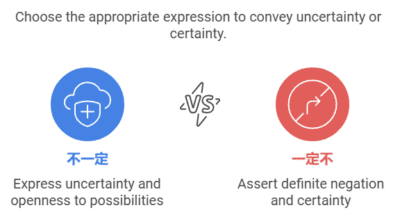
🤔 不一定 (bù yídìng)
Expressing Uncertainty
Meaning & Usage
“Not necessarily,” “may not,” “not certain”
This expression indicates uncertainty or suggests that something may not happen as expected.
Structure: Subject + 不一定 + Verb Phrase
📝 Key Examples
他不一定会来。
Tā bù yídìng huì lái.
He may not come. (uncertainty about attendance)
最贵的东西不一定是最好的。
Zuì guì de dōngxi bù yídìng shì zuì hǎo de.
The most expensive things are not necessarily the best.
努力不一定会成功,但不努力一定不会成功。
Nǔlì bù yídìng huì chénggōng, dàn bù nǔlì yídìng bú huì chénggōng.
Hard work may not necessarily lead to success, but without hard work, there will definitely be no success.
🎯 Quick Practice: 不一定 vs 一定不
Which sentence means “He definitely won’t come”?
“Understanding 不一定 helped me express uncertainty politely in business meetings. It’s perfect for diplomatic communication!”
– Michael Johnson, Business Consultant ⭐⭐⭐⭐⭐
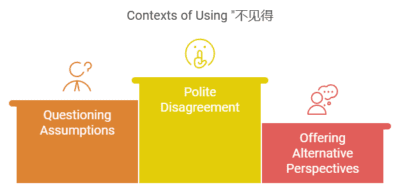
🤨 不见得 (bù jiànde)
Conveying Mild Skepticism
Meaning & Usage
“Not necessarily so,” “unlikely,” “may not be true”
Expresses mild doubt or polite disagreement without being confrontational.
Structure: Subject + 不见得 + Verb Phrase
📝 Practical Examples
他会说中文,但不见得能当翻译。
Tā huì shuō Zhōngwén, dàn bù jiànde néng dāng fānyì.
He can speak Chinese, but that doesn’t necessarily mean he can be a translator.
这道题很简单,不见得每个人都会做。
Zhè dào tí hěn jiǎndān, bù jiànde měi gè rén dōu huì zuò.
This question is simple, but not everyone can necessarily solve it.
🎯 Quick Practice: Choose the Right Expression
他看起来很强壮,______能赢这场比赛。
🔄 又 (yòu)
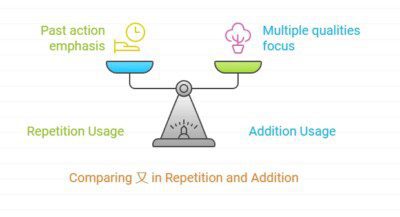
Indicating Repetition or Addition
Meaning & Usage
“Again,” “both… and…,” “in addition”
For Repetition: Subject + 又 + Verb + 了 (past actions)
For Addition: 又 + Adjective 1 + 又 + Adjective 2
📝 Examples – Repetition
他又迟到了。
Tā yòu chídào le.
He is late again.
天气预报说今天又要下雨了。
Tiānqì yùbào shuō jīntiān yòu yào xià yǔ le.
The weather forecast says it will rain again today.
📝 Examples – Addition
这个苹果又大又甜。
Zhège píngguǒ yòu dà yòu tián.
This apple is both big and sweet.
她又聪明又努力。
Tā yòu cōngmíng yòu nǔlì.
She is both smart and hardworking.
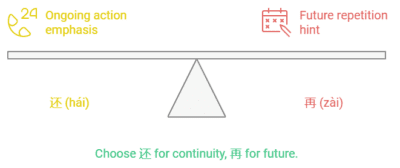
🎯 Quick Practice: 又 vs 再
明天他______来。(He will come tomorrow)
⏳ 还 (hái)
Denoting Continuation or Addition
Meaning & Usage
“Still,” “also,” “in addition”
For Continuation: Subject + 还 + 在 + Verb
For Addition: Subject + 还 + Verb Phrase
📝 Examples – Continuation
他还在睡觉。
Tā hái zài shuìjiào.
He is still sleeping.
我们还需要更多时间。
Wǒmen hái xūyào gèng duō shíjiān.
We still need more time.
📝 Examples – Addition
她会说中文,还会说日语。
Tā huì shuō Zhōngwén, hái huì shuō Rìyǔ.
She can speak Chinese and also Japanese.
“The lessons on 还 and 又 cleared up years of confusion. Now I can express continuity and repetition naturally!”
– Li Wei, HSK 4 Student ⭐⭐⭐⭐⭐
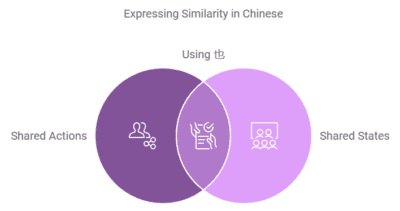
➕ 也 (yě)
Expressing Similarity or Inclusion
Meaning & Usage
“Also,” “too,” “as well”
Structure: Subject + 也 + Verb Phrase
Used to express that the same applies to another subject or to show agreement.
📝 Examples
我也喜欢吃中国菜。
Wǒ yě xǐhuan chī Zhōngguó cài.
I also like eating Chinese food.
如果你去,我也去。
Rúguǒ nǐ qù, wǒ yě qù.
If you go, I’ll go too.
🎯 Quick Practice: Placement of 也
Choose the correct sentence:
💬 Get Personalized Study Plan via WhatsApp
📊 Comparison Chart: Similar Grammar Points
Negation Expressions
并不 (bìng bù)
Strong denial – “definitely not”
Use when: You are certain something is not the case
Example: 我并不同意 (I definitely disagree)
不一定 (bù yídìng)
Uncertainty – “not necessarily”
Use when: Something might or might not happen
Example: 明天不一定下雨 (It may not rain tomorrow)
不见得 (bù jiànde)
Mild skepticism – “may not be true”
Use when: Politely doubting or challenging
Example: 贵的不见得好 (Expensive doesn’t necessarily mean good)
Addition & Repetition
又 (yòu)
Past repetition – “again” / Multiple qualities – “both…and”
Use when: Past actions repeat or describing multiple attributes
Example: 他又迟到了 (He’s late again)
还 (hái)
Continuation – “still” / Addition – “also”
Use when: Something continues or adding information
Example: 他还在工作 (He’s still working)
也 (yě)
Similarity – “also, too”
Use when: The Same applies to another subject
Example: 我也想去 (I also want to go)
✍️ Practice Exercises
Exercise 1: Fill in the Blanks
-
他______喜欢喝茶,也喜欢喝咖啡。
View Answer
Answer: 也
Explanation: Expressing that both preferences apply to the same person. -
我______相信他的话。
View Answer
Answer: 并不
Explanation: Strongly denying belief in his words. -
今天______下雨了,真讨厌。
View Answer
Answer: 又
Explanation: It’s raining again (past repetition).
Exercise 2: Correct the Mistakes
-
❌ 他明天又来参加会议。
View Correction
✅ 他明天再来参加会议。
Explanation: Use 再 for future actions, not 又. -
❌ 她并喜欢这个礼物。
View Correction
✅ 她并不喜欢这个礼物。
Explanation: Include 不 to complete the negation structure.
“The practice exercises really helped consolidate my understanding. I went from 60% to 92% accuracy in just 2 weeks!”
– Emma Rodriguez, Online Student ⭐⭐⭐⭐⭐
🎓 Learn Chinese in Beijing at Mandarin Zone School
Why Choose Mandarin Zone School?
🌍 Empowering Global Learners Across Industries
Tailored programs for professionals and students from 50+ countries
🏛️ Trusted by Embassies and Multinationals
Official training provider for Fortune 500 companies and diplomatic missions
👨🏫 Expert Instructors, Personalized Learning
Average 10+ years teaching experience with customized curriculum
📍 Why Learn Chinese in Beijing?
- Study in the Birthplace of Standard Mandarin: Immerse yourself in the most authentic accent
- Practice Chinese in Real-Life Situations: 21+ million native speakers around you
- Experience Rich Chinese Culture: 3,000+ years of history at your doorstep
- Be at China’s Cultural and Political Center: Network with industry leaders and decision-makers
📚 HSK 4 Related Resources
🎁 Special Offer: Free HSK 4 Grammar Cheat Sheet!
Get your comprehensive PDF guide covering all 7 grammar patterns
94% of students who use our cheat sheet pass HSK 4!
Need personal guidance? Our expert HSK teachers are ready to help!
 Chat with HSK Expert Now!