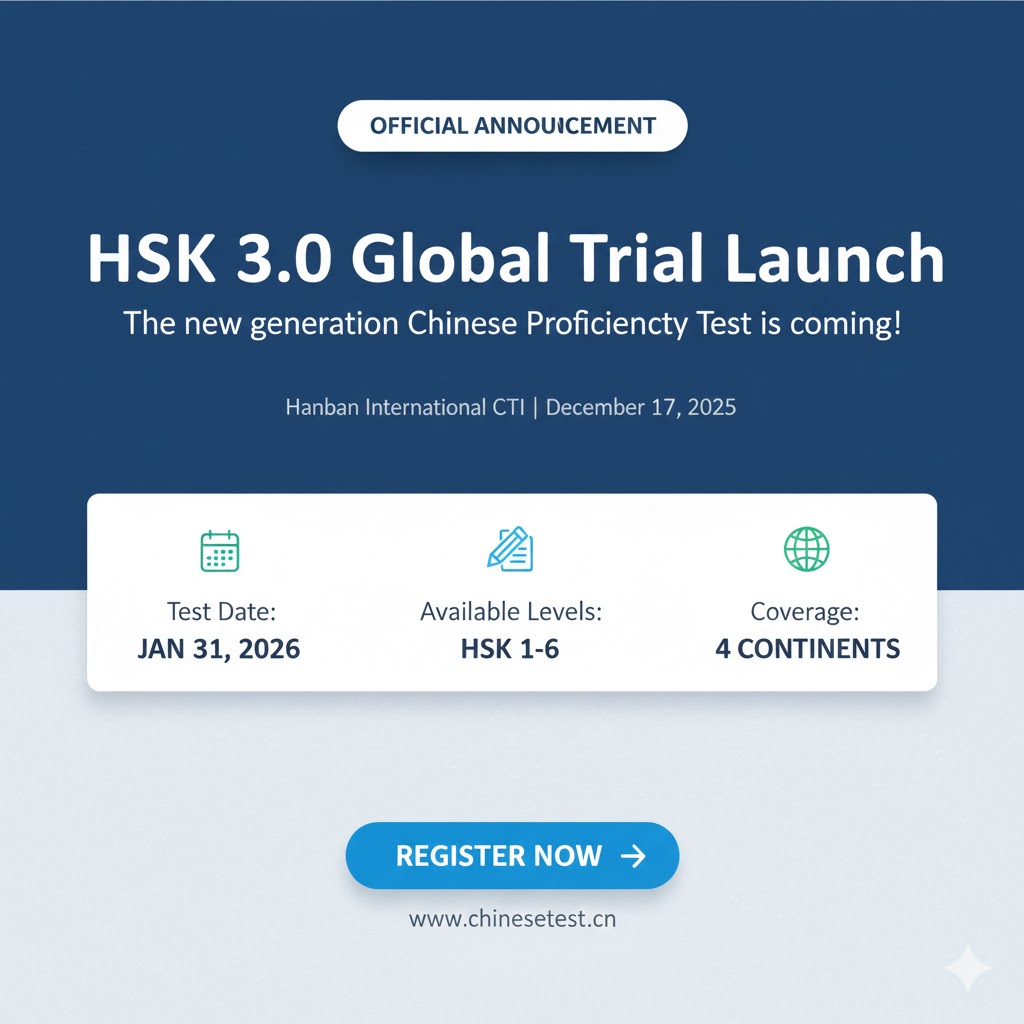
Check your registration page before choosing materials. If it says HSKK Advanced or simply HSK Speaking Test, use our current HSKK guide. If it explicitly says HSK 5 Speaking, HSK 6 Speaking, or HSK 3.0, use this guide. Test-center implementation may vary during the 2026 transition. Last reviewed June 2026.
The 30-second brief
The HSK 5 and HSK 6 Speaking Tests (HSK 五级 / 六级口语) are the speaking components of HSK 5 and 6 under the new HSK 3.0 syllabus. Under 3.0 you register for the written and speaking exams together — speaking is no longer optional.
Both levels share the same shape: five questions, three sections, ~23 minutes including 10 minutes of prep. The structure is identical at 5 and 6 — what changes is how abstract the questions get and how much you have to say.
If you've passed HSK 4, the format will feel familiar. The new work is retelling longer passages and building a clear argument under time — the two things that decide your score.
Plan your HSK 5 or HSK 6 speaking test
Confirm the format first, then connect your speaking practice to the written level, exam date and registration deadline.
Need one plan for written and speaking preparation? Start with the complete HSK preparation hub.
In this guide
Format at a glance
Same three sections for HSK 5 and HSK 6. Here's what you'll be asked, in order.
Hear a passage, then reproduce its key points — accurately, no opinions added.
Narrate a picture sequence with cause and effect. HSK 5 = 3 images; HSK 6 = 4.
Take a clear position on an open question and back it with reasons and an example.
| # | Task | Questions | Time each | HSK 5 → HSK 6 difference |
|---|---|---|---|---|
| 1 | 听后复述 · Listen & retell | 2 | 1.5 min | Longer, denser passages at HSK 6 |
| 2 | 看图说话 · Tell a story | 1 | 2 min | 3 images (HSK 5) → 4 images (HSK 6) |
| 3 | 回答问题 · Express opinion | 2 | 2.5 min | Personal & reflective → abstract & argumentative |
What you should train for
Build a balanced speaking performance instead of trying to sound perfect in one area. These four dimensions are the most useful way to diagnose your recordings.
Scoring transparency: the public sample papers confirm the task structure and timing, but they do not publish a final point-by-point rubric for the new level-matched HSK 5/6 speaking test. Treat the four areas above as practical training dimensions, not an official equal-weight scoring formula. For the current three-level HSKK format, see the HSKK guide.
What changed from the old HSKK Advanced
If you trained for HSKK Advanced (the band most HSK 5–6 learners used to take), three things are different now — and the written exam changed too (see Old HSK vs New HSK 3.0).
HSKK Advanced (old)
HSK 5 & 6 Speaking (new)
The headline shift: "read aloud" is gone. Section 2 is now a picture-story you build yourself — from decoding text to constructing it. And because speaking is level-matched, HSK 6 is no longer "the same test as HSK 5." Which raises the real question…
HSK 5 vs HSK 6: same skeleton, harder questions
Identical format: 5 questions · 3 sections · ~23 min · 10 min prep. The difference isn't the structure — it's the difficulty of what's inside it.
HSK 5 Speaking Test
Complete, fluent, real-life
HSK 6 Speaking Test
Abstract, argued, nuanced
Put simply: HSK 5 asks you to describe and explain; HSK 6 asks you to argue. Same five questions, same clock — but at 6 the retell passages are denser and the opinion prompts reward a position with reasons, not a tidy description.
Build the written foundation alongside speaking: use the HSK 5 complete guide, HSK 5 vocabulary list, HSK 5 grammar guide and HSK 5 grammar quiz; for the next level, use the HSK 6 complete guide and HSK 6 vocabulary list.
The three tasks, and the shape that wins each
You hear a passage once and reproduce it in 90 seconds. This tests memory and summary, not creativity — you're not asked for your opinion, just the key points in order. The trap: trying to remember every word. Catch the spine instead. Hear real HSK 5 and HSK 6 passages in the practice section below.
Narrate the picture sequence as one connected story with a beginning, turn, and end. Graders listen for connectors and cause-effect, not a list of what's in each frame. Don't just label — link.
The longest answers on the test. Use the A-R-E-C skeleton — memorize the order, not the words — and you can speak for 2.5 minutes on anything. At HSK 6, add a counter-point or nuance before your close.
Try a task yourself
Practice prompts written in the style of each section (not official questions). Record yourself, keep to the time limit, and don't pause.
Play a real HSK 5 or HSK 6 passage once, then retell the key points in 90 seconds — don't replay, and don't add your opinion. (Full transcripts are in the downloadable sample pack.)
Narrate this 3-frame story as one connected event: (1) a student realizes she has left an important document at home; (2) a classmate offers to help and they take a shared bike back; (3) they arrive at the classroom just before the presentation begins. Use cause-and-effect connectors and end with one sentence about cooperation.
Answer with A-R-E-C: “Do you think adults should continue learning new skills after they start working? Why?” Give two reasons and one concrete personal or workplace example.
Narrate this 4-frame story with connectors and cause-effect: (1) a woman plants a bare sapling in an empty yard; (2) over seasons she waters and prunes it; (3) the tree grows tall and full; (4) children now play in its shade. Begin with the scene, link each frame, and close with one line about what it shows.
Answer with A-R-E-C, and add one counter-point before your close: "Some people say technology has made us more connected but also more lonely. Do you agree? Why?"
Model answers: basic, strong & advanced
The same prompt answered at three instructional levels, so you can see how structure, language range and nuance improve. Answers are in Chinese; the analysis is in English. These are teaching examples, not official score predictions, and the prompts are written in the exam's style rather than copied from a live test.
你认为养成一个好习惯为什么这么难?
"Why is it so hard to build a good habit?" — a personal, reflective HSK 5 topic.
我觉得养成好习惯很难。因为我们都比较懒,有的时候没有时间,也没有人提醒。比如我想每天运动,但是常常坚持不下来。所以我觉得养成好习惯需要时间。
Why it is basic: On-topic and complete, but the vocabulary is basic (很难, 比较懒), the structure is loose, and the example is thin. It shows a usable baseline, but it needs clearer structure and richer language.
我认为养成好习惯之所以困难,主要有两个原因。第一,好习惯往往需要长期坚持,而人很容易被眼前的舒适吸引;第二,缺少明确的目标和反馈,就很难看到进步。举个例子,我以前想每天背单词,但因为没有计划,坚持了一周就放弃了;后来我把目标拆小,反而更容易坚持了。
Why it is strong: A clear A-R-E-C structure with 第一/第二, good connectors (之所以…主要…, 而), a real before-and-after example, and more formal vocabulary (长期坚持, 明确的目标和反馈). A solid, well-organized answer with clear development.
在我看来,养成好习惯之所以难,本质上是因为它要求我们用长远的利益去对抗当下的本能。人天生倾向于即时的满足,而好习惯的回报往往是缓慢而隐性的,短期内几乎感觉不到。不过我认为,与其责怪自己意志力不够,不如改变方法和环境——比如把目标拆得足够小,让坚持变得几乎不费力。说到底,习惯的养成与其说靠自律,不如说靠设计。
Why it is advanced: Near-native — a clear thesis (long-term gain vs immediate instinct), abstract reasoning, idiomatic phrasing (即时的满足, 缓慢而隐性的, 与其…不如…), and a memorable closing line. Fluent and sophisticated.
有人认为成功主要靠个人努力,也有人认为更多取决于机遇。你更赞同哪种观点?请说明理由。
"Is success mostly about effort, or opportunity? Which do you agree with, and why?" — an abstract, argumentative HSK 6 topic.
我觉得成功主要靠努力。因为如果你不努力,就算有机会也抓不住。很多成功的人都很努力地工作。所以我认为努力比机遇更重要。
Why it is basic: It takes a position and stays on-topic, but the reasoning is thin and one-sided, the vocabulary is basic, and it doesn't engage with the complexity the prompt invites. It is understandable, but it does not yet show the depth expected at the higher level.
我个人更倾向于认为努力起着决定性的作用。一方面,机遇往往转瞬即逝,只有提前做好准备的人才抓得住;另一方面,持续的努力本身也会带来更多机会。当然,我并不否认机遇的重要性,但如果没有努力作为基础,再好的机遇也会白白溜走。因此,我认为努力是更根本的因素。
Why it is strong: A clear stance defended with two structured reasons (一方面…另一方面), a concession to the other side (当然,我并不否认…), and formal connectors throughout. Well-organized and persuasive.
我认为把努力和机遇对立起来,本身就是一个误区。与其争论哪个更重要,不如说二者相互成就:机遇决定了一个人能达到的上限,而努力决定了他能在多大程度上接近这个上限。一个缺少机遇的人,再努力也可能事倍功半;而一个不努力的人,即便机遇降临,也未必有能力承接。如果一定要我选,我会更看重努力——因为机遇无法掌控,而努力是我们唯一能确定的变量。换句话说,我们能做的,就是不断准备好自己,然后等风来。
Why it is advanced: Sophisticated and dialectical — it reframes the question (rejecting the either/or), uses precise abstract vocabulary (上限, 事倍功半, 承接, 变量), concedes then commits to a nuanced stance, and lands a memorable image (等风来, "wait for the wind"). Near-native argumentation.
Notice the ladder: the basic answers are on-topic; the stronger answers add structure, range and — at HSK 6 — genuine nuance. These labels are instructional rather than official score bands. Want a teacher to diagnose your own recording? Get a free HSK 5/6 speaking check.
What you can — and can't — do alone
You can self-study
You can't reliably do alone
The path from HSK 4 to 5 to 6
Speaking levels build on each other. If you're coming up from HSK 4, here's how the work changes — see our HSK 4 Speaking guide for the level below.
Lock A-R-E-C and a 3-image story arc. Answers are ~2 min and topics are everyday.
Longer retells (1.5 min) and 2.5-min answers. Add range and keep it fluent over a longer stretch.
Denser retells, 4-image stories, abstract prompts. Take a stance, add a counter-point, stay clear under time.
Planning the written exam too? See the full HSK 5 guide and HSK 6 guide, and check the 2026 HSK test dates.
A focused 6-week study plan
This plan assumes your written Chinese is already near the target level. HSK 5 candidates with a strong HSK 4 base may compress it into four weeks; HSK 6 candidates often need six to eight.
Check your registration wording, record one full baseline and identify the weakest task. Review the registration checklist.
Practice one-play listening, keyword notes and 90-second retells. Track missed people, actions, causes and results.
Build 3-image HSK 5 and 4-image HSK 6 stories with scene, sequence, turning point, result and close.
Use A-R-E-C on five prompts per day. HSK 6 candidates add a concession or counter-point before the conclusion.
Recycle vocabulary and grammar from your target level, then get outside feedback on repeated pronunciation, logic and pacing problems.
Complete two or three full speaking simulations under real timing. Review only the highest-impact errors between mocks.
For HSK 5 language work, use the HSK 5 grammar guide and free HSK 5 grammar quiz. For broader exam planning, use the complete HSK preparation hub.
Get a free HSK 5/6 speaking diagnostic
Send one 60–90 second recording, your target level, test date and a screenshot of the registration wording. A teacher will confirm the format and identify the single speaking weakness that will make the biggest difference to your next six weeks.
Frequently asked questions
Is HSK 6 Speaking harder than HSK 5?
How many questions are on the HSK 5 / HSK 6 Speaking Test?
When does the HSK 5/6 Speaking Test apply to me?
Is speaking mandatory with HSK 5 or HSK 6?
What is the official passing score and rubric?
Is there translation in HSK 5/6 Speaking?
Can I prepare for it on my own?
How long should I prepare?
Which guide should I use if my booking says HSKK Advanced?
Continue your HSK 5 & 6 preparation
HSK 5 core resources
HSK 6 core resources
About this guide. Written by Margherita Liu, Principal of Mandarin Zone, with 20 years of experience teaching Chinese as a foreign language. Mandarin Zone has taught thousands of international learners since 2008. The task descriptions and timing in this guide are based on the published HSK 3.0 syllabus and HSK 5/6 speaking sample materials. Because implementation and scoring details may be refined during rollout, candidates should follow the wording on their registration page and the latest official candidate notice. Model-answer labels are instructional, not official score predictions. Last reviewed June 2026.