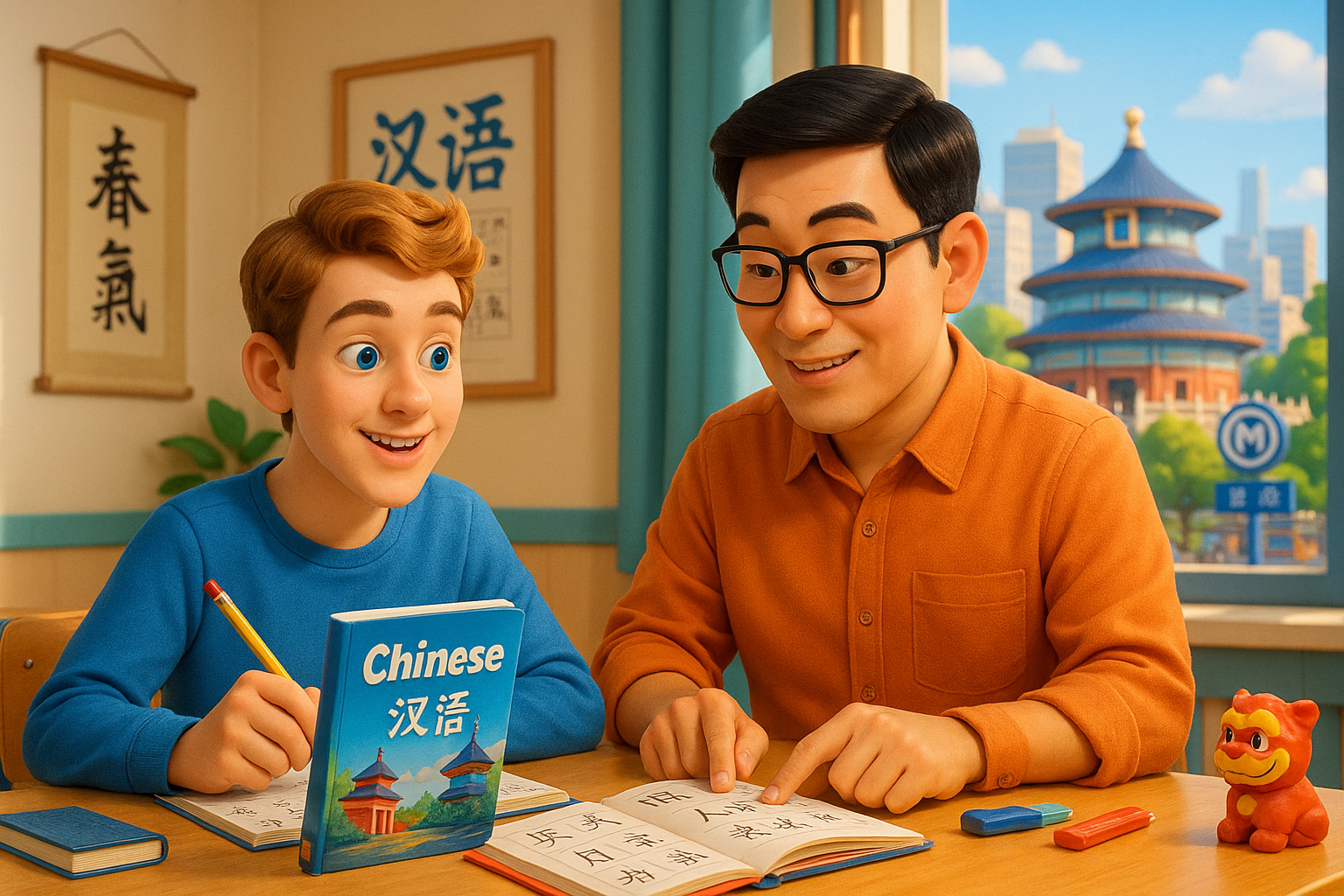
Is Chinese Harder Than Japanese? The Definitive 2025 Guide
Expert Analysis from Beijing's Leading Chinese Language School
🤖 AI-Powered Summary
Quick Answer: Both Chinese and Japanese require 2,200 hours to master (FSI data), but they present different challenges. Japanese has more complex grammar and writing systems (3 scripts vs 1), while Chinese has tonal pronunciation that's initially harder. Most learners find Japanese slightly more difficult overall due to its writing complexity, though individual learning styles greatly influence perceived difficulty.
Key Insight: Your success depends more on motivation and learning method than inherent language difficulty. Choose based on your goals: Chinese for business/global opportunities, Japanese for technology/entertainment sectors.
✨ Easy Takeaways
📚 Table of Contents
✨ Personalized Language Recommendation Tool
Get a data-driven recommendation in 30 seconds
Quick Comparison: Chinese vs Japanese Difficulty
| Aspect | Chinese (Mandarin) | Japanese | Winner for Ease |
|---|---|---|---|
| Grammar Structure | SVO (like English) | SOV + particles | Chinese ✅ |
| Writing Systems | 1 system (Hanzi) | 3 systems (Kanji/Hiragana/Katakana) | Chinese ✅ |
| Pronunciation | 4 tones + neutral | Pitch accent (less critical) | Japanese ✅ |
| Character Readings | Usually 1 per character | Multiple (on'yomi/kun'yomi) | Chinese ✅ |
| Verb Conjugation | None | Complex system | Chinese ✅ |
| Politeness Levels | Vocabulary-based | Grammar-based (keigo) | Chinese ✅ |
| FSI Hours to Proficiency | 2,200 hours | 2,200 hours | Tie 🤝 |
Writing Systems: The Core Complexity Difference
Chinese Writing: Unified System
Strengths:
- One system: Only Hanzi (汉字) to master
- Consistent readings: 学 (xué) = study (always)
- Logical radicals: Components hint at meaning
- No alphabet mixing: Pure character-based
(wǒ xué zhōngwén - I study Chinese)
Each character = one syllable = one meaning unit
Challenges:
- 2,000-3,000 characters for literacy
- Complex stroke order rules
- Similar-looking characters (大/太/犬)
Japanese Writing: Triple System
Strengths:
- Hiragana: Simple phonetic for grammar
- Katakana: Clear foreign word marking
- Kanji context: Helps distinguish homophones
- Furigana: Reading aids available
(watashi wa nihongo wo benkyō shimasu)
Mix of kanji (私,日本語,勉強) + hiragana (は,を,します)
Challenges:
- 2,136 jōyō kanji + 2 kana sets
- Multiple readings per kanji (生: sei, shō, nama, etc.)
- Context-dependent pronunciations
- Script-switching mental load
Hidden Advantages Often Overlooked
🇨🇳 Chinese Hidden Strengths
- No conjugation: 吃 (eat) never changes form
- Logical time markers: 了 for past, 会 for future
- Compound clarity: 电脑 (electric-brain = computer)
- Tone patterns: Become intuitive with practice
🇯🇵 Japanese Hidden Strengths
- Kanji boost: Instantly understand meaning even without pronunciation
- Grammar regularity: Rules are complex but highly consistent
- Immersion resources: Vast anime/manga/game content
- Phonetic guides: Hiragana can annotate any kanji
Grammar Deep Dive: Structure vs Simplicity
Real Example: "I will eat dinner with my friend tomorrow at the restaurant"
Chinese (Simple & Direct)
我明天和朋友在餐厅吃晚饭
Word order: I + tomorrow + with + friend + at + restaurant + eat + dinner
- ✅ Same SVO order as English
- ✅ No verb changes
- ✅ No particles needed
- ✅ Time simply stated
Japanese (Complex & Precise)
私は明日友達とレストランで晩ご飯を食べます
Word order: I[topic] + tomorrow + friend[with] + restaurant[at] + dinner[object] + eat[polite-future]
- ❌ Reversed SOV order
- ❌ Multiple particles (は、と、で、を)
- ❌ Verb conjugation for politeness
- ❌ Must track grammatical relationships
| Grammar Feature | Chinese Example | Japanese Example | Complexity |
|---|---|---|---|
| Past Tense | 我吃了 (I ate) - Just add 了 | 食べました (tabemashita) - Verb changes | Chinese easier ✅ |
| Negative | 我不吃 (I don't eat) - Add 不 | 食べません (tabemasen) - Verb changes | Chinese easier ✅ |
| Questions | 你吃吗? (You eat?) - Add 吗 | 食べますか? (tabemasu ka?) - Add か + intonation | Tie 🤝 |
| Conditional | 如果...就... (if...then...) | 〜たら、〜ば、〜と、〜なら (4+ forms) | Chinese easier ✅ |
Pronunciation: Tones vs Sounds
🇨🇳 Chinese: The Tonal Challenge
The Famous "Ma" Example:
- mā (妈) = mother ⸺ (high level)
- má (麻) = hemp ⸝ (rising)
- mǎ (马) = horse ⸒⸓ (dipping)
- mà (骂) = scold ⸝⸌ (falling)
- ma (吗) = question particle (neutral)
Additional Challenges:
- Tone changes (3rd tone sandhi)
- Regional accent variations
- Retroflex sounds (zh, ch, sh, r)
🇯🇵 Japanese: The "Simple" Sounds
Sound Inventory:
- 5 vowels: a, i, u, e, o
- Limited consonants (no l/r distinction)
- Systematic syllable structure (CV)
- Pitch accent (less critical than tones)
Underestimated Challenges:
- Long vowels: おばさん (aunt) vs おばあさん (grandmother)
- Double consonants: いた (was) vs いった (went)
- Pitch accent: はし (bridge/chopsticks/edge)
- Devoicing: です sounds like "des"
- Gemination timing: Critical for comprehension
Cultural Context & Practical Usage
🇨🇳 Chinese Cultural Learning
- Business: More direct communication style
- Hierarchy: Important but expressed simply
- 面子 (Face): Central concept, vocabulary-based
- 关系 (Guanxi): Relationship networks crucial
- Formality: Title + surname system
Advantage: Cultural rules are learned separately from grammar
🇯🇵 Japanese Cultural Learning
- Keigo: Politeness built into grammar
- 内/外 (Uchi/Soto): In-group/out-group distinctions
- 本音/建前: True feelings vs public facade
- Seasonal greetings: Socially mandatory
- Bowing + language: Physical and verbal politeness
Challenge: Culture and language are inseparable
Which Language Matches Your Learning Style?
Musical Learners
Better fit: Chinese
Tonal system rewards musical ear
Logical Learners
Better fit: Japanese
Systematic grammar rules appeal
Visual Learners
Tie
Both use character systems
Kinesthetic Learners
Better fit: Chinese
Character writing more unified
Social Learners
Better fit: Chinese
Simpler conversation structure
Reading/Writing
Better fit: Japanese
Rich written resources available
Purpose-Based Recommendations
| Your Goal | Chinese Suitability | Japanese Suitability | Recommendation |
|---|---|---|---|
| International Business | ⭐⭐⭐⭐⭐ Massive market | ⭐⭐⭐ Specific sectors | Chinese 🇨🇳 |
| Technology Sector | ⭐⭐⭐⭐ Growing fast | ⭐⭐⭐⭐⭐ Established | Both valuable 🤝 |
| Entertainment/Media | ⭐⭐⭐ C-dramas, music | ⭐⭐⭐⭐⭐ Anime, games | Japanese 🇯🇵 |
| Academic Research | ⭐⭐⭐⭐ Ancient texts | ⭐⭐⭐⭐ Modern research | Depends on field 🤔 |
| Travel/Tourism | ⭐⭐⭐ Tones needed | ⭐⭐⭐⭐⭐ Tourist-friendly | Japanese 🇯🇵 |
| Cultural Understanding | ⭐⭐⭐⭐ Diverse regions | ⭐⭐⭐⭐⭐ Unique culture | Personal preference 💭 |
Realistic Learning Timelines
🇨🇳 Chinese Milestones
- Master tones & pinyin
- 500 basic characters
- Simple conversations
- HSK 1-2 level
- 2000 characters
- Daily conversation fluency
- Read simple texts
- HSK 3-4 level
- 3000+ characters
- Professional proficiency
- Native content access
- HSK 5-6 level
🇯🇵 Japanese Milestones
- Hiragana & Katakana mastery
- Basic grammar patterns
- 300 basic kanji
- JLPT N5 level
- 1000 kanji
- Complex grammar forms
- Casual conversation
- JLPT N4-N3 level
- 2000+ kanji
- Keigo mastery
- Business proficiency
- JLPT N2-N1 level
Learning Resources Comparison
🇨🇳 Chinese Learning Ecosystem
✅ Strengths:
- Government support (Confucius Institutes)
- Growing online platforms
- HSK standardized system
- Increasing global teachers
- Business-focused materials
⚠️ Limitations:
- Less entertainment content for beginners
- Fewer graded readers
- Regional dialect confusion
🇯🇵 Japanese Learning Ecosystem
✅ Strengths:
- Massive entertainment library
- Established textbook series
- Strong online communities
- Graded manga/light novels
- JLPT clear progression
⚠️ Limitations:
- Fewer teachers globally
- Business materials limited
- Cultural barrier to resources
Real Student Experiences
"I studied Japanese for 2 years before switching to Chinese. The grammar is SO much easier! I reached conversational level in Chinese faster than I did in Japanese. However, tones were a nightmare for the first 6 months."
"As someone who learned both, Japanese writing is definitely harder long-term. But Chinese tones nearly made me quit in the beginning. Stick with whichever matches your goals!"
"I chose Japanese for anime but stayed for the culture. Yes, kanji readings are insane, but the systematic grammar appeals to my engineering brain. Chinese felt too 'loose' for me."
"Don't believe anyone who says one is definitively harder. I'm fluent in both - they're different kinds of difficult. Chinese starts hard (tones) but gets easier. Japanese starts easy but stays challenging."
Frequently Asked Questions
According to the US Foreign Service Institute, both require 2,200 hours to reach proficiency, making them equally challenging overall. However, they present different types of difficulties:
- Chinese: Harder pronunciation (tones) but simpler grammar
- Japanese: Easier pronunciation but complex grammar and writing
Most learners find Japanese slightly harder due to its three writing systems and complex grammar, but individual experiences vary greatly based on learning style and background.
Choose based on your primary goals rather than difficulty:
- Learn Chinese first if: Your focus is business, you want faster conversational progress, or you're interested in a growing global language
- Learn Japanese first if: You're passionate about Japanese culture/media, want to live in Japan, or prefer systematic grammar rules
If planning to learn both, starting with Chinese can help with recognizing kanji meanings later, though the pronunciation systems are completely different.
Both offer excellent career opportunities but in different sectors:
- Chinese: Better for international business, trade, diplomacy, and emerging markets. With 1.4 billion speakers, it offers broader global opportunities
- Japanese: Excellent for technology, gaming, automotive, and entertainment industries. Highly valued in specific sectors despite fewer speakers (125 million)
Consider your industry and geographic preferences when choosing.
With consistent daily study (1-2 hours):
- Chinese: Basic conversation in 6-12 months, daily fluency in 18-24 months
- Japanese: Basic conversation in 12-18 months, daily fluency in 24-36 months
These timelines assume quality instruction and regular practice. Immersion can significantly accelerate progress.
Yes and no:
- Helps: You'll recognize many kanji meanings (about 70% overlap)
- Doesn't help: Pronunciations are completely different, and Japanese kanji often have multiple readings
- Can confuse: Some characters have different meanings or simplified differently
Overall, Chinese knowledge provides a modest advantage but isn't a game-changer for learning Japanese.
🎯 Ready to Start Your Language Journey?
Join thousands of successful students at Mandarin Zone Beijing
✨ Special January 2025 Offer
- 📚 Free placement test & study plan
- 🗣️ Trial class with native teachers
- 🏠 Student accommodation assistance
- 🎓 20% discount for semester enrollment
📍 Beijing Campus: Room 1208, Tongguang Building, Chaoyang District
☎️ +86 10 6538 0023 | 🌐 www.mandarinzone.com
The Final Verdict: A Balanced Perspective
🎯 Evidence-Based Conclusion
Both languages require equal time investment (2,200 hours) but challenge learners differently.
Chinese is harder if you:
- Struggle with musical pitch
- Have difficulty hearing tonal differences
- Come from a non-tonal language
- Need immediate speaking ability
Japanese is harder if you:
- Prefer simple, logical systems
- Struggle with multiple scripts
- Dislike complex grammar rules
- Want faster reading progress
The "easier" language is the one that aligns with your goals and motivates you to continue learning.
Success in either language depends more on consistency, quality instruction, and genuine interest than on inherent difficulty.