Free Chinese Pinyin Converter
Paste any Chinese text to get accurate pinyin with tone marks — and see the HSK 3.0 level of every word, so you know at a glance how hard a passage is. No sign-up, works on any device.
Chinese Pinyin Converter
Convert any Chinese text to pinyin, with each word tagged by its HSK level.
HSK levels are based on the HSK 3.0 standard (国际中文教育中文水平等级标准, 2021).
Interactive tone practice
Click any tone card to hear the pronunciation. Audio depends on your browser's speech support.
Why use this converter
Accurate pinyin
Tone marks for every word, with context-aware readings for polyphones like 行 (xíng or háng).
HSK levels built in
Each word is color-coded by its HSK 3.0 level, so you can see a text’s difficulty at a glance.
Marks or numbers
Switch between nǐ hǎo and ni3 hao3, and copy the result with one click.
Free, works anywhere
No sign-up and no install. Works on phone, tablet, and desktop.
How to use the converter
From Chinese text to pinyin with HSK levels in three steps.
Enter your Chinese text
Paste or type Chinese into the box — the Hanzi to Pinyin tab is open by default. A single word or a full passage both work. In a hurry? Tap one of the Quick examples under the tool.
Choose your output
Pick tone marks (nǐ hǎo) or tone numbers (ni3 hao3), and decide whether to color-code each word by its HSK level. You can toggle these any time.
Convert and read it
Click Convert. Pinyin appears above each word, underlined in its HSK level color, with an estimated level — the hardest word in your text. Press Copy to grab the pinyin. Shortcut: Ctrl or Cmd + Enter.
Practicing tones?
Switch to the Tone Practice tab. Click any tone to hear it, or type a syllable like ma or hao to hear it in all five tones. Audio uses your browser’s built-in speech, so quality varies by device.
See the HSK level of every word
This converter does more than romanize Chinese. As it adds pinyin, it checks each word against the HSK 3.0 vocabulary standard and color-codes it by level — so you can tell whether a text matches your level or pushes past it.
What the colors mean
HSK 2
HSK 3
HSK 4
HSK 5
HSK 6
Each word is underlined in the color of its level. Words above HSK 6, or not on the official list, are shown with pinyin but no level mark.
About the HSK 3.0 standard
HSK 3.0 (国际中文教育中文水平等级标准, published 2021) is the new Chinese proficiency standard rolling out in 2026, replacing the older six-level HSK. It expands to nine levels across three bands — elementary (HSK 1–3), intermediate (HSK 4–6), and advanced (HSK 7–9) — with a much larger vocabulary and, for the first time, separate guidance on which characters a learner should recognize versus write.
Old HSK (2.0)
- 6 levels
- About 5,000 words
- One level per word
New HSK (3.0)
- 9 levels, 3 bands
- Much larger vocabulary
- Separate recognition & writing levels
Tones and tone changes (sandhi)
Mandarin has four tones plus a neutral tone. The converter shows the standard dictionary tone for each word — but in real speech, some tones shift. Here are the tones, and the changes worth knowing.
The four tones, plus neutral
Same syllable, four meanings — tone is what tells them apart. Use the Tone Practice tab in the tool to hear any syllable in all five tones.
Why the pinyin can differ from what you hear
A converter gives each word its citation tone — the tone it has on its own. When words combine, Mandarin adjusts some of them, so you will see nǐ hǎo even though it is said closer to ní hǎo. These are the rules that matter most:
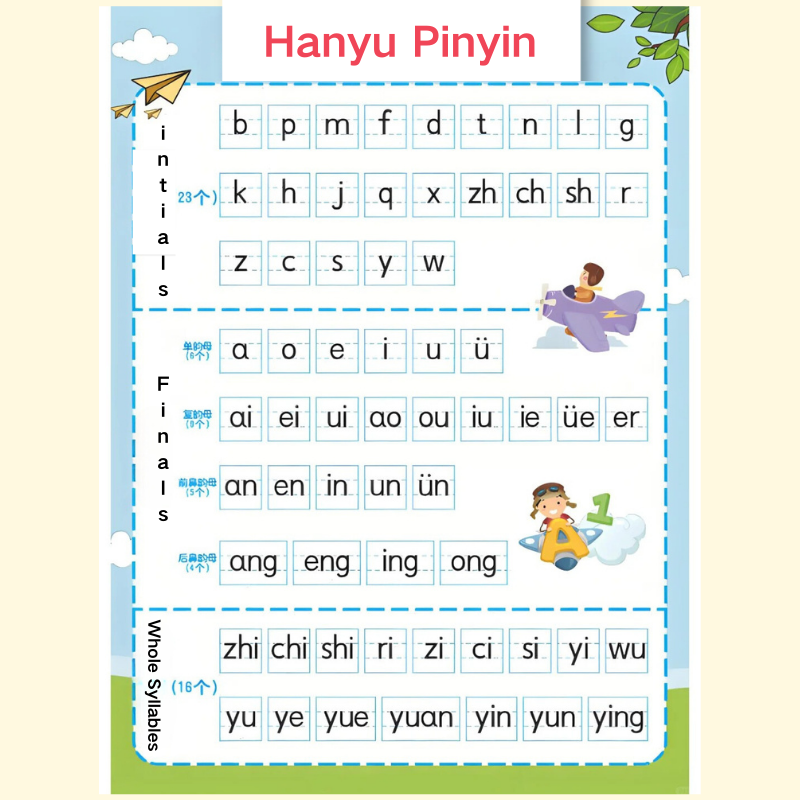
Complete Hanyu pinyin chart
Every Mandarin sound in one table — all initials (声母), finals (韵母), and the combinations they form. A useful reference to keep open while you study.
Understanding the pinyin system
Pinyin (拼音), officially Hanyu Pinyin, is the standard way of writing Mandarin sounds in the Latin alphabet. Adopted in 1958, it is how most learners first read Chinese and how Chinese is typed on phones and computers.
What a syllable is made of
An initial (声母), a final (韵母), and a tone. The chart above shows every valid combination; the tone is what separates mā, má, mǎ, and mà.
Why learn pinyin
Type Chinese on any device, look words up in a dictionary, build correct pronunciation, and lay the foundation for HSK study. See the tones and sandhi section above for the sounds themselves.
Frequently asked questions
What HSK level is my Chinese text?
Does this use HSK 2.0 or HSK 3.0?
How accurate are the HSK levels?
What changed between HSK 2.0 and HSK 3.0?
What is the difference between recognition level and writing level?
Can teachers use this to check reading materials?
Can I switch between tone marks and tone numbers?
Why does the pinyin show nǐ hǎo and not the pronunciation I hear?
Does it work with Traditional characters?
Is it free? Do I need to sign up?
Can I copy or download the results?
Keep learning
From Mandarin Zone
Guides to take you further:
Other references
Ready to take your Chinese further?
Use the converter whenever you read, then build real fluency with structured lessons and guides from a Beijing Chinese-language school.