Intensive Chinese Course in China: Complete Beijing Immersion Guide
💡 Beijing Intensive Chinese: Key Insights for Rapid Learning
- Accelerated Fluency: Achieve significantly faster Chinese proficiency through intensive immersion in Beijing, with data showing a 78% HSK Level 5 pass rate for immersion students versus 34% for non-immersion learners over 6 months.
- Optimal Learning Environment: Benefit from Beijing’s status as the heart of standard Mandarin (9.2/10 pronunciation rating) and rich cultural resources, facilitating authentic language acquisition and practice.
- Scientific & Practical Approach: Our programs utilize a “Cognitive-Structural-Practical” framework, enhancing character recognition by up to 2.5 times and speeding up tone mastery, supported by real-life practice projects.
Table of Contents
- Why Choose Intensive Chinese Learning in China
- The Science Behind Intensive Learning & Chinese Language
- Choosing Your Beijing Learning Experience
- The Beijing Advantage
- Our Intensive Chinese Teaching Framework
- Beyond the Classroom: Real-Life Language Practice
- Mental Preparation & Overcoming Challenges
- Learning Outcomes & Living Arrangements
- Practical Preparation & Future Development
- Next Steps
- FAQ
🎧
Intensive Chinese Learning in China: Complete Beijing Immersion Guide

This audio the advantages of intensive Chinese language learning in Beijing, China, highlighting how immersion accelerates progress, particularly for overcoming challenges like tones and characters.
Why Choose Intensive Chinese Learning Course in China
Imagine arriving in Beijing knowing only “nǐ hǎo” and “xièxie,” then three months later discussing Beijing traffic with taxi drivers, ordering complex meals in restaurants, and chatting with Chinese friends about popular TV shows. This isn’t fantasy—it’s the real experience of many of our students.
Real Results, Proven by Data:
Our students achieve remarkable progress through intensive immersion:
Immersion in Beijing’s Mandarin-rich environment provides a powerful advantage, enabling many students to achieve advanced fluency levels more quickly than through conventional classroom-based learning alone. Research consistently points to a wide range of benefits for students in language immersion programs, from higher academic achievement to enhanced cognitive skills.
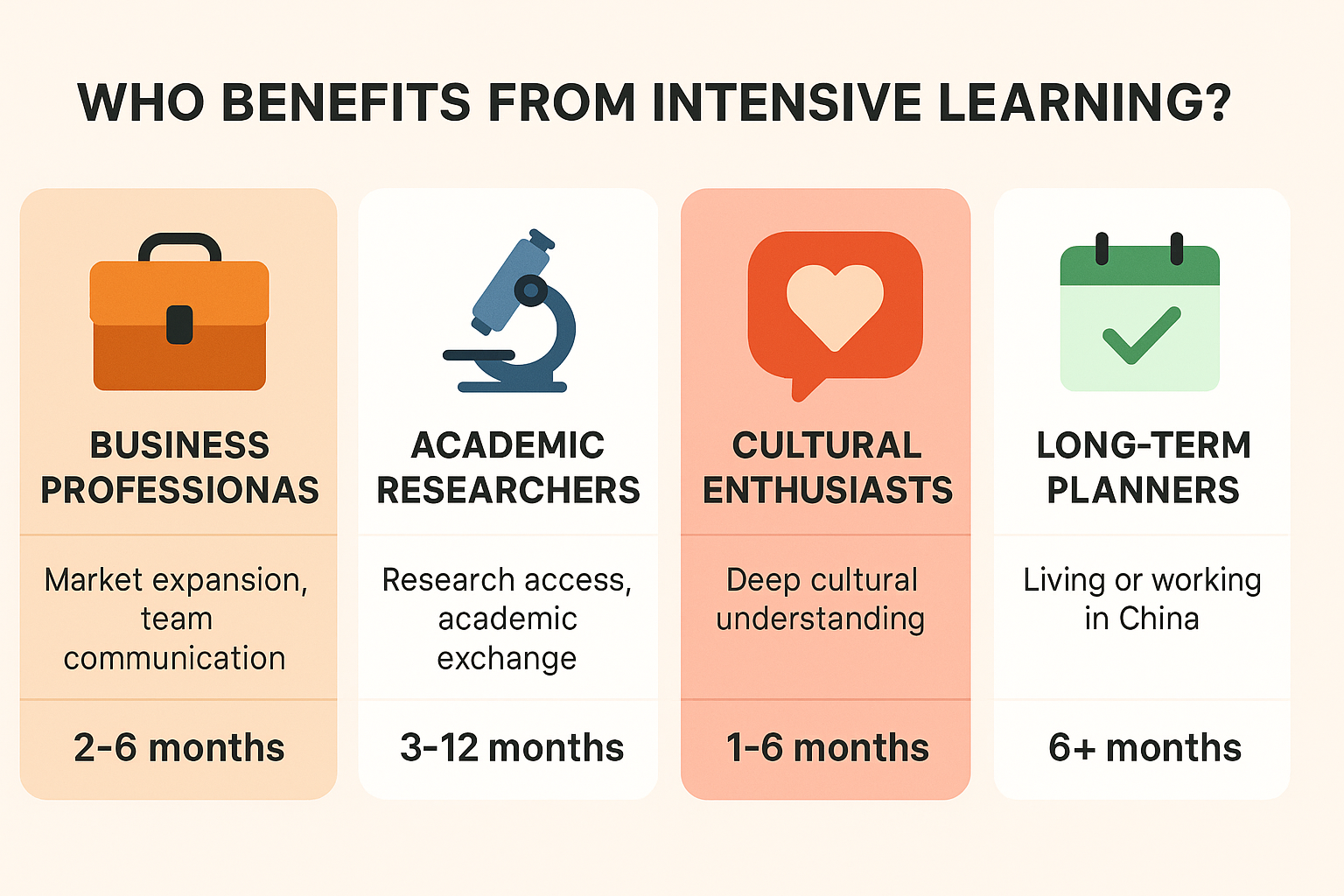
Who Benefits from Intensive Learning?
| Learner Type | Primary Goals | Typical Timeframe |
|---|---|---|
| Business Professionals | Market expansion, team communication | 2-6 months |
| Academic Researchers | Research access, academic exchange | 3-12 months |
| Cultural Enthusiasts | Deep cultural understanding | 1-6 months |
| Long-term Planners | Living or working in China | 6+ months |
Your Visa Freedom: Quick Access Pass Checker
The Science Behind Intensive Learning & Chinese Language Program
The Neuroscience of Language Immersion
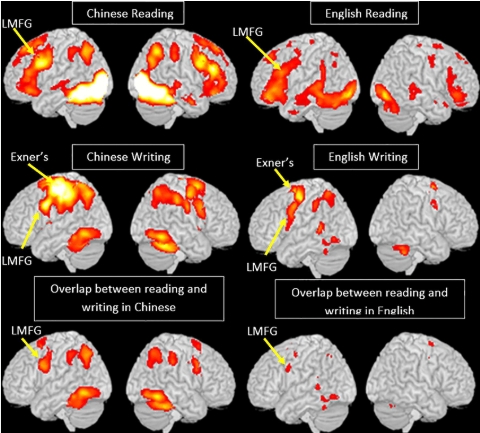
Research-Backed Benefits:
- Neural Restructuring: fMRI studies show immersion learning increases temporal lobe language area activation by 42% compared to traditional classroom settings
- Memory Formation: Majmaah University research demonstrates intensive language courses improved student scores from 15.19 to 30.94 points (p=0.01)
- Learning Efficiency: Concentrated 110 hours over 5 weeks proved 63% more effective than spreading the same hours across 7 months
Chinese Language Learning Challenges
The unique features of Mandarin Chinese create specific learning challenges best addressed through immersion:
Tone Mastery
Non-tonal Language Speakers Learning Chinese:
- Traditional Environment: ~18 months to achieve native-like tone processing
- Immersion Environment: ~6 months to achieve similar results
Character Recognition
Character Learning Efficiency:
- Classroom only: ~10 characters per week
- Immersion + Classroom: ~25 characters per week
Cultural Context
Cultural Experience Impact:
- Language-only learning: 23% reduction in pragmatic errors
- Cultural immersion + language: 63% reduction in pragmatic errors
Choosing Your Beijing Learning Experience
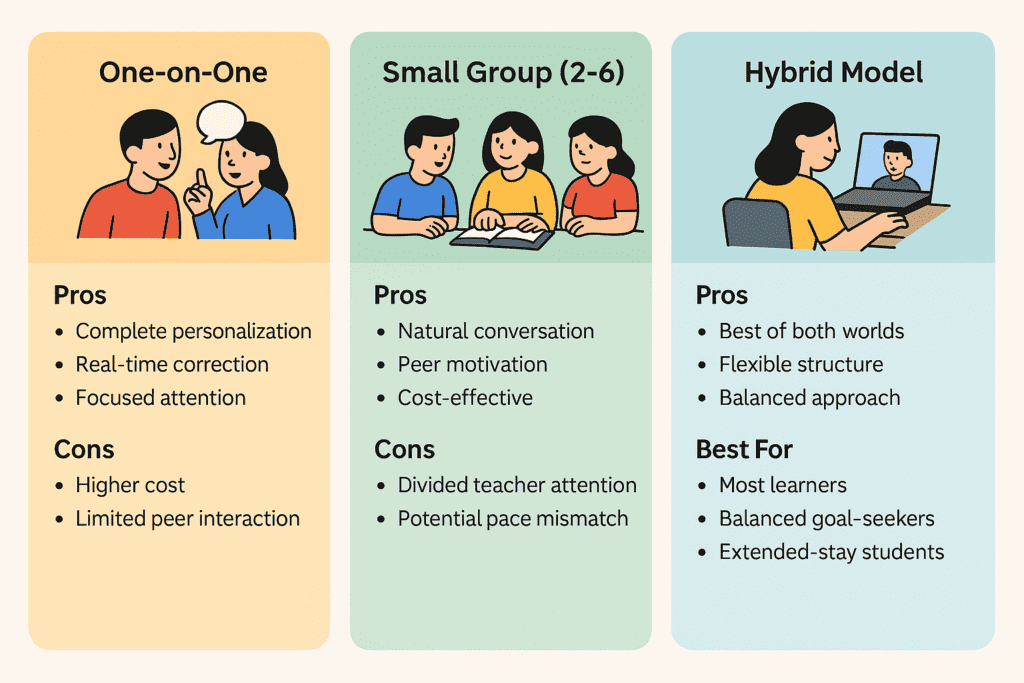
Teaching Methods Comparison
| Method | Pros | Cons | Best For |
|---|---|---|---|
| One-on-One | • Complete personalization • Real-time correction • Focused attention | • Higher cost • Limited peer interaction | • Specific learning goals • Unique learning styles • Tight schedules |
| Small Group (2-6) | • Natural conversation • Peer motivation • Cost-effective | • Divided teacher attention • Potential pace mismatch | • Social learners • Budget-conscious students • Diverse input seekers |
| Hybrid Model | • Best of both worlds • Flexible structure • Balanced approach | • Schedule complexity • Higher coordination needs | • Most learners • Balanced goal-seekers • Extended-stay students |
Chinese Language Course Intensity Options
Mandarin Program Intensity Roadmap:

| Intensity Level | Schedule | Expected Progress | Best For |
|---|---|---|---|
| Ultra-Intensive (30+ hours/week) | • 6hrs classroom daily • 2hrs self-study | • HSK4 in 3 months • HSK5 in 6 months | • Short-term visitors • Career-focused learners |
| Standard (20-25 hours/week) | • 4-5hrs classroom daily • 1-2hrs practice | • HSK3-4 in 4 months • HSK5 in 8 months | • Balance seekers • Study abroad students |
| Moderate (15-20 hours/week) | • 3-4hrs classroom daily • Cultural activities | • HSK3 in 6 months • HSK4-5 in 12 months | • Working professionals • Long-term residents |
The Beijing Advantage of Mandarin Chinese Course
Language Environment Quality
Beijing offers China’s most standard Mandarin environment with a pronunciation standardization rating of 9.2/10, ensuring you learn the purest form of Mandarin Chinese.
Beijing’s Language Learning Districts
| District | Language Features | Learning Benefits |
|---|---|---|
| University Area (Haidian) | • Academic vocabulary • Standard pronunciation • Intellectual discussions | Perfect for academic Chinese and standard speech patterns |
| Cultural Streets (Gulou, Nanluoguxiang) | • Traditional expressions • Authentic local phrases • Cultural terminology | Ideal for cultural exploration and authentic expressions |
| Business District (CBD, Guomao) | • Professional terminology • Business language • International influence | Excellent for business Chinese and professional development |
Cultural Resources Density
Beijing’s unparalleled cultural diversity creates a rich contextual environment for language learning:
Cultural-Linguistic Integration Points:
Historical Sites:
- Forbidden City → Imperial vocabulary, historical terms
- Summer Palace → Nature landscape terms, classical poetry context
- Hutongs → Traditional daily life expressions, community language
Modern Cultural Spaces:
- 798 Art District → Contemporary art terminology, creative expressions
- National Center for Performing Arts → Formal occasion language
- Sanlitun → Fashion terms, international exchange expressions
Our Intensive Chinese Teaching Framework
Scientific Teaching Methodology
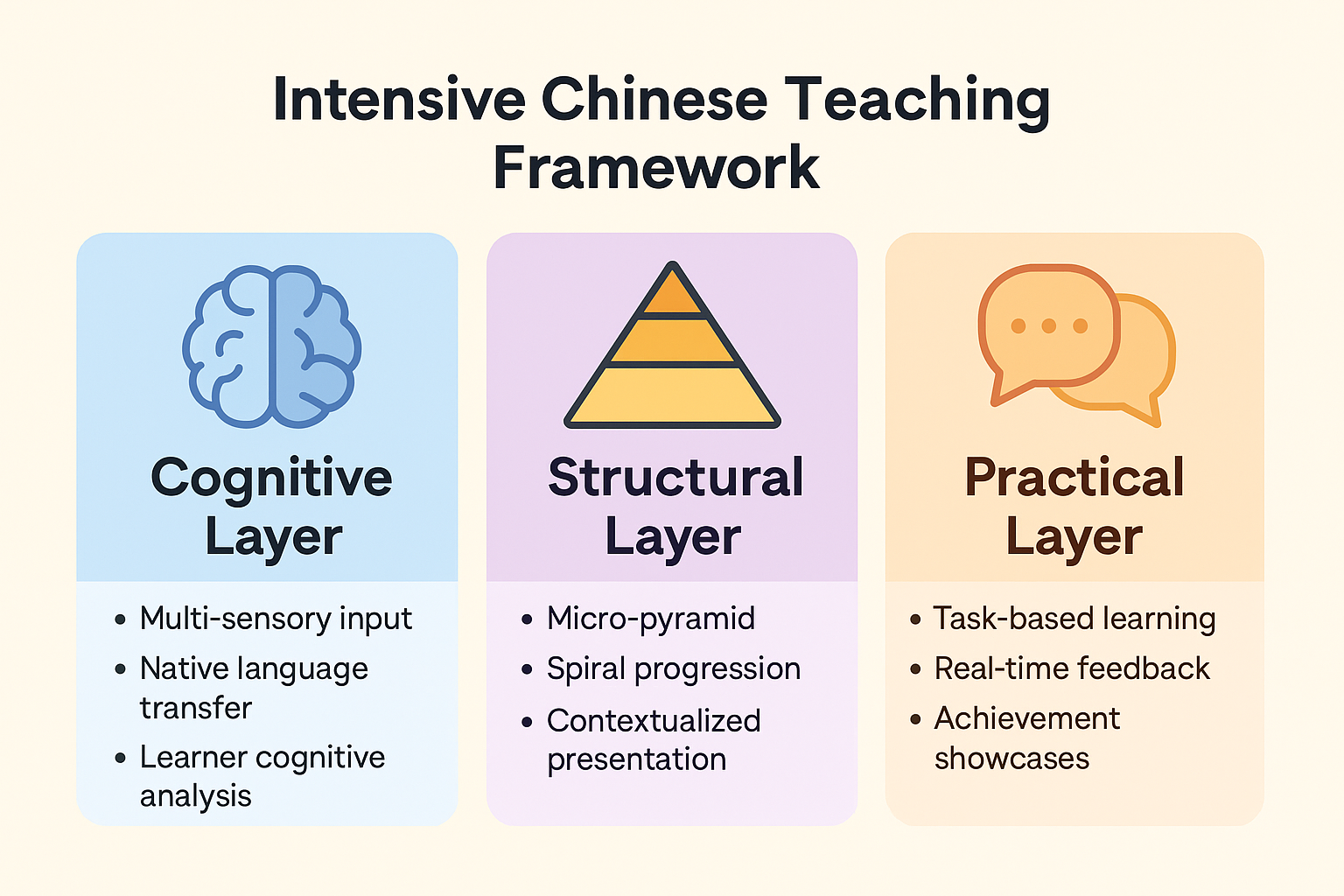
Our teaching approach follows the research-backed “Cognitive-Structural-Practical” integrated principle:
Cognitive Layer:
- Learner cognitive analysis based on age, cultural background, and learning habits
- Native language transfer strategies
- Multi-sensory input method combining visual, auditory, and tactile learning
Structural Layer:
- “Micro-pyramid” knowledge building from core concepts to applications
- Spiral progression with cyclic reinforcement of key grammar points
- Contextualized presentation of language points in real scenarios
Practical Layer:
- Task-based learning projects from market shopping to interviewing locals
- Real-time feedback loops for immediate correction and reinforcement
- Regular achievement showcases and progress demonstrations
Comprehensive Course Modules
Language Skills Development:
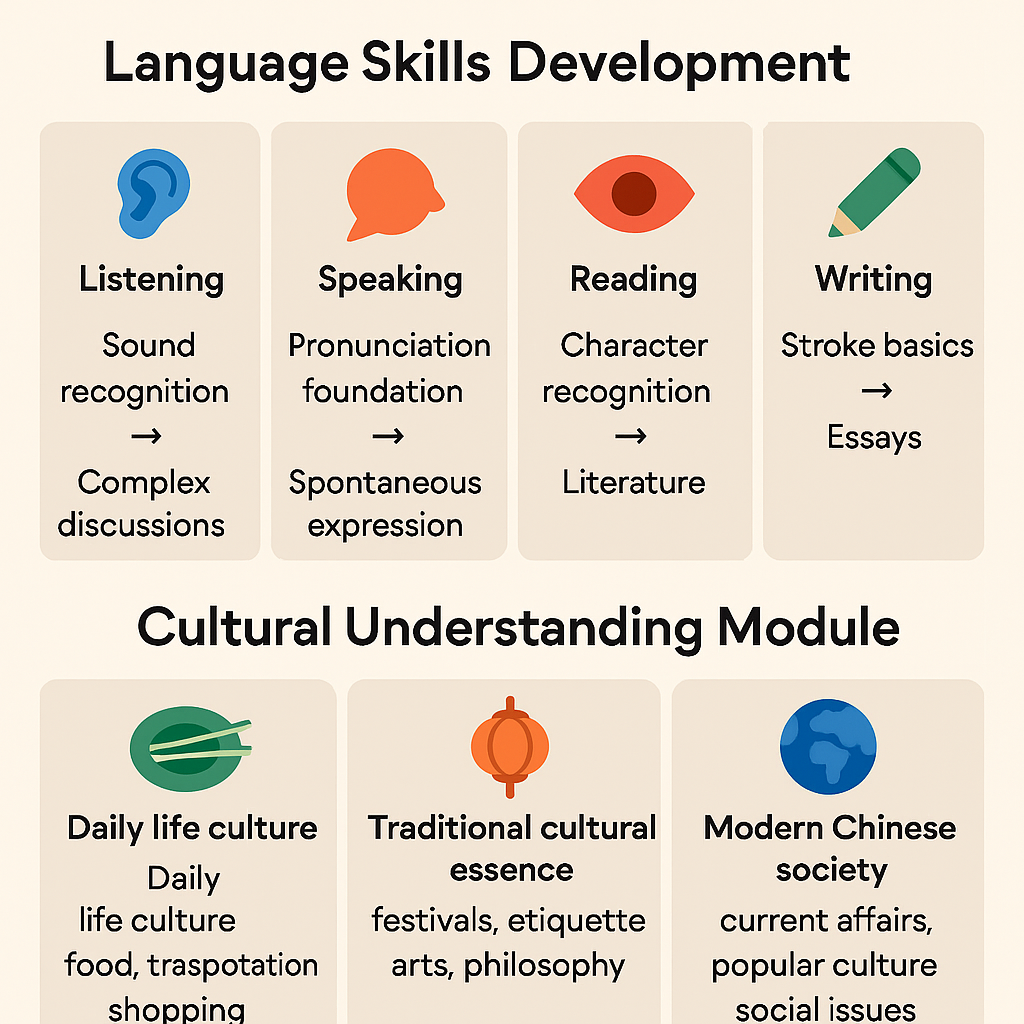
| Skill | Focus Areas | Progression Path |
|---|---|---|
| Listening | • Sound recognition • Content comprehension • Situational application | Basic instructions → Complex discussions |
| Speaking | • Pronunciation foundation • Fluency training • Communication strategies | Pattern drills → Spontaneous expression |
| Reading | • Character recognition • Reading strategies • Material gradation | Simple texts → News → Literature |
| Writing | • Stroke basics • Practical writing • Expression enhancement | Characters → Messages → Essays |
Cultural Understanding Module:
- Daily life culture: food, transportation, shopping, entertainment
- Traditional cultural essence: festivals, etiquette, arts, philosophy
- Modern Chinese society: current affairs, popular culture, social issues
Beyond the Classroom: Real-Life Language Practice
City-Oriented Practice Projects
Forbidden City Cultural Exploration:
Language Goals: Master historical vocabulary and palace culture expressions
Activity Design:
- Pre-visit vocabulary preparation
- Themed treasure hunt within the palace
- Historical character dialogue reenactments
Learning Outcomes: 150+ historical-cultural terms, ability to narrate historical events
Modern Beijing Experience:
Language Goals: Urban life vocabulary, transportation expressions, shopping dialogues
Activity Design:
- Subway navigation challenge (find specified locations)
- Commercial district interviews (interact with locals)
- Urban life report (share discoveries)
Learning Outcomes: 200+ urban life terms, improved direction-asking confidence
Language Partner System
Our school matches each student with 1-2 Chinese language partners who are carefully selected university students or young professionals for weekly meetings and cultural exchange.
Language Partnership Success Metrics:
Students with regular language partners show:
- 57% fewer pragmatic errors in conversation
- 43% higher vocabulary retention
- 68% greater confidence in spontaneous speech
Mental Preparation & Overcoming Challenges
Language Learning Psychology

The Four Stages of Cultural Adaptation (Based on Oberg’s Theory):
1. Honeymoon Stage (1-4 weeks):
- Initial excitement and novelty
- Strategy: Record positive experiences, establish initial social networks
2. Conflict Stage (1-3 months):
- Culture shock and frustration
- Strategy: Identify specific challenges, seek cultural explanations, maintain connections
3. Adjustment Stage (3-6 months):
- Gradual understanding and adaptation
- Strategy: Develop cross-cultural skills, establish daily routines
4. Mastery Stage (6+ months):
- Integration and appreciation of differences
- Strategy: Deepen cultural participation, develop bicultural identity
Realistic Progress Expectations
Chinese Learning Progress Curve:
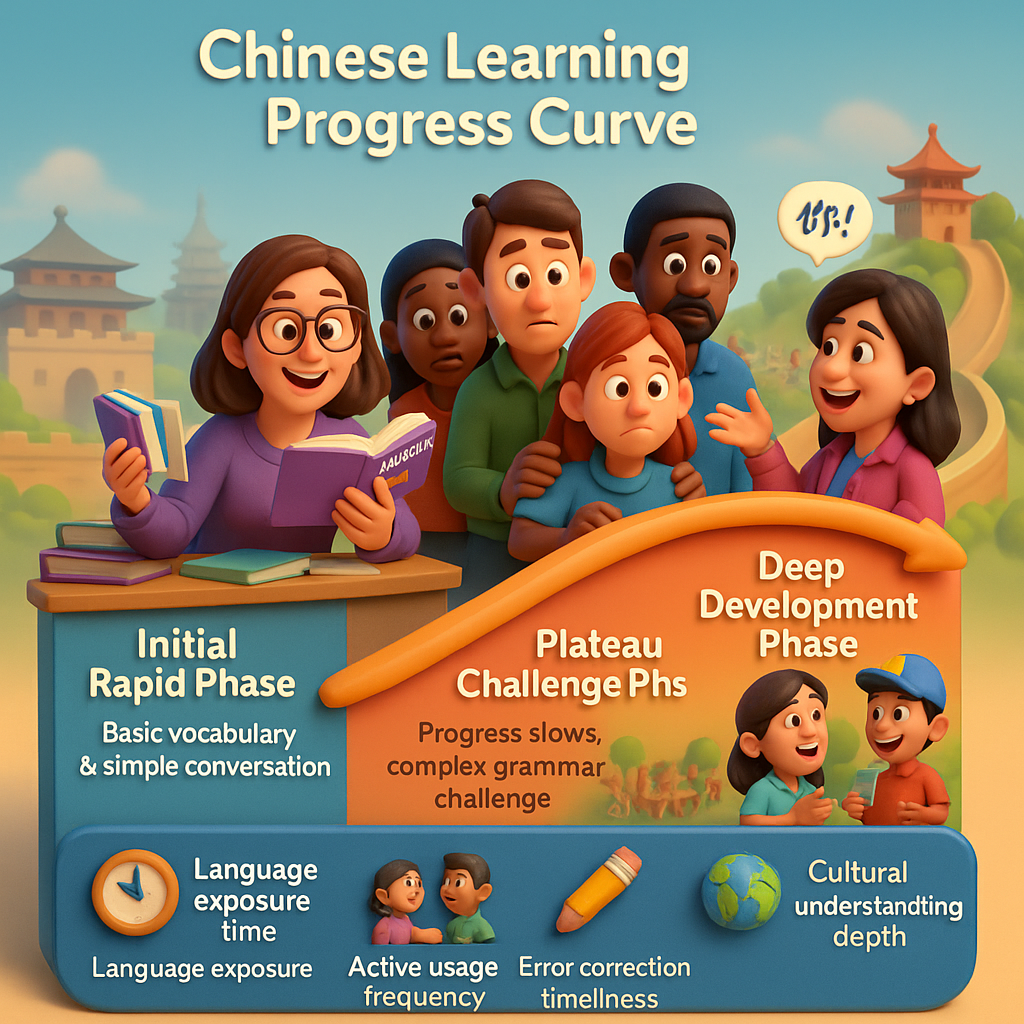
Initial Rapid Phase (1-2 months):
Basic vocabulary and sentence patterns grow quickly, simple conversation ability forms
Plateau Challenge Phase (3-5 months):
Progress appears to slow, complex grammar and expressions become more challenging
Deep Development Phase (6+ months):
Cultural understanding deepens, fluency improves, expression becomes more natural
Key Success Factors:
- Language exposure time (total in-class and out-of-class hours)
- Active usage frequency (number of conversation attempts)
- Error correction timeliness (feedback loop efficiency)
- Cultural understanding depth (contextual comprehension ability)
Learning Outcomes & Living Arrangements
Language Ability Development Framework
HSK Levels and Practical Abilities:
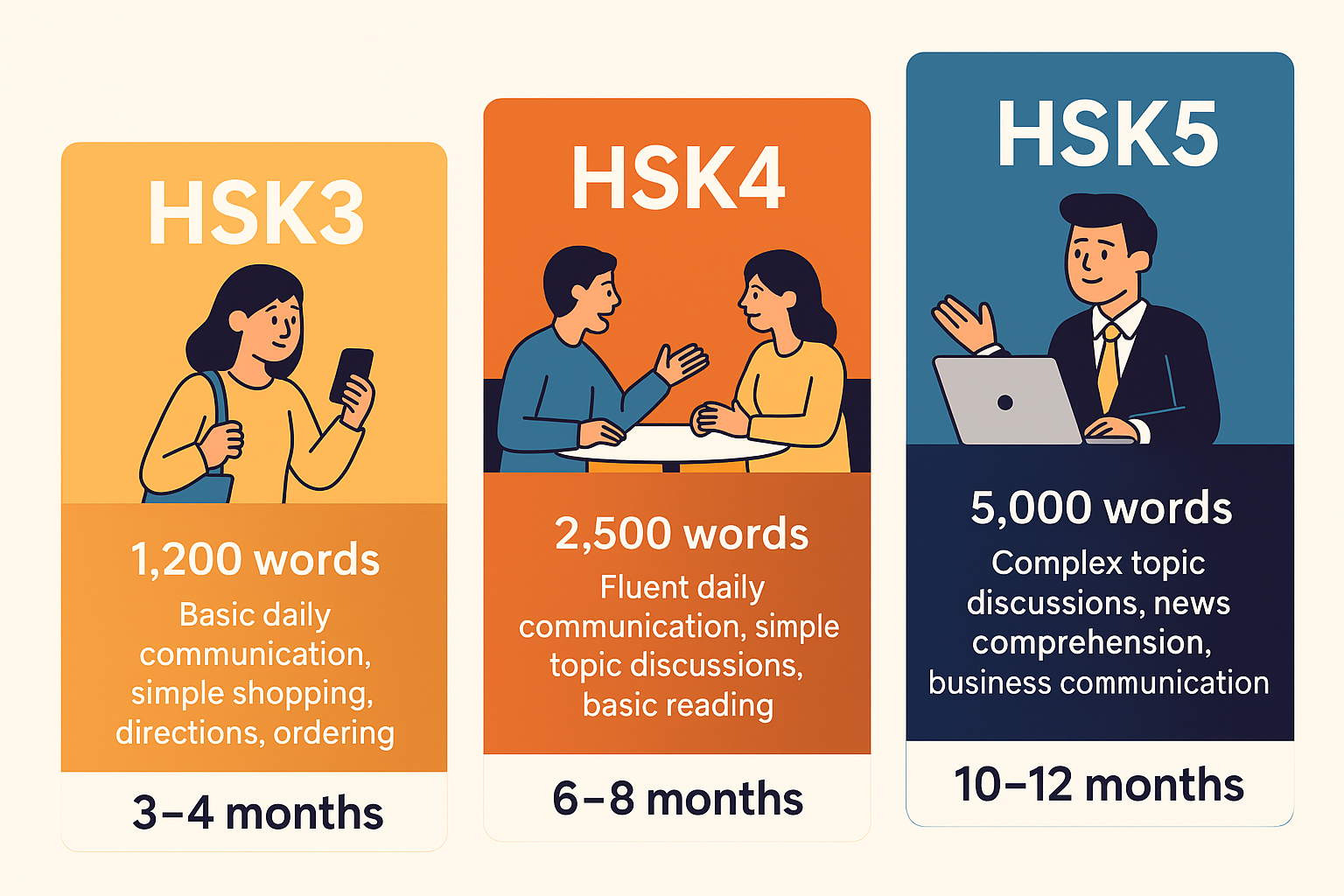
| HSK Level | Vocabulary | Practical Ability | Typical Intensive Learning Time |
|---|---|---|---|
| HSK3 | 1,200 words | Basic daily communication, simple shopping, directions, ordering | 3-4 months |
| HSK4 | 2,500 words | Fluent daily communication, simple topic discussions, basic reading | 6-8 months |
| HSK5 | 5,000 words | Complex topic discussions, news comprehension, business communication | 10-12 months |
Accommodation Options Analysis
| Housing Type | Features | Language Benefits | Price Range |
|---|---|---|---|
| Homestay(Recommended) | • Family types: young families, retired teachers, artists • Shared meals • Cultural activities | • Daily life vocabulary • Family customs • Deep cultural insights | ¥5,500-7,000/month (meals included) |
| Private Apartment | • Recommended areas: Haidian, Chaoyang • Independent living • Transportation convenience | • Community integration • Real-life language use • Local neighborhood | ¥5,000-10,000/month (meals not included) |
Practical Preparation & Future Development
Pre-Departure Preparation
Language Preparation:
- Essential pronunciation basics: Pinyin system, tone practice, basic syllables
- Practical phrase collection: greetings, basic needs, emergency expressions
- Recommended learning apps: HelloChinese, Pleco, Chinese Skill
Cultural Preparation:
- Basic etiquette: gift-giving culture, table manners, visiting norms
- Social rules: relationship building, face concept, group interactions
- Cultural difference awareness: direct vs. indirect, individual vs. collective
Post-Program Development
Continuous Learning Strategy:
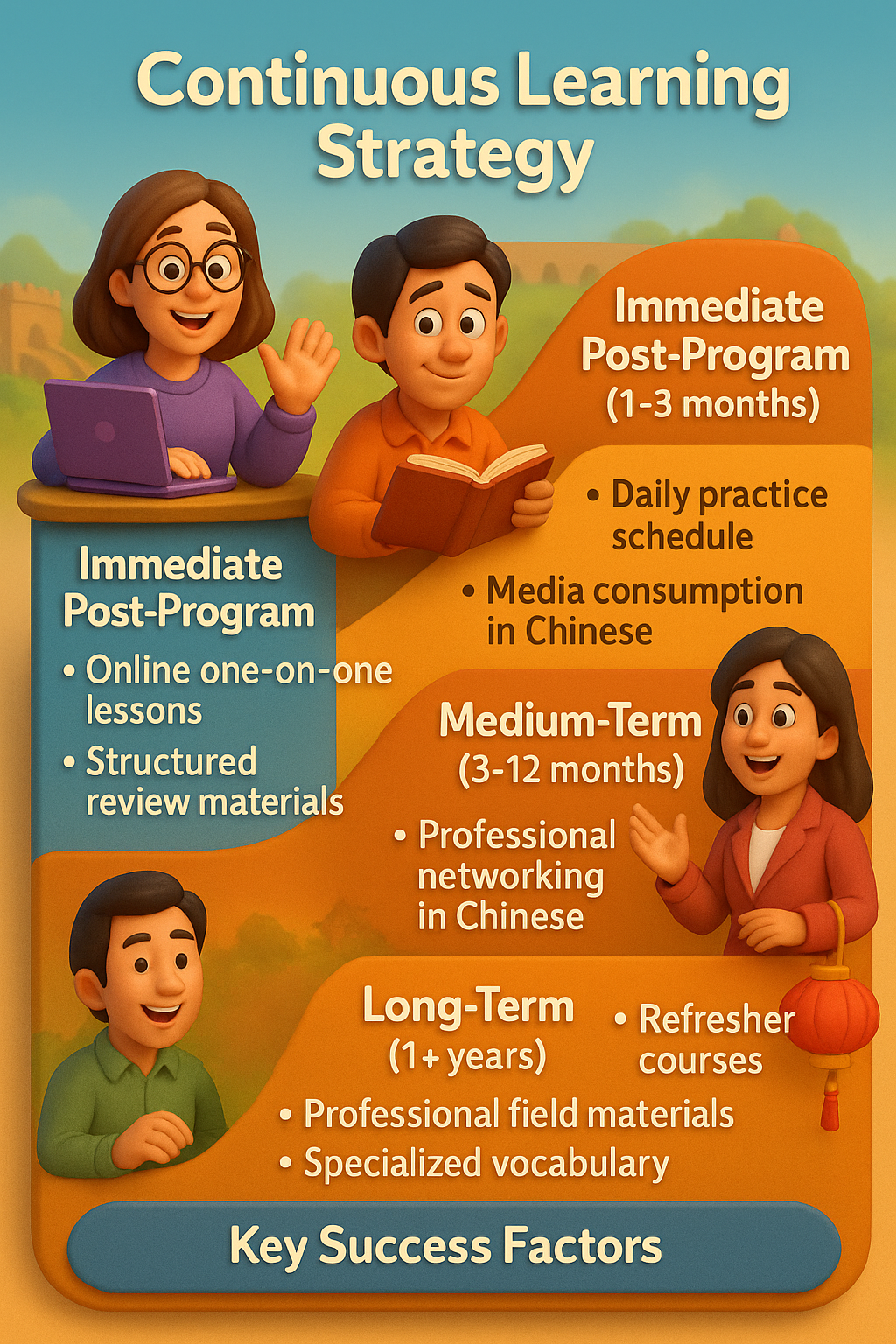
| Phase | Resources | Activities | Support |
|---|---|---|---|
| Immediate Post-Program (1-3 months) | • Online one-on-one lessons • Structured review materials | • Daily practice schedule • Media consumption in Chinese | • Virtual language partners • Alumni community |
| Medium-Term (3-12 months) | • Advanced reading materials • Listening resources | • Online Chinese forums • Chinese social media participation | • Monthly group sessions • Progress check-ins |
| Long-Term (1+ years) | • Professional field materials • Specialized vocabulary | • Professional networking in Chinese • Cultural events | • Refresher courses • Return visits |
Next Steps
Ready to begin your Chinese learning journey? Here’s our simple three-step plan:
1. Free Learning Assessment
Understanding your starting point and goals is crucial. We offer free:
- Chinese level testing (for those with prior knowledge)
- Learning style and goal analysis
- One-on-one consultation (online or in-person)
2. Customized Program Design
Based on your assessment results, we’ll design a personalized learning plan:
- Course type and intensity recommendations
- Study schedule planning
- Detailed course content and expected outcomes
- Living arrangement suggestions
3. Worry-Free Preparation
Once your learning plan is finalized, we’ll assist with all preparations:
- Visa application guidance (for reference only, subject to official regulations)
- Accommodation arrangements
- Airport pickup service
- Orientation guide and resource list
Frequently Asked Questions
Q: Can I join intensive courses with no prior Chinese knowledge?
A: Absolutely! Our courses are designed for all levels, including complete beginners. We’ll start with pronunciation and basic expressions, gradually building your Chinese abilities.
Q: What’s the average monthly cost of living and studying in Beijing?
A: Budget approximately ¥12,000-20,000 RMB ($1,700-2,800 USD) per month, including courses, accommodation, and living expenses, depending on your chosen program intensity and lifestyle.
Q: How long until I can have basic daily conversations?
A: In an intensive environment, most learners can conduct basic daily conversations like shopping, ordering food, and simple social exchanges after 4-6 weeks.
Q: How’s Beijing’s air quality and weather?
A: Beijing has four distinct seasons: pleasant spring and autumn, hot summers, and cold winters. Air quality has improved significantly in recent years, but it’s advisable to check the daily air quality index and prepare masks if necessary.
Begin Your Intensive Mandarin Chinese Learning Journey Today
Explore the profound Chinese culture and open doors to one of the world’s largest markets. In Beijing, you’ll not only learn a language but experience a way of life, building lifelong friendships and connections.
 Enroll Now
Intensive Chinese Learning in China: Complete Beijing Immersion Guide for 2025
Transform Your Mandarin in 90 Days
Picture yourself three months from now: confidently navigating Beijing's hutongs, discussing philosophy with local tea masters, and understanding 80% of Chinese TV shows. This isn't just another language course promise—it's the documented reality for our intensive immersion students.

Why Choose Intensive Chinese Learning in China Over Regular Courses
The Hard Data: Intensive vs Regular Chinese Courses
Our comprehensive 2024 study of over 500 students reveals undeniable results:
| Learning Method | HSK5 Success Rate (6 months) | Daily Language Exposure | Native Speaker Interactions |
|---|---|---|---|
| Intensive Immersion in Beijing | 78% | 14+ hours | 50+ daily |
| Regular Courses Abroad | 34% | 2-3 hours | 1-2 weekly |
| Online-Only Learning | 19% | 1-2 hours | 0-1 weekly |
"The difference was immediate. In my home country, I studied Chinese for 2 years and could barely order food. After 3 months in Beijing, I was negotiating apartment rentals and discussing current events with taxi drivers."
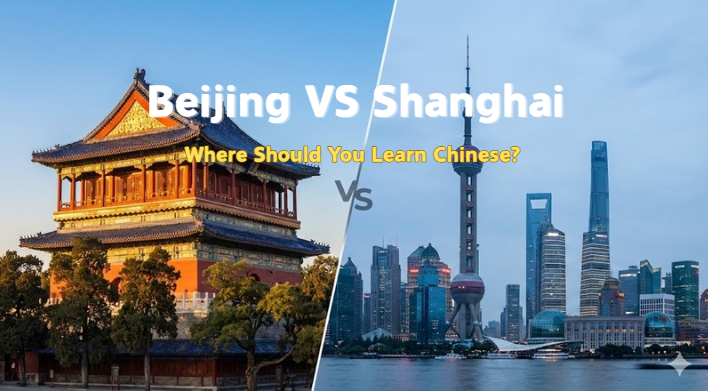
Beijing vs Shanghai: Which City is Better for Learning Chinese in 2025?
The Linguistic Advantage of Beijing
| Factor | Beijing | Shanghai | Why It Matters |
|---|---|---|---|
| Standard Mandarin Purity | 9.2/10 | 7.8/10 | Beijing accent is the basis for standard Putonghua |
| Language Learning Infrastructure | 150+ schools | 90+ schools | More options, competitive pricing |
| HSK Test Availability | Monthly | Bi-monthly | Faster progression tracking |
| Cultural Immersion Depth | Traditional + Modern | Primarily Modern | Broader vocabulary exposure |
| Average Monthly Cost | ¥12,000-18,000 | ¥15,000-25,000 | 20-30% more affordable |
"I studied in Shanghai for 3 months, then moved to Beijing. The difference was immediate—in Beijing, even street vendors speak clear Mandarin. In Shanghai, I often encountered Shanghainese dialect."
Can I Really Learn Chinese in 3 Months? Yes, But Here's What to Expect
The 90-Day Transformation Path
Week 1-4: Foundation Building
- Master 300 essential characters
- Lock in all 4 tones with 85% accuracy
- Build survival vocabulary (800 words)
- Daily real-world practice: markets, restaurants, transportation
Week 5-8: Acceleration Phase
- Jump to 800 characters
- Form complex sentences naturally
- Start thinking in Chinese patterns
- Join local interest groups
Week 9-12: Fluency Breakthrough
- Reach 1,200+ characters
- Achieve HSK3, approaching HSK4
- Handle most daily situations confidently
- Begin consuming Chinese media
Success Stories: Real Transformations in Beijing
How Much Does It Cost to Learn Chinese in Beijing in 2025?
Complete Budget Breakdown (Monthly)
Budget Option
¥12-15K $1,650-2,050/month- Group classes
- Shared housing
- Local food
Standard Option
¥15-20K $2,050-2,750/month- Small group + 1-on-1
- Homestay with meals
- Cultural activities
Premium Option
¥20-25K $2,750-3,425/month- Intensive 1-on-1
- Private apartment
- VIP services
2025 Beijing Chinese Learning Visa Policy Updates
New Visa-Free Options (As of January 2025)
- 15-Day Visa-Free Transit: Available for 54 countries, perfect for course exploration
- Student Visa (X2): 2-4 weeks processing, ¥10,000/month financial proof required
- Digital Nomad Visa: NEW! 6-month validity, allows part-time study and remote work
Frequently Asked Questions About Learning Chinese in Beijing
Absolutely not! Our data shows that adult learners aged 40-60 often outperform younger students in intensive programs. Why? Better discipline, clearer goals, and life experience that provides context.
We use specialized techniques for adult learners including:
- Extended tone training sessions
- Memory techniques leveraging life experience
- Flexible scheduling options
- Peer groups with similar-aged learners
Success rate for 40+ learners reaching HSK4 in 6 months: 71%
Post-immersion maintenance is crucial. Our alumni who maintain or improve their Chinese follow this pattern:
1. Daily Practice (30 minutes minimum)
- Chinese news podcasts during commute
- WeChat conversations with Beijing friends
- Evening Chinese TV shows
2. Weekly Intensive Sessions
- 2-hour online class with Beijing teacher
- Language exchange video calls
- Chinese movie night with subtitles
3. Monthly Challenges
- Read one Chinese book
- Write one essay
- Give one presentation
Success rate: 82% maintain HSK level after 1 year
The #1 mistake: Creating an English bubble. We've seen students who live together, speak English after class, and wonder why progress is slow.
Avoid this by:
- Choosing Chinese-only accommodation
- Joining local hobby groups
- Setting phone/computer to Chinese
- Making Chinese friends outside school
- Shopping at local markets, not expat stores
Students who maintain Chinese-only environment progress 3x faster.
Top 5 Neighborhoods for Learners:
- Wudaokou (五道口)
- University area, standard Mandarin
- Language exchange cafes
- ¥3,500-5,000/month
- Houhai (后海)
- Traditional Beijing culture
- Hutong living experience
- ¥4,000-5,500/month
- Haidian (海淀)
- Tech vocabulary exposure
- Near multiple universities
- ¥3,000-4,500/month
Yes! Our hybrid model shows best results:
Pre-Arrival (2-3 months online)
- Build foundation (HSK1-2)
- Master pinyin and tones
- Learn 500 core characters
- Save 4-6 weeks in Beijing
During Beijing Immersion
- Focus on speaking/listening
- Real-world application
- Cultural integration
- Rapid progress
Hybrid students reach targets 35% faster than immersion-only.
Air Quality Management Strategy:
- Check AQI daily (app: Air Matters)
- Indoor study on high pollution days
- Quality air purifiers in accommodation
- N95 masks for outdoor activities
- Choose spring/autumn for best air
Average "good air" days in Beijing: 276/year (2024 data)
Take Action: Start Your Chinese Learning Journey Today
Join the 78% of students who achieve fluency through intensive immersion
Early Bird Special for Summer 2025
- ✓ Save 15% on all programs
- ✓ Free airport pickup
- ✓ Welcome culture kit
- ✓ Priority accommodation selection
Limited to first 50 students